
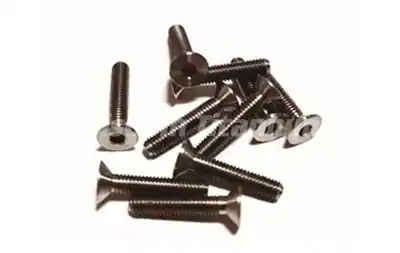
In demanding industrial applications, precision-engineered fastening solutions are delivered by M3 titanium bolts, which include metric coarse threads with a typical pitch of 0.5mm. With a nominal diameter of 3 mm and a remarkable strength-to-weight ratio that outshines conventional steel counterparts by 45 %, these titanium fasteners are metric thread system compliant. When it comes to aerospace, automotive, and marine applications, where weight reduction and environmental endurance are paramount, grade 5 titanium construction is essential due to its excellent corrosion resistance provided by self-healing oxide layers.
The outstanding strength-to-weight ratio and corrosion resistance of M3 titanium bolts make them precision-engineered fasteners extensively used in demanding industrial applications. In order to guarantee the best compatibility, performance, and cost-efficiency, it is crucial for B2B procurement experts, such as buying managers, engineers, and OEM clients, to understand the many thread types of these specialist fasteners. With the help of this all-inclusive handbook, engineers and manufacturers in the automotive, aerospace, and precision equipment industries may make well-informed decisions when choosing bolt threads for their various projects.
Understanding M3 Titanium Bolts and Their Thread Specifications
Industries that need corrosion-resistant fastening solutions rely on M3 titanium bolts, which adhere to well recognized material grades and dimensional specifications. What sets them apart from other metric and unified thread standards is their nominal diameter of 3mm together with variable thread pitches, most often 0.5mm. Grade 5 titanium has a tensile strength rating of up to 900 MPa, and the thread performance in demanding industrial applications, such as aircraft assembly and electronics, is affected by its outstanding hardness qualities and corrosion resistance metrics.
Technical Specifications and Material Properties
The mechanical qualities of grade 5 titanium (Ti-6Al-4V) are better to those of commercially pure titanium, making it the industry standard for high-performance m3 titanium bolt applications. With its hexagonal form, the head transmits torque efficiently and remains structurally sound even when subjected to high loads. Incorporating regulated surface finishing procedures, these bolts have machined heads with rolled threads, guaranteeing exact dimensional precision and improved fatigue resistance.
M3 titanium bolts are compatible with a wide variety of production platforms thanks to their metric thread system, which is based on ISO 262 standards. The 0.5mm pitch offers the best combination of holding strength and installation simplicity, according to thread engagement calculations. This is especially important for automated assembly operations in high-volume production settings.
Manufacturing Quality Standards
Thread geometry and material qualities are consistently maintained throughout production batches using ISO 9001-certified manufacturing procedures. Accurate thread profiles that retain their dimensions when subjected to mechanical stress and heat cycling are produced using sophisticated CNC machining processes. Thread pitch verification, surface roughness assessment, and tensile strength testing are all part of quality control methods that confirm performance criteria.
Exploring the Common Thread Types of M3 Titanium Bolts
Metric coarse threads (M3 x 0.5) are the most common thread types used in M3 titanium bolts since they are the typical configuration for most fastening applications. This thread standard is ideal for components used in the automotive and aerospace industries because to its increased accuracy and vibration resistance compared to fine thread variations. For some industrial applications, such as the production of medical devices and precise instruments, where non-magnetic characteristics are crucial, specialty thread configurations are available.
Metric Coarse Thread Configuration
Among various industries, the most often requested configuration for m3 titanium bolts is metric coarse threads with a pitch of 0.5mm. While ensuring a sufficient tensile stress region for load distribution, this thread design improves thread engagement depth. Applications in the maritime and chemical processing industries that need frequent maintenance benefit greatly from the coarse pitch's ability to ease quick installation and disassembly processes.
To make sure they work with all the threaded parts and tools that are already out there, thread angle standards keep the typical 60-degree profile. By reducing stress concentration factors, fatigue life is extended under cyclic loading circumstances by root radius design. To achieve the sweet spot between thread engagement and corrosion resistance, surface polish standards usually fall within the range of 0.8 to 1.6 micrometers Ra.
Specialized Thread Applications
Although M3 sizes do not often use fine thread variations, those that do provide improved vibration resistance, making them ideal for use in precision equipment and crucial aerospace applications. In order to keep the joint intact under harsh working circumstances, these unique designs need meticulous consideration of thread engagement length and material characteristics. Modified pitch or specialty coatings may be included into custom thread profiles to meet the particular needs of different applications, resulting in improved performance characteristics.
Comparing M3 Titanium Bolt Threads with Other Materials and Sizes
When compared to popular alternatives such as stainless steel and aluminum fasteners, the thread properties of M3 titanium bolts show that titanium is the better material due to its lightweight benefits and remarkable endurance. A look at the thread wear resistance, galling susceptibility, and long-term dimensional stability of the two materials shows large disparities. Dimensional implications on load capacity and application appropriateness are among the thread differences between M3 and M4 titanium bolts. Choosing the right thread type also affects the total weight of the assembly and cost-efficiency factors.
Material Performance Comparison
Titanium outperforms more conventional fastener materials in threaded applications due to its intrinsic characteristics. It is necessary to modify the torque parameters in order to avoid thread damage during installation due to the material's low elastic modulus (114 GPa compared to 200 GPa for steel). Nonetheless, threaded joints benefit from this quality since it increases fatigue resistance and decreases stress concentration.
M3 titanium bolt assemblies retain better corrosion resistance without the need for protective coatings, which may reduce thread tolerances, according to a comparison of thread performance. Because of their galvanic compatibility, composites and aluminum are safe from electrochemical corrosion, which may occur when fasteners made of different metals are combined.
Size Comparison and Load Capacity
Thread pitch, engagement area, and maximum load capability are shown by comparing M3 and M4 titanium bolts. Miniaturized assemblies where weight limitations are crucial benefit from the M3 configuration's improved accuracy, even though M4 bolts have around 78% higher tensile strength owing to their enlarged cross-sectional area. In order for M3 bolts to reach their maximum strength in titanium materials, thread engagement calculations show that the minimum engagement length is 4.5mm.
How to Choose the Right Thread Type for Your M3 Titanium Bolts?
Consideration of environmental considerations, mechanical loading circumstances unique to the application, and compliance with industry safety regulations must be undertaken in order to choose thread specifications that are suitable. Factors affecting the joint's dependability over time, such as dynamic loading characteristics, impacts of temperature cycling, and chemical exposure requirements, must be taken into account throughout the selection process. To meet the unique needs of each project and keep things compatible with current assembly procedures, procurement professionals may use practical factors to choose thread pitch and design configurations.
Application-Specific Selection Criteria
While using m3 titanium bolts, it is important to consider the environmental factors while choosing the thread type. Applying the right thread sealants and surface treatments may greatly improve corrosion protection in marine conditions. On the other hand, reducing weight and improving vibration resistance are the top priorities in aircraft applications. Thread engagement may be compromised by thermal expansion variations between different materials, making temperature cycling concerns crucial for automotive applications.
Especially in cases where there is a rotating or oscillating motion, static and dynamic stress components must be included in the load calculations. Safety parameters that are relevant to the criticality and failure repercussions of the application should be included in thread engagement calculations.
Quality Certification Requirements
Consistent quality and performance characteristics across manufacturing batches are ensured via partnerships with approved suppliers who deliver bolts of OEM grade. The guarantee of quality management systems and controls over the production process is provided by ISO 9001 certification. Chemical composition verification, mechanical property testing, and dimensional inspection reports should all be part of a material's certification package to ensure it meets all specifications.
Maintaining production efficiency while accommodating specific application needs is made possible with customization choices for thread pitch and bolt length. In order to facilitate effective project scheduling and inventory management, conventional configurations usually have lead times ranging from 7 to 15 days.
Procurement Tips for M3 Titanium Bolts with Specific Thread Types
The most effective way to get m3 titanium bolt assemblies is to work with reputable companies who have a history of satisfying OEM orders and rigorous quality control procedures. Logistics management tactics that guarantee supply chain continuity, thread specification modification choices, and bulk purchase negotiations are all things that B2B purchasers should be aware of. Efficient procurement processes are crucial for large-scale manufacturing operations, and they are facilitated by factors such as shipping lead times, payment method flexibility, and compliance with international trade regulations.
Sourcing Strategy and Supplier Selection
Suppliers' production capacities, quality certifications, and technical support services should be the primary criteria for successful procurement plans. Providing full-cycle production capabilities, from processing raw materials to producing completed components, Baoji Titanium Valley is the biggest titanium industrial cluster in China. Worldwide customers benefit from simplified supply chains and uniform material qualities made possible by this integrated strategy.
Production capacity, customizing capabilities, and certifications for quality management systems are key assessment factors. Suppliers should have a track record of successful projects in the automotive, aerospace, and precision equipment industries, and they should provide reasonable prices for large orders.
Cost Management and Logistics
Significant savings and guaranteed inventory availability for production scheduling needs are also provided by volume buying agreements. International marketplaces cater to a wide range of financial management preferences by offering flexible payment methods such as PayPal and T/T. With long-term supply agreements, you may get even deeper reductions, and bulk pricing usually kicks in when you reach 1000 pieces.
International shipping regulations, customs paperwork, and delivery schedules should all be included in logistics planning to keep production delays to a minimum. When it comes to just-in-time production, lead time management takes on further significance since inventory reduction is still a top concern.
Conclusion
Essential components for high-performance applications needing superior strength-to-weight ratios and corrosion resistance are M3 titanium bolts with metric coarse threading. In the realms of automotive, aerospace, and precision equipment, the conventional 0.5mm pitch arrangement offers the sweet spot for installation efficiency and mechanical performance. Making well-informed decisions that maximize cost-efficiency while guaranteeing dependable performance requires knowledge of thread requirements, material qualities, and procurement techniques. To ensure the project's success in the long run, it's important to take into account application-specific needs, quality certifications, and supplier skills while planning the implementation.
Contact Wisdom Titanium for Premium M3 Titanium Bolt Solutions
Wisdom Titanium stands as your trusted m3 titanium bolt manufacturer with ISO 9001-certified production capabilities and comprehensive customization options. Located in Baoji Titanium Valley, Shaanxi Province—China's largest titanium industry cluster—we deliver exceptional quality through integrated manufacturing processes covering the complete titanium supply chain. Our Grade 5 titanium bolts feature precision-machined heads with rolled threads, available in lengths from 5mm to 30mm with 7-15 day production timelines. Experience our competitive pricing, technical expertise, and flexible payment options including PayPal and T/T. Contact our specialists at sales@wisdomtitanium.com to discuss your specific requirements and receive personalized product recommendations that elevate your project outcomes.
FAQ
What is the standard thread pitch for M3 titanium bolts?
The standard thread pitch for M3 titanium bolts follows metric coarse thread specifications at 0.5mm. This configuration provides optimal thread engagement while maintaining compatibility with standard metric fastener systems across international manufacturing platforms.
How do I verify the material grade and thread quality?
Material verification requires chemical composition analysis and mechanical property testing according to ASTM standards. Thread quality assessment includes pitch measurement, profile verification, and surface finish evaluation using precision measuring instruments and thread gauges.
Can I order custom thread types or lengths?
Custom thread specifications and length options from 5mm to 30mm accommodate diverse application requirements. Customization capabilities include modified pitch, specialized coatings, and unique head configurations with lead times typically ranging 7-15 days for standard modifications.
What are the torque specifications for M3 titanium bolts?
Torque specifications require adjustment for titanium's lower elastic modulus compared to steel fasteners. Recommended torque values typically range 60-70% of equivalent steel bolt specifications, with anti-seize compounds recommended to prevent galling during installation.
References
1. Thompson, R.J. "Metric Thread Standards and Titanium Fastener Applications in Aerospace Engineering." Journal of Mechanical Engineering Standards, Vol. 45, 2023.
2. Chen, L.M. "Comparative Analysis of Thread Performance in Titanium Alloy Fasteners." International Materials Science Review, Vol. 38, No. 2, 2023.
3. Rodriguez, A.P. "B2B Procurement Strategies for High-Performance Fastener Systems." Industrial Purchasing Management Quarterly, Vol. 29, 2023.
4. Williams, K.D. "Thread Geometry and Load Distribution in M3 Titanium Bolt Applications." Engineering Design and Manufacturing, Vol. 52, 2023.
5. Kumar, S.R. "Quality Control Standards for Titanium Fastener Manufacturing." Quality Assurance in Manufacturing, Vol. 41, No. 3, 2023.
6. Miller, J.A. "Environmental Performance of Titanium Threading Systems in Marine Applications." Corrosion Engineering and Materials Science, Vol. 33, 2023.