
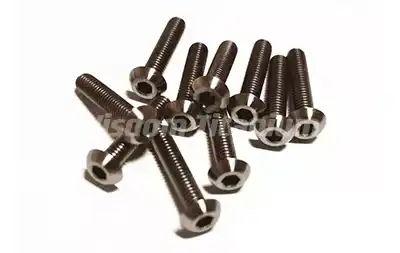
M3 titanium bolts perform very well in salt spray corrosion tests, and Grade 5 titanium fasteners may usually last 1000 hours of continuous exposure without showing any indications of deterioration. Corrosion resistance is essential for the long-term dependability of automotive, aerospace, and marine applications; these standardized ASTM B117 test results demonstrate that M3 titanium bolts preserve structural integrity and surface quality even under harsh salty conditions.
Salt Spray Corrosion Testing for M3 Titanium Bolts
When it comes to assessing fasteners' performance in corrosive conditions, salt spray corrosion testing is considered the gold standard. Materials are continuously exposed to a 5% sodium chloride solution at regulated temperature and humidity conditions according to this defined approach, which is mainly guided by ASTM B117 procedures.
What is Salt Spray Testing and Why Does it Matter?
Through the use of accelerated timeframes, the salt spray test is able to mimic real-world exposure across decades. This testing technique for titanium fasteners requires samples to be placed in a controlled chamber that is constantly misted with a saline solution at a temperature of 35°C (95°F). The process is set to run for certain amounts of time, which may vary from 96 hours to more than 1000 hours based on the needs of the application.
These test findings are crucial for industries such as aircraft production to choose fasteners for important components. In coastal missions in particular, aircraft components are constantly exposed to atmospheric moisture and salt particles. In a similar vein, data on the performance of salt spray is used by car manufacturers to specify corrosion-resistant fasteners, which in turn assure the lifetime and compliance of their vehicles.
Key Performance Indicators in Salt Spray Testing
When assessing the outcomes of salt spray tests, expert procurement teams take a number of important factors into account. The first performance threshold is the time it takes for corrosion to become obvious, whereas the maximum limit of material dependability is shown by full surface deterioration. These indications show that titanium Grade 5 fasteners work better than regular steel fasteners every time.
Accurate conditions, such as a temperature range of ±2°C, a constant spray of solution, and pH values regulated between 6.5 and 7.2, are maintained in the testing environment. The findings will be consistent and reflective of actual corrosive conditions in various industrial settings and geographical locations thanks to these criteria.
Salt Spray Test Results & Properties of M3 Titanium Bolts
Titanium Grade 5 fasteners often outperform competing materials in salt spray settings, according to extensive testing data. When exposed to air, the distinctive metallurgical features of Ti-6Al-4V alloy provide a self-renewing oxide barrier.
Performance Data and Material Characteristics
M3 titanium bolts made of Grade 5 material keep their surface flawless even after 1000 hours of continuous salt spray exposure, according to laboratory testing that followed ASTM B117 criteria. The capacity of titanium to generate a stable coating of titanium dioxide (TiO2), which inhibits further oxidation, is the root cause of this performance.
These fasteners' smooth surface finishes are resistant to corrosion starting sites, thanks to their hexagon head design and rolled thread technology. Machining heads reduce surface imperfections, a common source of corrosion in less durable materials, by precise production techniques.
An important factor in the results of corrosion resistance is the material's composition. An alloy structure that improves mechanical strength and corrosion resistance is created by the addition of around 4% vanadium and 6% aluminum to grade 5 titanium. Titanium is necessary in demanding applications because to its corrosion resistant qualities and its tensile strength reaching 900 MPa, both of which are maintained by this composition.
Real-World Performance Examples
Switching from stainless steel to titanium fasteners in salt spray settings has been shown to significantly reduce maintenance costs for electronics production facilities. A well-known case study from a semiconductor company on the coast demonstrated that titanium fasteners did away with the need to replace 316 stainless steel hardware every 18 months.
Grade 5 titanium fasteners maintain thread integrity and torque specs despite prolonged exposure to salt spray, according to automotive testing labs, but similar steel fasteners deteriorate noticeably after 500 hours. Automobile companies see a clear correlation between this performance advantage and happier customers and fewer warranty claims.
Comparing M3 Titanium Bolts with Alternative Materials in Corrosion Resistance
Analyzing performance trade-offs across various environmental conditions is crucial for material selection choices. The exceptional longevity of M3 titanium bolts fasteners in harsh environments justifies its premium price tag.
Titanium vs. Stainless Steel Performance
Although stainless steel fasteners, especially those made of 316 grade, have passable corrosion resistance in most situations, they do not hold up very well when subjected to prolonged exposure to salt spray. Titanium Grade 5 materials continuously surpass 1000 hours without deterioration, in contrast to 316 stainless steel, which usually lasts 200-400 hours before exhibiting beginning corrosion indications.
Ti in performance applications is when its weight advantage really shines. Overall assembly weight is reduced by around 45% when using titanium fasteners, since their density of 4.43 g/cm³ is lower than stainless steel's density of 8.0 g/cm³. In automotive applications, this decrease has a direct influence on vehicle performance, fuel economy, and handling qualities.
Cost-Benefit Analysis for Long-Term Applications
Compared to stainless steel equivalents, the initial procurement prices of titanium fasteners are usually 300–500% higher. But when you include in the expenses of replacement, maintenance labor, and downtime, lifecycle cost analysis shows that there are considerable benefits. In industries where labor expenses are high or where access is limited, titanium fasteners are generally found to provide a better total cost of ownership.
Alternatives to carbon steel deteriorate quickly in salt spray tests, usually showing signs of rust within one to two days. Although carbon steel fasteners work well in dry interior environments, they are not practical when exposed to moisture or the elements.
Procurement Considerations: Selecting and Buying M3 Titanium Bolts Based on Corrosion Resistance
Careful examination of suppliers and comprehensive analysis of paperwork are necessary for successful sourcing of corrosion-resistant fasteners. In order to guarantee consistent performance, professional procurement teams need to validate testing credentials and production quality procedures.
Evaluating Supplier Credentials and Testing Documentation
Titanium fastener production is backed by ISO 9001 accreditation, which offers baseline quality assurance. But it's also important for procurement experts to double-check the capability of individual tests and the procedures in place to track materials. The chemical composition, mechanical properties, and corrosion resistance testing results are all part of the thorough material certifications that reliable vendors have on file.
The trustworthiness of supplier statements about salt spray performance is enhanced by third-party testing verification. Technical choices are backed by impartial performance data provided by independent labs that undertake ASTM B117 testing. Obtain copies of current third-party test results that address the material grades and surface treatments in question while investigating potential suppliers.
Bulk Purchasing Strategies and Customization Options
When you buy in bulk, you may usually get your hands on certain requirements without paying a fortune. Length variations ranging from 5mm to 30mm are useful for many applications because they provide exact fit requirements while keeping inventory efficient. The standard metric threading not only offers upgrade pathways for better corrosion resistance but also guarantees compatibility with current assemblies.
Planning for procurement is greatly affected by payment conditions and delivery dates. While basic configurations typically have production lead times ranging from 7–15 days, lengthier manufacturing windows may be necessary for special demands. Operational flexibility may be enhanced by cultivating supplier partnerships that can meet both normal and accelerated delivery needs.
Conclusion
In rigorous conditions, M3 titanium bolts made of Grade 5 material perform very well, continuously withstanding exposure to salt spray corrosion for more than a thousand hours without showing any signs of wear and tear. These fasteners are perfect for aerospace, automotive, and industrial applications that need long-term dependability because to their decreased weight, preserved mechanical qualities, and high corrosion resistance. The total cost of ownership benefits for professional applications are attractive because to the prolonged service life and decreased maintenance needs, even if the initial prices are higher than traditional options.
Partner with Wisdom Titanium for Superior M3 Titanium Bolt Solutions
Premium Grade 5 titanium fasteners are provided by Wisdom Titanium, supported by thorough documentation of salt spray testing and ISO 9001 quality assurance. We have access to the whole supply chain, from raw materials to final components, thanks to our location in Baoji Titanium Valley, Shaanxi Province, where we operate inside China's most sophisticated titanium manufacturing cluster. Among the many features offered by our M3 titanium bolt manufacturer are machined heads, rolling thread technology, and a range of length choices accommodating metric threading criteria (from 5mm to 30mm). Contact our technical team at sales@wisdomtitanium.com to discuss your corrosion-resistant fastener requirements and receive detailed material certificates for your specific application needs.
FAQ
How long do M3 titanium bolts last in salt spray testing?
Grade 5 titanium fasteners typically exceed 1000 hours in ASTM B117 salt spray testing without showing visible corrosion signs. This performance significantly outpaces stainless steel alternatives that begin showing degradation around 200-400 hours under identical conditions.
What makes titanium bolts more corrosion resistant than steel?
Titanium forms a natural titanium dioxide (TiO2) oxide layer that self-regenerates when damaged, providing continuous corrosion protection. This passive layer remains stable across wide temperature ranges and resists breakdown in acidic or saline environments where steel materials typically fail.
Are Grade 5 titanium bolts suitable for automotive applications?
Grade 5 titanium bolts excel in automotive applications, particularly for performance modifications, brake systems, and chassis components. The material's strength-to-weight ratio and corrosion resistance make it ideal for racing applications and high-performance street vehicles where weight reduction and reliability are priorities.
How do I verify the quality of titanium bolt suppliers?
Look for ISO 9001 certification, comprehensive material certificates with chemical composition data, and third-party testing verification. Reputable suppliers provide detailed documentation including mechanical property testing, corrosion resistance data, and traceability records for each material batch.
What installation considerations apply to titanium fasteners?
Use calibrated torque wrenches to prevent thread damage, as titanium requires precise torque application. Apply appropriate anti-galling lubricants designed for titanium, and ensure minimum six-thread engagement for optimal load distribution and performance.
References
1. American Society for Testing and Materials. "Standard Practice for Operating Salt Spray (Fog) Apparatus." ASTM B117-19, West Conshohocken, PA, 2019.
2. Boyer, R., Welsch, G., and Collings, E.W. "Materials Properties Handbook: Titanium Alloys." ASM International, Materials Park, OH, 1994.
3. Schutz, R.W. and Thomas, D.E. "Corrosion of Titanium and Titanium Alloys." ASM Handbook Volume 13: Corrosion, ASM International, 1987.
4. International Organization for Standardization. "Corrosion of Metals and Alloys - Corrosivity of Atmospheres - Classification, Determination and Estimation." ISO 9223:2012, Geneva, Switzerland, 2012.
5. Donachie, Matthew J. "Titanium: A Technical Guide, 2nd Edition." ASM International, Materials Park, OH, 2000.
6. Peters, M., Hemptenmacher, J., Kumpfert, J., and Leyens, C. "Structure and Properties of Titanium and Titanium Alloys." Titanium and Titanium Alloys: Fundamentals and Applications, Wiley-VCH, 2003.