
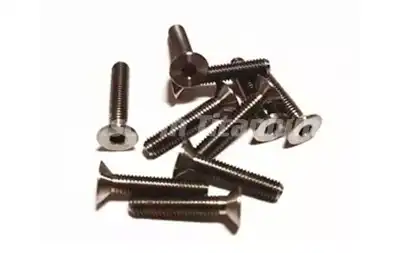
Metric M3 titanium bolts are metric fasteners with outstanding material qualities that are used in high-performance sectors. There is no better bolt than these Grade 5 titanium alloy bolts when it comes to strength-to-weight ratios, corrosion resistance, and harsh condition durability. When compared to steel alternatives, the tensile strengths of Ti-6Al-4V may reach 900-1170 MPa, and the material is 45 percent lighter. Their biocompatibility and lack of magnetic characteristics make them very versatile and ideal for high-performance environments in the aerospace, automotive, and medical industries.
M3 Titanium Bolts Material Composition
To start learning about the basic features of titanium fasteners, you need to know exactly how big they are and what they're made of. M3 titanium bolts are generally constructed of Grade 5 (Ti-6Al-4V) titanium alloy. They have a nominal thread diameter of 3mm and a typical coarse pitch of 0.5mm. These precise metric fasteners follow worldwide standards like DIN 912 and ISO 4762 to make sure they can be used in any country and that the quality is always the same.
Chemical Composition and Titanium Grades
To improve mechanical qualities over commercially pure titanium, Grade 5 titanium alloy—the main material for M3 titanium bolts—includes around 6% aluminum and 4% vanadium. The structure of this alpha-beta alloy provides the best possible combination of toughness, malleability, and resistance to corrosion. Vanadium improves hardenability and strength retention at high temperatures, whereas aluminum increases strength and decreases density.
Grade 5 titanium features an alpha phase that helps with creep resistance and a beta phase that makes it stronger at normal temperature; these phases make up the microstructure of the material. This microstructure may be tailored to precise mechanical characteristics using heat treatment procedures, enabling customisation for various applications. The uniform grain size and phase distribution achieved by our manufacturing method allows for the prediction of mechanical performance across different batches.
Specifications and Manufacturing Standards
In order to provide precise dimensions and a high-quality surface polish, modern M3 titanium bolt production follows rigorous manufacturing standards. Our bolts' rolling threads and machined hexagon heads make them more resistant to fatigue than bolts with cut threads. By applying compressive pressures, thread rolling work-hardens the surface, preventing cracks from starting or spreading.
Lengths from 5 mm to 30 mm may meet the needs of the bicycle, motorcycle, and automotive industries. The hexagonal head shape helps keep tools from slipping during installation and makes it easier to apply torque evenly. Most surface treatments can get Ra values below 1.6 micrometers, which makes them less likely to corrode by lowering stress concentrations.
Mechanical Strength and Durability: How M3 Titanium Bolts Perform
Titanium fasteners have better mechanical performance than other materials, which makes them perfect for mission-critical applications. Grade 5 titanium bolts usually have values between 830 and 1000 MPa, however values between 900 and 1170 MPa are more common. Stainless steel alternatives usually have tensile strengths between 520 and 750 MPa, therefore these numbers show a big advantage.
Tensile and Shear Strength Analysis
Extensive mechanical testing shows that M3 titanium bolts maintain their great strength-to-weight ratios even when they are under diverse types of stress. It has a density of just 4.43 g/cm³ and a maximum tensile strength of more than 1000 MPa, which is about 40% stronger than stainless steel. Shear strength levels that are usually between 60% and 70% of tensile strength make sure that applications that need lateral stress work reliably.
Another important benefit is fatigue resistance. Titanium fasteners have endurance limitations that are almost half of their maximum tensile strength. Applications involving cyclic loads, such as those in the automotive and aerospace industries, greatly benefit from this quality. Its microstructure and the positive impacts of rolling threading production procedures provide the material great resistance to fatigue fracture formation.
Temperature and Environmental Performance
Titanium's remarkable resistance to changes in temperature greatly broadens the range of applications for M3 titanium bolts compared to more traditional materials. This fastener set is ideal for uses where there may be large temperature swings since it retains structural integrity from cryogenic temperatures up to 400°C. Because it nearly matches the coefficient of thermal expansion (8.6 × 10⁻⁶ /°C), thermal stress is reduced in assemblies made of heterogeneous materials.
One big advantage of titanium fasteners is that they don't rust. When made into a strong, self-healing coating, titanium dioxide is far more resistant to oxidation, chloride attack, and galvanic corrosion. This passivation layer can repair itself if it becomes damaged, thus it doesn't require surface treatments or coatings. This means it will protect for a long time.
Advantages of Using M3 Titanium Bolts in Critical Applications
Titanium fasteners provide quantifiable operational advantages and performance enhancements when used in demanding applications. The most noticeable benefit is the decrease in weight. M3 titanium bolts, for example, are 45 percent lighter than stainless steel bolts of the same size. Increased payload capacity in aircraft systems and better vehicle dynamics in automotive applications are direct results of this weight reduction.
Weight Reduction and Performance Enhancement
Titanium fasteners have several uses in the automobile industry, but they are most useful in high-performance and racing vehicles. Lower rotational mass increases acceleration and braking performance, while reduced unsprung weight improves suspension response. After switching out the steel fasteners in crucial suspension and chassis parts for titanium ones, racing teams saw a noticeable increase in lap times.
These fasteners are widely used by motorcycle manufacturers in engine components, braking systems, and suspension assemblies. They provide benefits such as reduced weight and vibration resistance. A more aggressive optimization of weight distribution is possible because to the low mass and high strength combination, which does not compromise structural integrity or safety margins.
Lifecycle Cost Benefits
M3 titanium bolts have a higher initial purchase cost than more traditional options, but the material often comes out on top in total cost of ownership calculations because of its longer service life and lower maintenance needs. In chemical industrial and maritime settings, where corrosion is common, preventing failures caused by corrosion saves money and time.
Due to its resistance to galling, seizing, and corrosion-related deterioration, titanium fasteners allow for much longer maintenance intervals. This increase in dependability improves operating safety margins while decreasing inspection frequency and preventative maintenance expenses. There is no need to worry about magnetic interference in delicate electronic systems due to the non-magnetic qualities.
Comparative Analysis: M3 Titanium Bolt vs Alternative Fasteners
A thorough assessment of performance attributes, financial concerns, and application-specific needs is necessary to choose ideal fastening methods. When compared to more traditional fasteners, M3 titanium bolts provide unparalleled performance at a price point that is practical for mission-critical applications.
Material Performance Comparison
Although stainless steel fasteners have decent strength and resistance to corrosion, titanium has superior strength-to-weight and temperature stability. Compared to titanium alternatives, grade 316 stainless steel has a much lower strength-to-weight ratio, with tensile strengths of around 620 MPa and a density of 8.0 g/cm³. Also, even in saltwater, stainless steel may break due to stress corrosion caused by chloride.
While carbon steel fasteners are inexpensive and strong, they must be coated to avoid corrosion. Coatings like this make materials thicker, make recycling more difficult, and cause them to break under extreme conditions. M3 titanium bolts are ideal for electrical applications since they are not magnetic, which is a difficulty when dealing with steel because of its magnetic qualities.
Grade 5 vs Grade 2 Titanium Comparison
Titanium alloy Grade 5 has higher mechanical strength and is more resistant to corrosion than commercially pure Grade 2 titanium. Grade 2 titanium is ideal for uses where resistance to corrosion is more important than ultimate strength, since its tensile strengths range from 345 to 485 MPa. For the majority of structural uses, grade 5 titanium's combination of strength and resistance to corrosion is ideal.
While both grades are capable of producing parts with comparable surface finishes and dimensional tolerances, Grade 5 alloy requires a more complex heat treatment procedure to get its ideal qualities. Because we can manufacture both materials, we can optimize them for individual applications according to their performance needs and environmental factors.
Procurement Insights: Sourcing High-Quality M3 Titanium Bolts
Building contacts with competent producers that uphold suitable certifications and quality management systems is crucial for successful procurement of titanium fasteners. Certification to AS9100 or an industry-specific standard may be necessary for aerospace applications, however certification to ISO 9001 is the bare minimum for acceptable quality.
Supplier Evaluation and Quality Assurance
Assessing a supplier's production capacity, quality control methods, and traceability systems are all part of the evaluation process. From the procurement of raw materials all the way through to the delivery of completed goods, reputable manufacturers keep full material traceability. The chemical composition, mechanical qualities, and dimensional compliance of the material should be documented with test certifications that should be included with every shipment.
Depending on the quantity and customized needs, the production lead times for M3 titanium bolts might vary from 7 to 15 days for conventional setups. In most cases, a premium price will be applied to rush orders that need accelerated processing. To keep manufacturing on schedule, inventory management systems should take these lead periods into consideration.
Pricing and Market Dynamics
Titanium fastener prices are affected by changes in raw material costs, the difficulty of producing them, and the demand in the market. For regular layouts and greater numbers, bulk purchase agreements may provide considerable cost benefits. Typical minimum order numbers for normal M3 bolts range from 100 to 500 pieces, however this may vary per provider.
For more modest purchases, telegraphic transfer is the usual method of payment, whereas PayPal is more suitable for bigger buys. For transactions involving many countries or orders of a certain size, letter of credit agreements could be feasible. We maintain low pricing structures while offering multiple payment choices to satisfy varied consumer needs.
Conclusion
For applications that need top-notch performance, M3 titanium bolts are the way to go because of their material attributes. With a weight reduction of 45% compared to steel alternatives, grade 5 titanium alloy construction achieves tensile strengths exceeding 1000 MPa. Their non-magnetic characteristics, thermal stability, and exceptional corrosion resistance make them a compelling choice for use in precision equipment, automobiles, and aircraft. To improve performance and successfully manage lifetime costs, it is necessary to understand these material attributes in order to make educated purchase choices.
Contact Wisdom Titanium for Premium M3 Titanium Bolt Solutions
Wisdom Titanium delivers exceptional m3 titanium bolt supplier services backed by ISO 9001 certification and comprehensive quality assurance. Located in Baoji Titanium Valley, Shaanxi Province, we leverage China's largest titanium industry cluster to provide Grade 5 titanium bolts with machined heads and rolled threads. Our 7-15 day production timeline, flexible payment options including PayPal and T/T, and complete length range from 5mm to 30mm ensure your procurement requirements are met efficiently. Contact our technical team at sales@wisdomtitanium.com to discuss your specific fastening needs and receive detailed quotations for your next project.
FAQ
What tensile strength can I expect from M3 titanium bolts compared to steel alternatives?
Grade 5 M3 titanium bolts typically achieve tensile strengths of 900-1170 MPa, significantly exceeding most stainless steel fasteners which reach 520-750 MPa. This superior strength, combined with 45% lower weight, provides exceptional strength-to-weight ratios for performance-critical applications.
How can I verify the authenticity and grade of titanium bolts before purchase?
Authentic titanium fasteners should include material test certificates documenting chemical composition and mechanical properties. Reputable suppliers provide complete traceability documentation and maintain appropriate certifications. Visual inspection reveals titanium's characteristic gray color and non-magnetic properties, though professional testing confirms grade authenticity.
Are M3 titanium bolts suitable for marine environments with saltwater exposure?
Titanium fasteners excel in marine applications due to their exceptional corrosion resistance and immunity to chloride-induced stress corrosion cracking. The self-healing titanium dioxide surface layer provides superior protection compared to stainless steel alternatives, making M3 titanium bolts ideal for saltwater environments.
What anti-galling measures should I implement during installation?
Titanium's tendency toward galling requires proper lubrication during installation. Molybdenum disulfide or specialized anti-seize compounds prevent cold welding between threaded surfaces. Controlled torque application and gradual tightening procedures minimize galling risk while ensuring proper preload achievement.
Do titanium bolts require special torque specifications?
Titanium's lower modulus of elasticity requires adjusted torque values compared to steel fasteners. Typical torque specifications run 15-20% lower than steel equivalents to prevent thread damage while achieving adequate preload. Manufacturer recommendations should guide specific torque values for critical applications.
References
1. Boyer, R., Welsch, G., & Collings, E.W. "Materials Properties Handbook: Titanium Alloys." ASM International Materials Park, 1994.
2. Lutjering, G. & Williams, J.C. "Titanium: Engineering Materials and Processes." Springer-Verlag Berlin Heidelberg, 2007.
3. Peters, M., Kumpfert, J., Ward, C.H., & Leyens, C. "Titanium Alloys for Aerospace Applications." Advanced Engineering Materials, Vol. 5, No. 6, 2003.
4. Rack, H.J. & Qazi, J.I. "Titanium Alloys for Biomedical Applications." Materials Science and Engineering C, Vol. 26, Issue 8, 2006.
5. Banerjee, D. & Williams, J.C. "Perspectives on Titanium Science and Technology." Acta Materialia, Vol. 61, Issue 3, 2013.
6. Cotton, J.D., Briggs, R.D., Boyer, R.R., Tamirisakandala, S., Russo, P., Shchetnikov, N., & Fanning, J.C. "State of the Art in Beta Titanium Alloys for Airframe Applications." JOM Journal of the Minerals, Metals and Materials Society, Vol. 67, No. 6, 2015.