
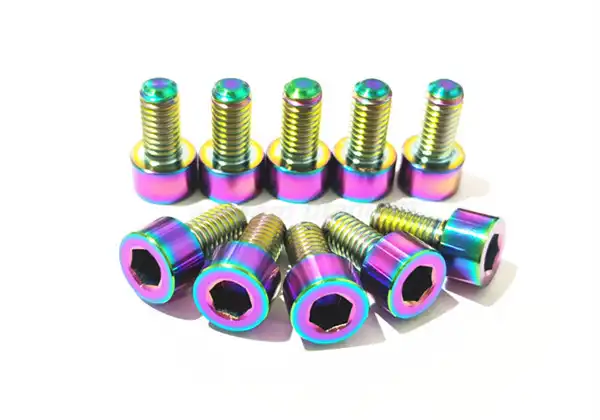
Titanium fasteners for bicycles deliver exceptional performance through their remarkable strength-to-weight ratio, superior corrosion resistance, and outstanding fatigue life. These components—ranging from stem bolts to brake caliper fasteners—typically weigh 40-50% less than steel equivalents while maintaining comparable or superior strength. The material's natural oxide layer provides unmatched protection against moisture, salt, and environmental degradation, making these fasteners ideal for road bikes, mountain bikes, and coastal riding conditions. Beyond performance, titanium's biocompatibility, non-magnetic properties, and aesthetic versatility make it the preferred choice for premium bicycle manufacturing and high-performance applications.
Understanding Titanium Fasteners and Their Role in Bicycles
There are titanium fasteners for bicycles that are designed to fit into bicycle frames, engine parts, brake systems, and places where accessories can be mounted. It is aerospace-grade titanium metals like Ti-6Al-4V (Grade 5) that are used to make these parts. This material is 90% titanium, 6% aluminium, and 4% vanadium. Its stress strength is about 830 MPa, and its density is only 4.43 g/cm³, which is a lot less than steel's density of 7.8 g/cm³.
Titanium gear is being used more and more in both the supply chain for OEM bikes and the supply chain for aftermarket bikes. It works better, that's why. Titanium fasteners are used in the suspension links of mountain bikes because they don't break easily when they get tired. Brands of road bikes put these parts in handlebar stems and seatpost clamps to cut down on weight without losing locking power. Custom bike shops use titanium's natural silver finish and the fact that it can be anodised to make builds that are one-of-a-kind and match the names of their clients.
Current Market Trends
The world market for bicycle parts wants more high-end materials. This is especially true in North America, where speed riding and bikepacking have become very popular. Industry statistics show that high-end bike makers now put titanium fasteners on all bikes that cost more than $3,000. This trend has an effect on the network that sends parts to different places. Wholesalers say that repair shops and assembly plants are placing more and more orders because they want long-lasting upgrade choices for the builds they make for customers.
Key Advantages of Titanium Fasteners for Bicycles
The unique properties of titanium fasteners for bicycles make them technically better than other choices. These properties directly meet important performance goals in bicycle engineering. People who work in procurement can decide if titanium is worth the price for certain markets and uses once they know about these benefits.
Exceptional Strength-to-Weight Ratio
Titanium fasteners are about half as heavy as high-grade steel screws, but they are just as strong. There is a difference in weight between steel M6 bolts and Grade 5 titanium ones. Steel bolts weigh about 6 to 8 grams. When you're putting together a whole bike, this difference is important. Changing 20–30 screws in the frame, seat, and other parts can save 80–120 grams without weakening the frame.
Tensile strength of the material ranges from 895 to 930 MPa for most grades. As long as the torque is between 5 and 6 Nm, this is strong enough for jobs that need to hold weight, like fitting brake callipers and stem faceplate bolts. For race teams that want to get an edge by making their bikes as light as possible, this mix is great. People who ride regularly can also benefit from faster acceleration and better climbing efficiency.
Superior Corrosion Resistance
When oxygen touches titanium, the inactive oxide layer grows back on its own. This makes it very hard for the world to hurt. If you ride your bike near the water, near the coast, or in the winter, when road salt speeds up rusting, this feature will come in very handy. Stainless steel can pit and rust in chloride-rich environments, but titanium fasteners stay strong and look good even after years of being in rough places.
At depths of more than one mile, tests done near the coast show that titanium parts don't rust and can handle being in dirty water with sulphides and chlorine compounds. It means fasteners that won't get stuck in the threads, don't lose their strength over time, and don't rust on carbon fibre and painted metal frames like steel hardware does.
Outstanding Fatigue Resistance and Longevity
Steel rivets wear out much faster than titanium ones. This is especially true when the threads are rolled instead of cut when making the rivets. When the material is cold-rolled, the structure of the grains stays the same, and the material is about 30% less likely to wear out. Nuts made this way can safely handle the cyclic loading that happens while riding, like the vibrations from the handlebars, the compression cycles of the suspension, and the forces from the drivetrain.
Studies from the business world say that properly defined titanium bolts can withstand millions of stress cycles without breaking. In other words, they can be used in cases where safety is very important. Because of this, stem bolts, brake mounts, and rotor fasteners are more likely to work, which lowers guarantee claims and boosts rider trust. Cost of ownership is also better because it lasts longer, even though it costs more at first.
Aesthetic Appeal and Customization Options
Titanium fasteners are made to work well, and the fact that they look different helps to tell goods apart. The material's natural silver-gray colour looks good with both old-fashioned metal frames and newer carbon fibre frames. One more way to make something look good is to treat the surface of it. You can get bright colours like blue, gold, purple, and bronze by anodising. Bicycle brands use these colours to make their signature looks. PVD finishing lets you have black, rainbow, or unique finishes that last a long time.
These customisation options do two things: they let brands make sure that all of their products have the same look and feel, and they let custom builders make products that meet their customers' needs. It works better because the processes make the surface harder, lower the friction coefficients to stop galling, and keep the base's purity. Different bicycle uses need different standard styles, such as DIN912 (socket head cap), DIN7991 (countersunk), DIN6921 (flange head), and ISO7380 (button head). These styles meet different needs for looks and usefulness.
Titanium vs. Other Fastener Materials — A Comparative Analysis
Before you buy titanium fasteners for bicycles, you should know how they compare to other materials in a number of performance areas. There are pros and cons to titanium, steel, aluminium, and stainless steel in this study. This will help you choose a material that fits your wants and your budget.
Weight Comparison
The material used has a big effect on how the bike's weight is spread out and how much it weighs all together. Steel bolts have a high tensile strength (around 800 to 1000 MPa for Grade 8.8), but they are not as thick as other materials, which makes them less useful in many situations. Alum screws aren't as strong, but they're lighter. Only 500 to 570 MPa is the tensile strength of Grade 7075 metal. This means it can't be used for high-stress jobs like brake mounts or stem bolts.
Titanium is as strong as steel but as light as aluminium, so it fills that need. You can save 100 to 150 grams by replacing all of a normal race bike's fixings with metal fasteners. The stem, seatpost, bottle cages, brake callipers, and accessory mounts are all part of this. Athletes know this is important, just like getting rid of a small water bottle or making the bar tape smaller.
Corrosion and Environmental Performance
As a general rule, stainless steel rivets are better than plain steel ones because they don't rust because they have more chromium in them (10.5 to 18%). But grades of stainless steel (304 and 316) that are often used for fasteners can still rust and pit when they are exposed to chloride. This is especially true near the coast or when chemicals are used to melt snow on the roads.
Titanium does not rust because of a different process. Its oxide layer forms right away and stays put, even in places where oxygen is not present. This means that the things that wear down stainless steel over time can't really hurt titanium fasteners. People who know a lot about bikes say that titanium bolts that have been used for years don't need penetrating oil or thread galling. Stainless steel or carbon fibre nuts, on the other hand, tend to get stuck in aluminium or carbon fibre parts.
Durability and Maintenance Requirements
How stable a product's fasteners are over time affects both its image and how much it costs to own. Because corrosion wears them down over time, steel bolts need to be checked and replaced often. Because bikes are kept or driven in all kinds of weather, this is especially important. When aluminium bolts are loaded over and over, they can crack because their fatigue limits are lower. This can be dangerous in important situations.
Titanium doesn't wear down easily and doesn't rust, so it lasts a lot longer between fixes. People who make bikes are less likely to file warranty claims about broken bolts or rust damage to nearby parts when the hardware is made of titanium. Titanium fasteners can be taken off and put back on many times without damaging the threads because the material doesn't gall. This makes maintenance easier. Stainless steel, on the other hand, tends to gall when threaded into aluminium or stainless steel parts.
Conclusion
People who make, sell, or build handmade bikes and want to make their products stand out by making them perform better should buy titanium fasteners for bicycles. The high ratio of strength to weight, high resistance to corrosion, and long wear life directly meet important needs in mountain bike, road riding, and other specialised uses. For markets that care about performance, the higher price is worth it because the product has a better reputation, less maintenance, and fewer replacement cycles over its lifetime than alternatives made of steel or aluminium. To be good at buying, you need to match the application's needs with the right types of materials, surface treatments, and supplier skills. Then, you need to work with approved manufacturers to make sure you get regular quality at a price that is competitive.
FAQ
How much weight can I save by switching to titanium bolts on a complete bicycle build?
Most of the time, a full titanium fasteners for bicycles change makes the bike 100 to 150 grams lighter than it was with steel gear. As well as clamps for the seatpost and brake calliper, bolts for the bottle cage, and screws for extras, this list has everything you need. The exact amount saved depends on how many fasteners can be changed and what the material was made of in the first place. There are more places to put suspension parts and other items on mountain bikes, so riders can save more weight.
Are titanium fasteners worth the higher cost compared to stainless steel?
Based on the application's objectives and how the target market is set up, the value offer is made. Titanium is superior to other metals because it is 40–50% lighter, doesn't rust (which is helpful near water or the beach), and doesn't break down easily, so it lasts longer. The price of high-end bikes can be explained by making their products stand out and putting their brands in better places. Getting rid of warranty claims about rust also saves money over the product's life.
Can titanium fasteners be customized with specific colors or finishes?
You can make your goods unique in many ways with anodising and PVD finish. Bright colours like blue, purple, gold, green, and bronze are made by Type II anodising, which controls the growth of the oxide layer. With a PVD covering, you can get gold, black, silver, and colourful metallic finishes that last longer. It makes the surface tougher too. It is possible to get colours to match a certain brand, but there may be a minimum order size depending on how skilled the seller is and how much it costs to set up the process.
Partner with Wisdom Titanium for Premium Bicycle Fastener Solutions
Wisdom Titanium makes high-quality titanium fasteners for bicycles industry. All over North America and the world, they work with makers, wholesalers, and specialised builders. Our ISO 9001-certified plant is in Baoji Titanium Valley, which is the biggest place in China to make titanium products. It lets us get high-quality raw materials directly and keeps our prices low while keeping the standard good.
We have a lot of standard bicycle fasteners in sizes M3 to M10 in stock. These come in well-known styles like ISO7380, DIN912, DIN7991, and DIN6921. The minimum order number (MOQ) can be as low as 200 pieces per size, and you can get a pattern made just for you. By anodising and PVD finishing, we can give your brand a unique look and make things work better at the same time.
For a long time, our company has been making titanium fasteners for bikes. We know how important it is to find the best balance between keeping costs low, making sure the structure is strong, and cutting weight. You can talk to our expert team about your specific needs, get material certifications, or set up a review of a sample by emailing sales@wisdomtitanium.com. We want to help you come up with new goods, so we offer quick engineering support and reliable delivery that works with your production plans.
References
- Boyer, R., Welsch, G., & Collings, E.W. (1994). Materials Properties Handbook: Titanium Alloys. ASM International, Materials Park, Ohio.
- Schutz, R.W. & Watkins, H.B. (1998). Recent developments in titanium alloy application in the energy industry. Materials Science and Engineering A, 243(1-2), 305-315.
- Lutjering, G. & Williams, J.C. (2007). Titanium (2nd Edition). Springer-Verlag, Berlin Heidelberg.
- Donachie, M.J. (2000). Titanium: A Technical Guide (2nd Edition). ASM International, Materials Park, Ohio.
- Veiga, C., Davim, J.P., & Loureiro, A.J.R. (2012). Properties and applications of titanium alloys: A brief review. Reviews on Advanced Materials Science, 32(2), 133-148.
- Cotton, J.D., 开B.R.D., Boyer, R.R., et al. (2015). State of the Art in Beta Titanium Alloys for Airframe Applications. Journal of Materials, 67(6), 1281-1303.




