
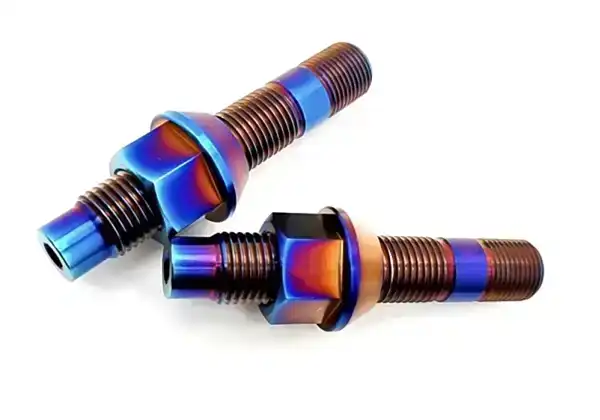
Titanium wheel stud conversion delivers measurable advantages that extend beyond simple material substitution. By replacing conventional steel studs with Grade 5 titanium alloy fasteners, vehicles experience reduced unsprung weight, enhanced corrosion resistance, and improved mechanical reliability under extreme conditions. This upgrade addresses critical pain points in automotive, motorsport, and commercial fleet applications—where performance consistency, maintenance intervals, and operational safety directly impact bottom-line costs and competitive positioning.
Understanding Titanium Wheel Stud Conversion
Titanium wheel stud conversion means switching out the steel wheel studs that came with the car from the factory for ones made of precision-engineered titanium metal. Titanium Grade 5 (Ti-6Al-4V) fasteners have a tensile strength of over 950 MPa, which is higher than steel, aluminium, or most other alloys. They also weigh about 43% less than steel equivalents. This substance is very good at resisting galvanic corrosion, keeping its shape at temperatures ranging from -200°C to 400°C, and showing superior fatigue resistance when loaded and unloaded many times. These are all qualities that directly address failure modes seen in high-stress automotive applications.
Why Industries Are Adopting Titanium Studs?
Titanium screws are becoming more popular because function and cost concerns are coming together. Racing teams need parts that can handle being heated and cooled over and over again and being hit by air tools during pit stops without breaking down or losing their power. Manufacturers of high-performance cars try to cut down on the weight of rotating assemblies to make the throttle response faster and the suspension less flexible. Longer service lives are important to commercial fleet owners because they want to cut down on breakdowns and repair downtime, especially near the coast where road salt speeds up corrosion.
In addition to their mechanical ability, fuel economy rules put pressure on manufacturers to use lightweight materials. Even cutting unsprung mass by 200 grams per wheel corner can improve how quickly and efficiently a vehicle speeds up and slows down, which can have a big impact on large fleets of vehicles.
Material Comparison: Titanium vs. Steel and Aluminum
Even though steel studs are cheap to buy and work well in most situations, they have problems like thread damage from corrosion and extra weight that makes them harder to handle. Aluminium is lighter than steel, but it doesn't have the tensile strength needed for high-torque applications. If the right lug nut torque specifications aren't followed (usually 80 to 140 ft-lbs based on the car class), the threads could become stripped.
Titanium Grade 5 fills this gap by being as strong as steel but as light as aluminium. When scratched, the alloy's passive oxide layer grows back on its own, protecting against corrosion in a way that zinc plating on steel can't. This trait is especially useful in marine settings and winter temperatures, where chemicals in the road speed up the breakdown process.
Vehicle Compatibility and Application Scope
Titanium wheel stud conversion works with cars whose performance is good enough to justify the extra cost. European sports cars with M12×1.5 or M14×1.5 threads, like the BMW M-series, Porsche 911, and Audi RS models, are good options because they are compatible with normal titanium studs. Circuit racing (GT3, touring cars), endurance events (Le Mans, Nürburgring), and rally competitions all use fasteners that need to work reliably in harsh conditions and quickly change wheels.
Titanium studs are used in commercial uses like luxury car companies that work in corrosive environments. They get rid of the need to change studs every few years because of rust seizure. New energy vehicles can reach their long-range goals by losing weight, and custom builders choose titanium hardware to make high-end builds stand out by adding functional upgrades rather than just cosmetic changes.
How to Convert to Titanium Wheel Studs – Step-by-Step Process?
For a transfer to go smoothly, it needs to be carefully planned out and installed according to specific steps that protect safety and keep the guarantee valid. The steps below show the purchasing and repair teams how to check specifications, choose parts, and put them in a way that meets industry standards.
Initial Assessment and Specification Verification
Write down the current wheel stud's thread width (M12, M14, 1/2"), thread pitch (1.25mm, 1.5mm, 20 TPI), underhead length, and seat shape (conical vs. spherical). To make sure the hub engages properly and the lug nuts work, these dimensions must exactly match titanium new studs. Check the service manual for your car or use thread pitch tools and callipers to measure the parts you already have.
Check the specs of the wheel wheel lug nut at the same time, making sure the socket dimensions and seat angle (usually a 60° conical or ball seat). Some aftermarket wheels need longer studs to fit the thicker wheels; to find the right length, add the thickness of the wheel's mounting surface to the minimum thread engagement requirements, which are usually 1.5× nominal diameter.
Selecting Appropriate Conversion Kits
The Ti-6Al-4V composition, which contains 6% aluminium and 4% vanadium, should be specified in titanium wheel stud conversion kits' Grade 5 material certification. Reliable sources provide proof that the materials can be tracked and test certificates that show they meet the requirements for aircraft materials (AMS 4928 for bar stock).
The way a thread is made is very important. Cold-working effects that create good compressive residue stresses make rolled threads 20–30% stronger than cut threads when it comes to wear strength. Quality conversion kits say that they are made from rolled thread and include tensile test results that show they have a minimum yield strength of 950 MPa.
When looking for parts, check with the seller to see what customisation choices they offer. Standard products meet common European (M12×1.5, M14×1.5) and American (1/2"-20, 7/16"-20) standards, but special uses may need lengths or thread configurations that aren't standard. Suppliers that give CNC cutting services can meet special needs, but the minimum order quantity is usually 100 sets.
Installation Process and Safety Compliance
Preparing the hub surface well is the first step in a proper installation. Usually, a hydraulic press or stud removal tool is needed to remove the current studs. Next, clean the hub mounting holes to get rid of rust, dirt, and any anti-seize compound that is still there. Check the mounting holes for damage or elongation that could make it harder for the studs to stay in place.
To install titanium studs, you need to use the right press-fit tools that spread the force evenly across the stud head without putting stress on the side. Check for full seating by measuring how far the studs stick out from the hub face and making sure the results are the same in all mounting places. Before putting on the wheel, apply an anti-seize powder made especially for titanium (copper-free versions are suggested).
To properly torque lug nuts, you should use a calibrated torque wrench and follow the manufacturer's instructions. Titanium studs usually accept the same torque values as OEM steel hardware, which range from 80 to 140 ft-lbs depending on the vehicle class. Use a star pattern tightening process to make sure that the load is spread out evenly. After 50 to 100 miles of use, re-torque the lug nuts to account for the initial settling. After that, do regular maintenance as usual.
Titanium Wheel Studs in Action: Industry Case Studies and Performance Validation
Performance claims are backed up by real-world implementation data that shows benefits in a variety of application settings. The cases below show how companies use titanium wheel stud conversion to make measured improvements to their operations.
Racing Applications: Endurance Competition Performance
During a 24-hour endurance race with 32 pit stops and full wheel changes, a European touring car racing team kept track of how well titanium studs worked. Pneumatic impact tools put studs through repeated high-torque installation cycles (120 ft-lbs) while time was tight. Thermal cycling from brake heat (more than 300°C) and ambient cooling also caused a lot of stress.
After the race, a check showed that there were no stud failures or thread damage in any of the wheel places. This is different from seasons past when steel studs were used and 15-20% had to be replaced in the middle of the race because they were galling or cross-threading. The team said that titanium's anti-galling properties and high thread precision made pit stops more consistent. This saved them two to three seconds per stop, which added up to an advantage of almost one full lap over the course of the race.
Commercial Fleet: Coastal Environment Durability
A luxurious car rental company in Florida's coastal areas switched 150 of their vehicles to titanium wheel studs because the steel parts that came with the cars kept rusting. Maintenance records from the past showed that 70% of vehicles needed full stud replacements during regular service intervals (every 24 months), which cost more than $200 per vehicle for labour.
After 36 months of titanium stud service, fleet maintenance data showed that there were no corrosion-related replacements and 40% less wheel service labour hours because there were no longer any steps for removing stuck studs. Within 28 months, the conversion gave a return on investment (ROI) and increased car availability by cutting down on unplanned repairs. The happiness scores of customers went up significantly after service delays related to wheels were eliminated during rental times.
Technical Validation: Laboratory Testing Results
Titanium Grade 5 wheel studs have been proven to work by independent testing laboratories following standard procedures. Tensile tests according to ASTM E8 shows that the maximum tensile strength is between 950 and 1050 MPa, which is higher than Grade 8.8 steel's strength of 800 to 900 MPa and 43% lighter. According to SAE J429 guidelines, fatigue testing shows that titanium studs can survive 10 cycles at 60% UTS without breaking. This is a level of performance that backs up promises of longer service life.
Corrosion resistance testing according to ASTM B117 (salt spray exposure) shows that titanium keeps its full thread integrity and dimensional stability after 2,000 hours of continuous exposure. Steel studs, on the other hand, show severe pitting and measurable thread degradation within 500 hours. These controlled test results give technical support to what has been seen in the field in terms of performance in race and fleet uses.
Conclusion
Titanium wheel stud conversion is a strategic update that pays off in speed, safety, and maintenance costs. The material's unique mix of strength, resistance to corrosion, and lightness gets around some of the problems that come with steel fasteners while still giving them an endless service life as long as they are properly maintained. Reduced rotational mass and better reliability in harsh conditions are good for racing applications. Commercial fleets save money on maintenance costs by getting rid of corrosion failures, and high-performance vehicle builders set their products apart by adding features that support premium positioning. When you look at titanium studs' value propositions through the lens of their lifecycle costs instead of their initial purchase price, they really stand out for uses where consistent performance and less downtime make the extra cost worth it.
FAQ
What thread sizes are available for titanium wheel stud conversion?
Standard titanium wheel studs come in M12×1.5, M14×1.5, and 1/2"-20 UNF thread sizes, which are suitable for most European and domestic vehicle applications. Custom thread sizes, such as M12×1.25, 7/16"-20, and non-standard lengths, can be made with a minimum order quantity of 100 sets, which can be used for special vehicle platforms and aftermarket wheel needs.
How much weight reduction can be achieved through conversion?
Titanium wheel studs are about 40–50% lighter than steel ones of the same size. A standard five-lug, four-wheel car with 20 studs can lose 400 to 600 grams of unsprung weight. Because of less rotational inertia, this leads to better handling and 0.2% to 0.4% better fuel economy in fleet applications.
Are titanium studs compatible with standard lug nuts?
Titanium wheel studs have the same thread specs and seat configurations as OEM steel studs. This means that they can be used with both factory and aftermarket lug nuts. To make sure the clamping force is right and that galling doesn't happen, the manufacturer's torque recommendations (usually 80 to 140 ft-lbs, depending on the type of vehicle) must be followed during installation.
What maintenance procedures do titanium studs require?
Titanium wheel studs need to be checked for torque every 6,000 miles or when the tires are rotated, and the threads need to be looked at visually when the wheel is taken off. Use anti-seize powder when installing the wheels, and tighten the lug nuts again after the first 50 to 100 miles of use. Unlike steel studs that need to be replaced because they rust, titanium hardware will last forever if it is properly cared for.
Partner with Wisdom Titanium for Your Wheel Stud Conversion Needs
Wisdom Titanium makes titanium wheel stud conversion kits that are precisely designed to meet the needs of demanding automotive, racing, and business fleet uses. We are an ISO 9001-certified company in Baoji Titanium Valley, which is China's best place to make titanium products. We use strict quality control protocols and vertical integration to do everything from sourcing raw materials to CNC machining. Our Grade 5 titanium wheel studs go through a lot of tests, such as PMI composition analysis, tensile proof, and thread precision gauging, to make sure that every output lot performs the same.
We can meet custom requirements such as non-standard thread sizes, longer lengths, and surface treatments, and our minimum order quantity is just 100 sets. We also offer expert help during the design development and installation planning process. Our experienced research and development (R&D) team helps with checking measurements and making sure products work together. We also keep a full stock of raw materials and have well-established production systems that keep wait times stable and project timelines predictable. Wisdom Titanium has the technical know-how and manufacturing capabilities to help you reach your performance goals, whether you're a titanium wheel stud conversion supplier looking for dependable bulk sourcing, an OEM putting lightweight fasteners into production vehicles, or a racing team that needs custom parts.
Contact our technical sales team at sales@wisdomtitanium.com to discuss your wheel stud conversion requirements. We welcome inquiries for custom projects, volume pricing, and material certifications that support your procurement standards. Visit wisdomtitanium.com to explore our complete fastener catalog and capabilities documentation.
References
- Boyer, R., Welsch, G., & Collings, E.W. (1994). Materials Properties Handbook: Titanium Alloys. ASM International.
- Donachie, M.J. (2000). Titanium: A Technical Guide, 2nd Edition. ASM International.
- Society of Automotive Engineers. (2018). SAE J429: Mechanical and Material Requirements for Externally Threaded Fasteners.
- Schutz, R.W. & Watkins, H.B. (1998). Recent developments in titanium alloy application in the energy industry. Materials Science and Engineering A, 243(1-2), 305-315.
- Lutjering, G. & Williams, J.C. (2007). Titanium, 2nd Edition. Springer Engineering Materials.
- American Society for Testing and Materials. (2016). ASTM E8/E8M-16a: Standard Test Methods for Tension Testing of Metallic Materials.