
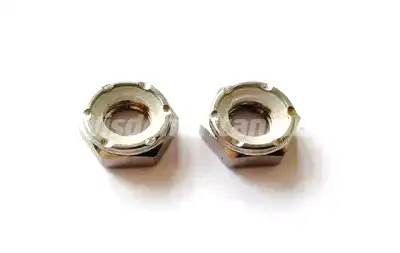
Nylon lock nuts are used for securing threaded connections that experience vibration, dynamic loads, or environmental stress where standard nuts would loosen over time. These specialized fasteners feature a nylon insert ring embedded at the top that grips bolt threads firmly, preventing rotation and loosening during operation. Titanium nylon lock nuts elevate this function by combining Grade 5 titanium's superior strength-to-weight ratio with nylon's reliable locking mechanism, making them indispensable in high-performance automotive modifications, motorcycle racing assemblies, aerospace components, marine equipment, and custom bicycle builds where both weight savings and dependable fastening are non-negotiable.
Understanding Nylon Lock Nuts and Their Applications
Nylon lock nuts are a major step forward in the technology used to hold things together. Instead of relying only on friction or pressure like regular hex nuts do, these closures have a nylon collar inside the nut body. When a bolt goes through, the nylon squeezes against the threads, making it very hard for the bolt to turn. This design stops vibrations from making the parts open on their own, which is a common way for machines, cars, and building structures to fail.
What Makes Titanium Nylon Lock Nuts Different?
By adding titanium metal, ordinary nylon lock nuts are changed into high-performance screws. Grade 5 titanium (Ti-6Al-4V) has a tensile strength of more than 120 ksi and weighs about 40% less than steel versions. In harsh situations, this metal lasts longer than stainless steel because it doesn't rust in sea, chemicals, or temperatures that range from very cold to over 400°C.
Precision forging is used to make sure that the grains in hot-forged hex titanium nylock nuts are aligned, which increases their fatigue resistance. This is very important for race teams fitting brake caliper bolts or motorcycle makers putting together sprocket nuts. The natural titanium finish looks good and is biocompatible, and it doesn't have any layers that could chip or break down.
Industries Relying on Nylon Lock Nut Technology
Shops that make modifications to cars that want to make supercars lighter often ask for titanium nylon lock nuts for wheel hub systems. Taking away even 200 grams of spinning mass makes control and acceleration more precise. Racing groups that follow FIA or SCCA rules need screws that can handle constant vibration at engine speeds of 8,000 RPM or more without pulling off.
These nuts are used by aerospace engineers on UAV drone rotor assemblies and satellite launch devices where failure is not an option. Titanium isn't magnetic, so it doesn't mess up guidance systems, which is something that steel bolts don't have to do. Titanium doesn't crack when exposed to chloride stress, which breaks down stainless steel in saltwater settings. This makes it useful for marine uses like boat rigging tools and ocean sensor mounting brackets.
Titanium nylon lock nuts are used in suspension pivots and engine parts by high-end bicycle makers. Mountain bikers riding over rough terrain create constant shock loads that would loosen regular nuts. The nylon insert, on the other hand, keeps its holding force through thousands of compression cycles.
Key Benefits and Performance Features of Titanium Nylon Lock Nuts
When purchasing managers look at different types of fasteners, they find that titanium nylon lock nuts are better than other materials. Because of these advantages, repair costs go down, safety margins get better, and service times get longer in demanding situations.
Superior Corrosion Resistance
Titanium quickly forms a protective oxide layer when it comes into contact with air. This layer acts as a wall that rust, galvanic corrosion, and chemical attacks can't get through. Automakers that make electric cars like this property for battery cover bolts that might get sprayed with road salt or coolant. Nuts made of zinc-plated steel rust in just a few months, but titanium screws stay strong for decades.
According to ASTM B117 salt spray standards, titanium doesn't corrode after 1,000 hours or more, but 316 stainless steel does develop pitting and fissure rust. This durability is important for motorbike brake disc bolts that are used in wet situations and with chemicals used to melt ice in the winter.
Extreme Temperature Stability
The nylon insert in good lock nuts keeps the closing force constant from -54°C to 120°C, which is a wide range of temperatures that most vehicles and machines will be used in. Grade 5 titanium keeps its mechanical qualities above 400°C, so it can be used for exhaust system bolts or turbocharger mounting hardware where stainless steel would soften.
Racing teams that put titanium nylon lock nuts on brake calipers like that hard stopping doesn't break down the nylon or cause thread galling when the nuts are heated over and over again. Titanium has a thermal expansion value that is very close to that of aluminum. This means that steel screws in aluminum housings won't come away from differential expansion.
Strength-to-Weight Performance
The lower density of titanium (4.5 g/cm³) compared to steel (7.85 g/cm³) makes it better for uses that need to save weight. Changing from steel to titanium wheel lug nuts saves about 150 grams per wheel, or 600 grams for a speed car as a whole. This straight decrease in unsprung weight makes the suspension respond better and the tire contact patch stays stable when turning.
Aerospace experts say that taking away one kilogram from an airplane's frame saves about three thousand liters of fuel a year. By using titanium nylon lock nuts for non-structural fastening tasks all over an airplane, you can make operations more efficient without lowering safety standards.
Reusability and Cost-Effectiveness
Titanium screws cost more up front than steel ones, but they last longer, so the extra money is worth it. All-metal lock nuts lose their torque after three to five uses, but quality nylon insert nuts work for ten or more setups as long as they are properly torqued. Racing teams that fix suspension parts between events like that they can be used again, which cuts down on the number of spare parts they need to keep on hand.
The longer working life gets rid of the need for replacements. Titanium screws are said to last 15 years or more in saltwater, while stainless steel fasteners need to be replaced every two to three years. Total cost of ownership, which includes work for replacement, shows that titanium is a better deal than other materials, even though it costs more at first.
Procuring Titanium Nylon Lock Nuts: What Buyers Need to Know
When making a B2B buying choice, you need to look at the supplier's skills, quality certifications, and logistical issues that can affect project timelines and the dependability of parts.
Supplier Selection Criteria
Certified raw materials are the first step in making high-quality titanium nylon lock nuts. Reliable suppliers get Grade 5 titanium rod stock that meets AMS 4928 (aerospace material specification) or ASTM B348 standards. Shipments should come with material certifications that show the chemical makeup and mechanical properties that have been checked using spectroscopy and tensile testing.
The process of making something is very important. For example, hot forging creates a better grain structure than machining from bar stock, which increases fatigue resistance by 20–30%. Our hot-forged hex titanium nylock nuts go through multiple stages of forging and then CNC thread rolling, which is a cold-working process that hardens the threads and makes them last longer than cut threads.
ISO 9001 certification means that quality management systems have been set up and cover incoming inspection, controls during production, and final verification. AS9100 standards are used in aerospace-grade production environments to improve traceability and process documentation. Automotive suppliers that want IATF 16949 certification show that they are committed to zero-defect manufacturing methods.
Pricing Strategies and Bulk Purchasing
When you buy directly from the factory, you don't have to pay the markups that distributors do, which cuts your costs by 25–35% compared to buying through retail channels. Our 100-piece minimum order quantity balances the costs of setting up tools with the amount of inventory that customers need. Buyers who are prototyping designs can ask for 10-piece sample quantities at slightly higher per-unit costs, switching to production volumes once the designs are finalized.
Common sizes (M6, M8, M10, and M12 metric threads) are in plenty of stock, so urgent orders can be shipped the same week. Custom sizes and thread pitches, on the other hand, need 3–4 weeks to prepare for forging dies and heat treatment cycles. Setting up blanket purchase orders with scheduled releases helps manufacturers keep track of inventory costs and make sure they have enough capacity during busy production times.
Titanium sponge prices change based on global supply dynamics, so locking in prices for 6 to 12 months protects buyers from price changes, which is especially helpful for OEMs budgeting production costs. If you commit to buying more than 1,000 pieces a year, you can get discounts that reach 15-20% below standard rates.
Verification and Quality Assurance
Critical dimensions and material properties should be checked by incoming inspection protocols. Thread gauges should confirm pitch diameter tolerances according to ISO 965 standards to make sure they fit properly with standard bolts. Nylon insert retention tests should use a certain amount of torque to make sure the insert doesn't come loose during installation, which would mean there isn't enough crimp interference.
Using the Rockwell C scale to check the hardness of titanium after solution treating and aging confirms that heat treatment works. Grade 5 titanium should measure 33–38 HRC. Lower hardness means that the aging cycles were not done correctly, which lowers its strength, while too much hardness means that the microstructure is brittle and likely to break.
Corrosion resistance is confirmed by salt spray testing according to ASTM B117. After 500 hours of exposure, quality titanium fasteners show no red rust, which is much better than stainless steel. Marine equipment manufacturers regularly do accelerated corrosion testing on incoming fasteners before approving suppliers.
Technical Support and Engineering Services
When you choose suppliers that offer application engineering support, you get more than just low prices. Our team helps you choose the right fasteners based on the joint design, the combinations of materials, and the loading conditions. Finite element analysis finds stress concentrations and suggests the right preload specifications to stop fatigue failures.
As part of OEM services, fasteners are delivered in sequenced kits that match the needs of the assembly station. This cuts down on picking errors and installation time. Kanban replenishment programs automatically place new orders when inventory levels reach certain levels, so there are no stockouts and no need for extra safety stock.
Aerospace customers get material certifications that can be tracked back to mill heat numbers and test reports. Medical device manufacturers get biocompatibility testing that meets ISO 10993 standards. Automotive suppliers get PPAP (Production Part Approval Process) packages that include dimensional reports, process flow charts, and control plans.
Conclusion
Many industries depend on vibration resistance and reliable fastening to make parts last longer and be safer. Titanium nylon lock nuts take this proven technology to the next level by combining Grade 5 titanium's high strength-to-weight ratio and corrosion resistance with nylon's reliable locking mechanism. Performance benefits can be seen in auto shops that modify cars, racing teams, aerospace manufacturers, marine equipment builders, and custom bicycle shops. For example, less unsprung weight improves vehicle dynamics, and corrosion resistance extends service life in harsh environments. Knowing the technical specifications, installation requirements, and procurement considerations helps engineers and purchasing managers make decisions that match fastener capabilities with application needs, resulting in safer, more durable assemblies.
Partner with a Trusted Titanium Nylon Lock Nuts Manufacturer
Wisdom Titanium offers factory-direct prices on hot-forged hex titanium nylock nuts designed for critical fastening applications in the aerospace, marine, automotive, and cycling industries. We are located in Baoji Titanium Valley, which is China's premier titanium production hub with full supply chain integration, and use our decades of metallurgical expertise and ISO 9001-certified manufacturing processes to make fasteners that meet the strictest requirements.
Our ready-to-ship inventory includes Grade 5 titanium fasteners with a natural finish and thread ranges from M3 to M24 in metric and full inch. There is a 100-piece minimum order, and bulk pricing is very competitive. OEM customization services can handle application-specific needs like non-standard thread pitches, flange-base designs, and left-hand threads, and are backed by experienced engineering teams that help with joint analysis and fastener selection.
Get in touch with our technical sales team at sales@wisdomtitanium.com to talk about your project needs. Whether you're a racing team looking for lightweight wheel hardware, an OEM manufacturer looking for titanium nylon lock nuts suppliers for production assembly, or a custom fabrication shop needing small batches of specialty fasteners, we can meet your needs for quality, documentation, and dependability.
FAQs
Can titanium nylon lock nuts be reused?
When properly torqued and removed without cross-threading, quality titanium nylon lock nuts usually keep locking effectively for 10 to 15 installation cycles. With each cycle, the nylon insert wears down, lowering the prevailing torque. Racing teams keep an eye on the torque values during reinstallation; once the prevailing torque drops below 30% of the initial specification, replacement is suggested. Applications involving critical safety functions should follow the manufacturer's reuse guidelines, which usually limit reuse to 3 to 5 cycles for brake systems in cars or airplanes.
What torque specifications should be applied?
As a general rule, lower the torque requirements for steel fasteners by about 15% when using titanium because it has a lower elastic modulus. For example, an M10x1.5 steel bolt normally needs to be torqued to 45 Nm in aluminum, but only 38–40 Nm when using titanium. Always double-check with engineering calculations or tests, as joint friction coefficients have a big effect on clamp load. Using calibrated torque wrenches and writing down tightening procedures ensures consistent assembly quality.
References
- Blake, Alexander. "What Every Engineer Should Know About Threaded Fasteners: Materials and Design." Marcel Dekker, Inc., 1986.
- Bickford, John H. "Introduction to the Design and Behavior of Bolted Joints: Non-Gasketed Joints." CRC Press, 2008.
- Boyer, Rodney, et al. "Materials Properties Handbook: Titanium Alloys." ASM International, 1994.
- Eccles, William. "Design Guidelines for the Selection and Use of Stainless Steel." Nickel Development Institute, 1994.
- Society of Automotive Engineers. "Prevailing Torque Type Steel Hex Locknuts." SAE Standard J2281, 2015.
- Veiga, C., et al. "Properties and Applications of Titanium Alloys: A Brief Review." Reviews on Advanced Materials Science, Volume 32, 2012.




