
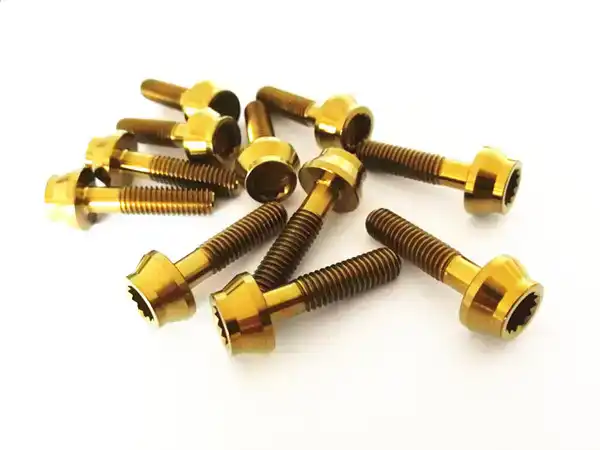
When precision production needs meet the need for lightweight yet extraordinarily robust fasteners, anodized titanium bolts emerge as the optimum answer. More and more industries, from aircraft to high-performance cars, depend on these specialized parts. China, particularly the renowned Baoji Titanium Valley, has established itself as a global leader in titanium production, supplying quality products at cheap pricing. This detailed tutorial walks you through all you need to know about importing these important components from China.
What Anodized Titanium Bolts Are and How They Are Used
What Makes Anodized Titanium Bolts Special
An anodized titanium bolt represents more than just any fastening. The anodization method forms a protective oxide layer on the titanium surface by an electrochemical reaction. Unlike aluminum anodization, which requires dyes, titanium anodization produces brilliant colors naturally by light interference on the oxide layer. Different voltages during anodization make the oxide layer thicker or thinner, which changes the color without hurting the metal.
These fasteners have remarkable performance qualities that set them unique. Ti-6Al-4V, or Titanium Grade 5, is made up of around 90% titanium, 6% aluminum, and 4% vanadium. This mixture forms an alpha-beta alloy with exceptional characteristics. The material weighs 45% less than steel equivalents while preserving higher strength. It doesn't rust as easily as most metals and works well at high temperatures.
Key Industries Driving Demand
Aerospace applications consume nearly 50% of global titanium production. Aircraft manufacturers employ these fasteners into airframes, engine components, and landing gear systems. The Boeing 787 has 15% titanium by weight, while the Airbus A350 incorporates 14% titanium throughout its structure. These numbers show how important the material is in modern aircraft, when every gram counts and reliability is key.
The car industry, especially for high-performance and racing applications, has been quite happy with titanium fasteners. Motorcycle and bicycle makers use these parts to make their bikes and motorcycles lighter without compromising strength. Racing teams recognize that lighter vehicles accelerate faster and handle more responsively. Premium car manufacturers now demand titanium hardware for performance-critical assemblies, realizing the long-term value despite higher initial prices.
Marine applications benefit from titanium's remarkable resistance to seawater corrosion. More and more ship propellers, submarine parts, and offshore platform gear use titanium fasteners. The material's capacity to survive hostile marine environments for decades without deterioration makes it economically advantageous over the product lifecycle.
Why Source from China's Baoji Titanium Valley?
The World's Premier Titanium Manufacturing Hub Baoji Titanium Valley, located in Shaanxi Province, represents China's largest and most complete titanium industry cluster. This location has garnered global reputation as one of the world's most prominent titanium production centers. The valley has hundreds of specialist titanium and titanium-alloy firms, generating an unequaled concentration of production experience and capabilities.
The industrial ecology covers the whole manufacturing chain. Processing raw titanium sponge into ingots changes them into bars, plates, tubes, and forgings. Then, manufacturers make high-performance alloys and parts that are very precise. This vertical integration enables quality control at every stage while retaining competitive price through operational efficiency.
Technical Capabilities and Quality Standards
The companies that make anodized titanium bolts in Baiji work in tough fields like aerospace, marine engineering, petrochemicals, medical implants, and making high-end equipment. They maintain ISO 9001 certifications and progressively participate in worldwide standards development. A lot of sites run national laboratories and research organizations that push the limits of titanium metallurgy and processing technology.
The region's producers offer substantial product diversity. Standard fastener specifications include DIN912, DIN933, DIN934, DIN985, DIN6921, DIN7991, and DIN6923, among others. Custom specs satisfy unusual application requirements. This flexibility, combined with full-process production capability from metallurgy to finishing, puts Baoji manufacturers as total solution providers rather than simply parts suppliers.
Benefits in terms of cost without sacrificing quality
There are a number of reasons why Chinese manufacturers can offer cheap prices. Integrated supply chains minimize logistics costs and lead times. Advanced automation and process optimization boost efficiency without sacrificing precision. Large production volumes spread fixed costs among many units. These benefits mean that prices are usually 20–40% lower than Western options, while still meeting the same quality standards.
Selecting the Right Supplier and Ensuring Quality Evaluating Manufacturer Credentials
Quality anodized titanium bolt providers exhibit verifiable qualifications beyond basic business permits. ISO 9001 certification shows that a company has good quality management systems in place. Long operational histories show that a company is stable and has a lot of experience. References from well-known companies provide clients trust in a company's competence. Manufacturers supplying aerospace or medical sectors face strict assessments, thus their certificates carry substantial weight.
Production capabilities matter as much as certifications. Manufacturers should have all the testing tools they need, such as hardness testers, torque wrenches, and tools for measuring size. Having in-house R&D means you can get help with custom design. Having a lot of raw materials and consistent prices shows that a business is mature. Production facilities using CNC machining give improved precision and consistency compared to manual procedures.
Knowing the specifications for materials
The ASTM B348 standards apply to Titanium Grade 5 (Ti-6Al-4V). This standard outlines chemical composition standards, mechanical qualities, and testing methodologies. Tensile strength often reaches 135 ksi, with yield strength at 120 ksi. The material maintains these qualities at temperatures up to 400°C, making it ideal for demanding applications.
The anodized titanium bolt procedure must meet particular requirements. Oxide layer thickness determines color and corrosion resistance. Type II anodizing provides layers 0.5 to 2.5 micrometers thick, sufficient for most purposes. Sealing correctly keeps pores from getting dirty and makes sure the product lasts a long time. Quality producers document anodization parameters and give process certifications upon request.
Rules for quality control and inspection
Comprehensive quality control begins with raw material examination. Before production starts, reliable manufacturers test incoming titanium rods for their chemical makeup and mechanical qualities. This check makes sure that the materials meet the ASTM B348 Grade 5 standards. Documentation accompanies each material batch, creating total traceability from mill to completed product.
In-process inspections monitor dimensional correctness, thread quality, and surface finish. CNC manufacturing offers tight tolerances, often within ±0.05 mm. Thread rolling gives higher fatigue resistance compared to cut threads. Surface finish impacts both appearance and performance, thus manufacturers employ many inspection locations throughout production. Final inspections verify all standards before packaging.
Minimum Order Quantities and Sampling
Standard anodized titanium bolts often have minimum order quantities around 200 pcs. This MOQ combines production efficiency with customer needs. Custom designs may require higher minimums to justify tooling costs. However, established suppliers frequently allow flexibility for repeat clients or large-volume accounts.
Free samples enable verification before committing to production orders. Samples should be tested in the same way as parts that are about to be made would be. Dimensional verification, hardness testing, and visual examination validate quality criteria. Samples also check that specifications match application needs, minimizing costly mistakes on large orders.
Creating lasting relationships with suppliers
Communication and Technical Support
Effective communication forms the foundation of effective supplier relationships. Technical discussions require precision and clarity. Detailed drawings that show tolerances for size, material specifications, and surface finish needs make everything clear. Manufacturers of anodized titanium bolts want well-thought-out questions that show they know how the product will be used and help them give accurate quotes.
Suppliers with experience offer engineering help during the entire procurement process. They can advise changes to designs that will make them easier to make, find materials that are best for certain uses, and find ways to save money. This way of working together is good for both sides because it makes better products and speeds up production.
Managing Quality Issues and Continuous Improvement
Even outstanding manufacturers occasionally suffer quality concerns. How these circumstances are handled demonstrates actual relationship potential. Responsive suppliers examine problems swiftly, give root cause analysis, and take corrective actions. Instead of seeing feedback as a way to avoid criticism, they see it as a chance to do better.
Regular performance assessments make relationships with suppliers stronger. Discussion of quality indicators, delivery performance, and communication effectiveness keeps expectations aligned. Constructive feedback helps suppliers understand client priorities and change their processes accordingly. This constant communication creates mutual trust and encourages continuous development.
Founded in 2016, Baoji Wisdom Titanium Industry and Trading Co., Ltd. combines ISO 9001-certified manufacturing with extensive customer service. Our skilled research and development team produces solutions that are just right for you. Complete raw material inventory ensures steady prices and reliable lead times. Mature production technology and whole-process quality control guarantee anodized titanium bolt perfection.
We work with businesses all over the world in the aerospace, energy, medical, automotive, motorcycle, and cycling industries. Contact us immediately for precise specifications, competitive estimates, and technical consultancy.
Email: sales@wisdomtitanium.com
FAQs
Q1: What is the minimum number of anodized titanium bolts I should expect to order when I import them from China?
A: For regular anodized titanium bolts, most Chinese manufacturers have a minimum order quantity of about 200 pieces. This MOQ indicates the economic balance between manufacturing setup costs and customer flexibility.
Q2: How long does production and shipment generally take?
A: The time it takes to make something depends on the specifications and the availability of raw materials. It can take anywhere from 7 to 15 days. Custom designs needing special tooling may extend to 3-4 weeks. Shipping duration varies on the chosen method and destination. Air freight delivers in 5-7 days but costs extra per kilogram.
Q3: What kinds of certifications should I ask my vendors for?
A: At minimum, vendors should hold ISO 9001 certification proving established quality management systems. Material test results that show compliance with ASTM B348 Grade 5 are an important part of quality assurance. Chemical composition studies and mechanical property certifications verify that products fulfill criteria. For aerospace applications, AS9100 certification demonstrates aerospace quality system compliance. Suppliers that work in the medical field generally have ISO 13485 accreditation. Ask for certificates of compliance with each shipment that show the products satisfy all the standards.
References
Tuofa CNC Machining. (2024). "Anodized Titanium: Ultimate Guide 2024."
Wikipedia. (2025). "Ti-6Al-4V."
Ulbrich. (2025). "Comparing Grade 9 and Grade 5 Titanium: How to Pick the Right Titanium Alloy."
China Customs HS Code Database. "China Customs HS Code & Tariff for Titanium Products."
Aircraft Materials. "Titanium Alloy Grade 5 / Ti 6Al-4V."