Global procurement managers face a recurring challenge. Finding reliable burnt titanium bolt suppliers who deliver consistent quality at reasonable prices remains frustratingly difficult.
In the last ten years, China's titanium production industry has changed a lot. What used to be a bunch of small workshops making different items has now become advanced industrial clusters. Some of the world's most advanced titanium processing facilities are now in Baiji, Shaanxi Province. These facilities serve the aerospace, medical, and defense industries and meet standards that are on par with those of any other country.
Evaluating Factory Credentials and Capabilities
Geographic Concentration in Baoji Titanium Valley
Baoji Titanium Valley in Shaanxi Province represents China's premier titanium manufacturing cluster. This industrial zone hosts over 600 titanium enterprises forming an integrated ecosystem from raw sponge production through precision component finishing. The geographic concentration creates competitive advantages unavailable to isolated manufacturers scattered across other regions.
Complete supply chain integration eliminates inefficiencies plaguing fragmented production networks. Titanium sponge producers supply nearby ingot manufacturers. Forging operations receive materials from adjacent facilities. CNC machine shops source bar stock within kilometers rather than importing from distant provinces. This proximity compresses lead times, reduces transportation costs, and enables quality traceability impossible with global supply chains.
Shared technical infrastructure accelerates innovation throughout the valley. National titanium research laboratories, university materials science departments, and corporate R&D centers collaborate on advancing processing technologies. Breakthroughs developed for aerospace applications rapidly transfer to commercial products. When improved heat treatment protocols or surface finishing techniques emerge, local manufacturers implement them within months rather than years.
Quality Certifications Beyond Basic ISO Standards
AS9100 certification indicates aerospace industry qualification extending beyond general ISO 9001 requirements. This standard adds aviation-specific controls for design, production, and testing. Factories holding AS9100 credentials demonstrate capabilities meeting aviation authorities' stringent demands—assurance that translates directly to burnt titanium bolt applications even when final products serve non-aerospace sectors.
Medical device certifications like ISO 13485 signal another level of quality system maturity. Biomedical titanium components demand absolute material purity, precise dimensional control, and comprehensive documentation. Manufacturers qualified for medical implant production necessarily maintain protocols exceeding requirements for decorative or structural fasteners. Their conservative engineering margins and rigorous testing benefit all customer segments.
Export certifications to specific markets provide additional validation. CE marking for European distribution, FDA registration for U.S. medical applications, or Lloyd's Register approval for marine components demonstrate successful navigation of complex regulatory frameworks. These certifications require external audits verifying manufacturing processes meet international standards—third-party validation unavailable from factories serving only domestic markets.
Production Capabilities for Burnt Titanium Fasteners
Controlled atmosphere furnace technology determines whether factories produce authentic burnt finishes or inferior imitations. Professional thermal oxidation requires programmable systems maintaining temperature uniformity within ±5°C throughout heating chambers. Temperature variations beyond this tolerance create mottled coloring or inconsistent hues across production batches—quality defects unacceptable for premium applications.
Size Range and Specification Flexibility
Comprehensive size offerings from M3 through M24 indicate mature production capabilities. Smaller burnt titanium bolts demand precision tooling and careful process control—microscopic thread forms require sharp cutting tools and stable machining parameters. Larger bolts need substantial equipment handling heavier bar stock and applying greater cutting forces. Factories spanning this complete range possess both technical expertise and equipment diversity.
Custom specification accommodation separates full-service manufacturers from rigid catalog suppliers. Applications occasionally require non-standard lengths, proprietary thread pitches, or unique head configurations. Facilities with in-house engineering support can optimize designs for manufacturability while meeting performance requirements. This flexibility proves invaluable when standard offerings don't address specific needs.
Color Consistency and Quality Control
Spectrophotometric verification provides objective color measurement beyond subjective visual assessment. Professional manufacturers employ instruments quantifying reflected light wavelengths, establishing numerical specifications for burnt blue finishes. Measurements within ±5 nanometers ensure visual uniformity enabling confident ordering for projects requiring matched appearance across component types.
First article inspection validates new production setups before full runs proceed. Comprehensive measurement of initial completed parts verifies thread pitch, head dimensions, overall length, and drive recess geometry against engineering drawings. Production continues only after first article approval—a quality gate preventing systematic errors from affecting entire batches. Factories skipping this step risk delivering non-conforming products.
Pricing Structures and Minimum Order Quantities
Volume-based pricing tiers reward larger commitments with progressive discounts. Burnt titanium bolt manufacturers typically structure pricing at breaks around 200, 500, 1,000, and 5,000 pieces. Unit costs might decrease 15-25% when ordering moves from minimum quantities to mid-tier volumes. These economies of scale reflect setup cost amortization and material procurement advantages—savings suppliers share with customers placing substantial orders.
Payment Terms and Transaction Security
Professional manufacturers accommodate various payment structures, balancing buyer protection with supplier cash flow requirements. Letter of credit arrangements provide security for large initial orders with unfamiliar suppliers—banks guarantee payment upon conforming document presentation. This financial instrument protects both parties when establishing new business relationships across international borders.
Lead Time Expectations and Rush Services
Standard products from existing inventory ship within 3-7 days of order confirmation. Manufacturers maintaining stock of popular sizes—M5, M6, M8 in burnt blue finish—enable rapid fulfillment for retailers, mechanics, and builders needing immediate availability. Inventory investment distinguishes established suppliers from pure make-to-order operations offering no stock flexibility.
Custom production runs typically require 2-4 weeks, depending on specification complexity. CNC programming, tooling setup, and quality validation consume initial time before actual machining begins. Controlled atmosphere heat treatment for burnt finishes adds several days for careful temperature profiling. Laser etching services introduce additional time for artwork preparation and programming. Understanding realistic timelines prevents unrealistic expectations.
Rush manufacturing services accommodate urgent requirements at premium pricing. Expedited scheduling might compress normal 3-week lead times to 10-14 days by dedicating resources and prioritizing production sequences. Premium charges typically add 20-30% reflecting overtime labor, disrupted scheduling, and opportunity costs. Professional suppliers clearly communicate capabilities and associated costs rather than overpromising unachievable delivery dates.
Spotlight: Baoji Wisdom Titanium Industry and Trading Co., Ltd.
Founded in 2016, Baoji Wisdom Titanium exemplifies the professional approach, distinguishing premium Chinese suppliers from commodity vendors. This ISO 9001-certified manufacturer operates within Baoji Titanium Valley's integrated industrial ecosystem, leveraging proximity to complete supply chains from titanium sponge through precision finishing.
Multi-industry credentials demonstrate manufacturing sophistication beyond basic fastener production. The company serves aerospace, medical, energy, oil and gas, marine, automotive, motorcycle, and bicycle sectors—applications spanning criticality levels from decorative to life-safety. This breadth indicates technical capabilities and quality systems robust enough for demanding requirements.
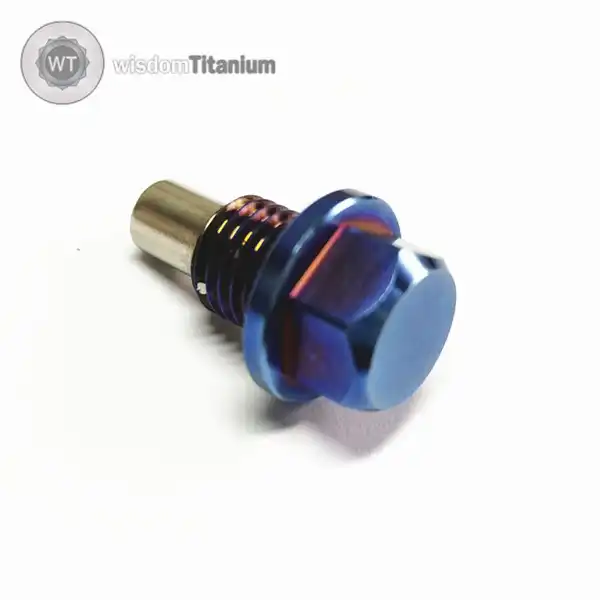
Burnt titanium bolt specifications reflect aerospace-derived engineering standards. Grade 5 titanium construction delivers 950 MPa tensile strength and 870 MPa yield strength with 16% elongation—values exceeding ASTM B348 minimums. Hardness measurements around 36 HRC confirm appropriate heat treatment. Burnt blue surface finishes result from controlled atmosphere oxidation rather than coatings or paints.
For detailed specifications, quotation requests, or technical consultation regarding burnt titanium bolt sourcing requirements, contact the sales team directly. Email inquiries to sales@wisdomtitanium.com with your application details, quantity needs, specification preferences, and delivery timelines. Expect comprehensive responses within 24-48 hours, including pricing across volume breaks, lead time estimates, customization options, and technical recommendations optimizing your specific requirements.
FAQs
Q1: How can I verify a Chinese factory's quality certifications are legitimate?
A: Verify certificate numbers directly with bodies like TUV, SGS, or BV and look for real evidence of active quality systems rather than relying on supplier-provided documents.
Q2: What should minimum order quantities be for custom burnt titanium bolts?
A: Custom burnt titanium bolts typically require a minimum order of about 200 pieces to justify setup and processing costs.
Q3: How do Chinese burnt titanium bolt prices compare to European suppliers?
A: Chinese burnt titanium bolts generally cost 40–60% less than European equivalents while offering comparable Grade 5 material performance.
References
- ASTM International. (2021). ASTM B348 - Standard Specification for Titanium and Titanium Alloy Bars and Billets. West Conshohocken, PA: ASTM International.
- Donachie, M. J. (2000). Titanium: A Technical Guide (2nd ed.). Materials Park, OH: ASM International.
- International Organization for Standardization. (2015). ISO 9001:2015 - Quality Management Systems Requirements. Geneva: ISO.
- Zhang, X., & Zhao, Y. (2012). Development of Titanium Industry in China. Materials Science Forum, 706-709, 194-199.
- Boyer, R., Welsch, G., & Collings, E. W. (1994). Materials Properties Handbook: Titanium Alloys. Materials Park, OH: ASM International.