
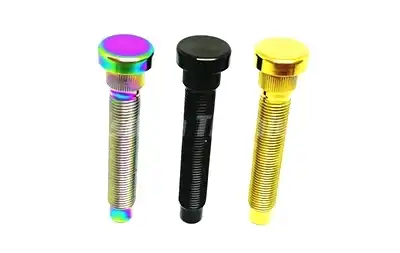
Titanium wheel studs function fine with wheel spacers if the whole system is put together correctly. The studs are constructed of Grade 5 titanium (Ti-6Al-4V), which has around 44% the density of steel and is corrosion resistant, making them ideal for racing teams and performance shops concerned with rotating mass. But weight is only one thing. Whether the arrangement is safe or not depends on the spacer thickness, thread pitch, stud length, thread engagement, lug nut design and torque. I have written this handbook for distributors, workshops and purchasers, who want the facts on fitment, installation, quality checks and bulk ordering.
Understanding Titanium Wheel Studs for Wheel Spacers
What Titanium Wheel Studs Are and How They Work?
There are threaded titanium wheel studs in the hub that hold the wheel, or a spacer and wheel, against the flat surface. Most studs have a shank or shoulder that goes on the hub and threads on the wheel side for the lug nut. A spacer adds depth, so the stud needs to be able to go through it while still giving the nut enough thread to grip. With spacers, a lot of people use longer titanium wheel studs because of this. The threads connect better when you add length to a joint. This helps the joint hold its clamping load when you drive hard, carry big loads, or use it off-road. The hub also has studs that stay in place, which lets the wheel slide into place while the tires are being changed. Wheel bolts are better when nuts are not available.
Benefits of Titanium Wheel Studs in Spacer Setups
It's good that this is light. Steel is about 7.85 g/cm³ dense, while Ti-6Al-4V is about 4.43 g/cm³ dense. One set of studs won't change how fast a car goes around a track, but over the life of a full wheel set, the savings add up. The studs are also placed at the wheel, which is harder to control because of its mass. Titanium also forms a thick oxide layer that stops it from rusting, even when it gets salty, wet, or washed a lot. The right amount of weight and strength is found in Grade 5. It costs more, there is a greater chance of galling, and it needs to be carefully put in place. Titanium is good for making things that are light, but not all cars should use it.
Titanium vs. Steel, Chromoly, and Aluminum
You can do a lot of hard work with steel because it is cheap, easy to find, and you know how to use it. Titanium is lighter than chrome steel because its density is about the same as other steels. Chrome steel is very strong and doesn't break down quickly. It's even lighter than steel (about 2.7 g/cm³), but it's not as strong, so it's not usually used to fasten safety-critical wheels unless an engineer designs and approves it for that use. Grade 5 titanium is stronger than Grade 9 (Ti-3Al-2.5V), but Grade 9 is easier to shape. ASTM B348 says that Grade 5 bar needs to have a tensile strength of at least 895 MPa.
Safety and Fitment for Spacer-Based Wheel Assemblies
Are Titanium Wheel Studs Safe for Wheel Spacers?
They could be, as long as the full load path is planned and checked. They are the hub, stud, spacer, and lug nut. They all let force move from the wheel to the bearing. Thread contact, torque, and friction are things you need to watch out for if you want to keep a bolted joint tight. When the spacer is bigger, the wheel moves farther away, which puts more stress on the wheel bearing. Make sure the stud doesn't touch or move any brake parts behind the hub. It's easier for titanium threads to get stopped than steel threads, so be careful with the pressure and the oil. Before using it for business, racing, or OEM, it's best to have an engineer look over the whole thing and test it.
How to Choose the Right Stud Size and Length?
Begin with the thread. M12x1.5, M14x1.25 and M14x1.5 are used a lot of individuals. The hub, pin and lug nut must be of the same width and pitch. Threads hate changing pitch too fast. Then locate the hub face, the spacer, the wheel seat, and the nut depth. The screw should not have to bottom out or touch the brake parts, for the nut to engage all its threads. Then verify the slope, the side shape, the drive, and the nut seat. If it fits on paper, it may not fit on the car. Before ordering, please compare all measurements to a drawing or real automobile.
Fitment by Vehicle and Spacer Type
It doesn’t matter what brand or size the threads are, they will not fit. The base of a BMW, Porsche, Subaru or Honda may be a different model year, hub shape, wheel seat, brake space or thread pitch. Slip on spacers use the studs that are there so most of the time you just need longer studs to fill the gap. Bolt-on spacers modify the stack again as they have their own studs. Some Porsches do feature center-lock systems that should be considered independently. If a regular part will not work, send a sketch or sample indicating thread size, overall length, shoulder size, tolerances, material and finish. After reading they can utilize your photo to manufacture the part.”
Installation, Maintenance, and Common Problems
Installing Titanium Wheel Studs Step by Step
First clean the wheel seat, hub, spacer, bolts and lug nuts. Dirt and rust might affect the actual forces involved in clamping. First look at the posts. Then place or press each stud in with the correct tool and driving function. Hand start each lug nut to prevent cross threading. Only use the lubrication, anti-seize or thread locker that the automobile or spacer manufacturer tells you to use. Use a calibrated torque wrench and the recommended torque number to tighten in stages and in a star pattern. Don't merely replicate a steel-stud number; friction is different If it's too tight, threads or pieces can break. If it's too loose, the wheel can come free.
Maintenance and Inspection
“It’s easy to take care of, but you have to be careful.” After the initial drive, and each time the wheels are changed, recheck the pressure of the nuts. Be sure to follow the manufacturer’s instructions. Over time, nuts can loosen due to noise and uneven roads. When changing tires or between races, check each stud for defects such as cracks, galling, bent shanks, rust and broken threads. If the marks on the wheel seat are not straight there may be a problem with the clamping. If a bolt is broken, it must be repaired at once. Also see if the wheel nuts fit titanium wheel studs. Normal nuts are not always the proper size or clamp well enough. Make a note of the dates you changed the wheels so you know when to do it again.
Common Problems and How to Avoid Them
Most of the trouble is in the way the parts are put together, and not in the metal. Most of the time people make wrong selections when they only look at weight, mix thread pitches, utilize steel torque figures, run dry threads or buy parts without keeping records of the material or specifications. Bad spacer seats, hubs not centered, too many screws sticking up, things that should be on this list. You can't remedy a badly planned spacer system with a well-made nut. Most difficulties will be avoided by using the correct thread gages, permitted compounds and a defined torque procedure. Your provider can also give you lots of records that can help you figure out what is happening. This way you don't have to take all the pieces out of stock.
Buying Titanium Wheel Studs in Bulk
Wisdom Titanium Product Specifications
Our titanium wheel studs are made from Steel Grade 5 (Ti-6Al-4V). There are thread sizes like M12 x 1.5, M14 x 1.25, M14 x 1.5, and more. The length can also be changed to fit your spacers. You can get it polished, anodized, or with a finish that you choose. Based on ISO 9001:2015, our quality system is good. Our bolts, nuts, and screws are cut with titanium bars, and they are checked over before they are sent out. Our research and development team can make parts based on a sample or idea you give us. We also keep stable-priced standard parts and raw materials on hand.
Manufacturing Base in Baoji Titanium Valley
The Baoji Titanium Valley is in Shaanxi Province. The Baoji Wisdom Titanium Industry and Trading Co., Ltd. has been trading titanium there since 2016. There is a huge and full titanium industry center in this area, which is one of the best places in the world to make titanium. Along with bars, plates, tubes, forgings, and titanium sponge, high-performance titanium alloys are also made. Being close to raw materials makes it easy for buyers to keep getting them. Because we work with people in aerospace, energy, medicine, marine, cars, motorcycles, and bikes, our team has a lot of experience with titanium fasteners and custom CNC parts.
Quality Control and Batch Consistency
When you buy in bulk, it's important that each batch is the same, since one bad lot can cause returns and warranty claims. The pitch, length, shoulder size, and finish of each lot are checked by someone who is good at what they do. For the lot you buy, any seller should be able to give you material certificates and inspection records. Before you place your order, let us know what papers you need. When we make things, we follow the steps in ISO 9001:2015. They are checked at every step and before they are sent out. Before you place a large order, compare samples to your own standards for pull and force. After that, run a small test batch to see what the installers say before you change the settings for the whole volume.
Writing an RFQ and Planning Your Order
Weeks of back and forth are cut down with a clear RFQ. This is what we want buyers to bring:
- Application details: Information about the use: The car, the hub, the wheel, the type of gap, and the thickness of it. Write down the thread size and pitch of the hub and ring nut, as well as the brake package and how the bike will be used, such as for drag racing, sliding, or everyday driving. Because of this, our experts know for sure how long and how wide the stud is.
- Product details: If you want to buy this item, you can pick Grade 5 titanium, the length of the stud, the shoulder or drive style, and the finish, which can be polished, anodized, or a special color. If you have one, please send a drawing or a sample. Please let us know about any marking or packing choices or tolerances you have. This will help us offer the right part the first time.
- Commercial details: Information about the business: Tell them how much you want to try, how much you plan to buy every year, when you want it delivered, and where it will go. Setting production and sending times early is helpful for people who buy race parts because they often need them before spring and fall. Before you start making something, talk about any privacy or channel needs right away so that everyone can agree on them.
A complete request lets us confirm fitment, quote accurately, and plan your order around the race calendar.
Conclusion
When weight savings and resistance to rust are important, titanium wheel studs work well with spacer-based wheel kits. The system as a whole is well thought out. Ti-6Al-4V is about 44% less dense than steel. Even though it's strong, it costs more and dents more easily than steel. To be safe, the full load path needs to have the right thread size and pitch, enough thread contact, the right stud length, parts that are clean, lubricants that are allowed, and force that can be managed. Mistakes made when fitting or putting the alloy together are more likely to cause it to fail than the alloy itself. People who buy in bulk care about more than just the unit price. They also care about consistent batches, clear specs, lot paperwork, and making plans for their order early on.
FAQ
Are titanium wheel studs safe with wheel spacers?
But only if the length of the pin, the torque, the thread contact, and the shape of the spacer are all right for the car. Test the whole system for business or race use.
Which thread sizes do you offer?
We have M12 x 1.5, M14 x 1.25, M14 x 1.5, and other sizes. Let us know what kind of threads you need by sending us a sketch or sample.
Can I order custom lengths and finishes?
Yes, you can change the length and pick a polished, anodized, or one-of-a-kind style.
Can I use steel torque values on titanium studs?
Not at all. Friction is different, so use the force number that works best for your part.
Request Titanium Wheel Studs From Wisdom Titanium
You can get these parts from Wisdom Titanium, which is based in Baoji and is ISO 9001:2015 certified. They use a CNC machine to make titanium wheel studs. Send a picture or sample to sales@wisdomtitanium.com along with how many spacers you need, their thickness, thread size, stud length, finish, and how many you need. After that, our team will look it over. Our titanium wheel studs can be seen at wisdomtitanium.com, where you can also get a price right away.
References
- ASTM B348/B348M, Standard Specification for Titanium and Titanium Alloy Bars and Billets, ASTM International, 2019
- Introduction to the Design and Behavior of Bolted Joints, 4th Edition, CRC Press, 2007
- Titanium: A Technical Guide, 2nd Edition, ASM International, 2000
- Titanium and Titanium Alloys: Fundamentals and Applications, Wiley-VCH, 2003
- Materials Properties Handbook: Titanium Alloys, ASM International, 1994
- ISO 9001:2015, Quality Management Systems – Requirements, International Organization for Standardization, 2015