
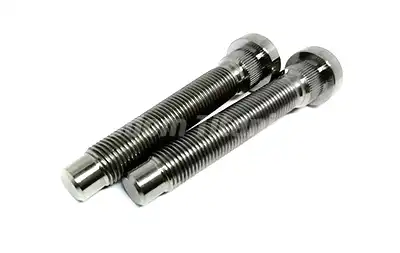
Titanium wheel studs and lug nuts are compatible when five details match: thread diameter and pitch, stud length, lug nut seat shape, hub fit, and wheel or brake clearance. A size label such as M12 or M14 does not prove a fit. I treat titanium wheel studs and lug nuts as one fastening system, then check it against the vehicle, the wheel, and the torque specification. This guide covers fitment, safety, installation, and buying steps for distributors, race shops, workshops, and OEM buyers in the United States. It also shows how Wisdom Titanium supports standard and custom orders.
Titanium Wheel Stud and Lug Nut Compatibility Fundamentals
How Titanium Wheel Studs and Lug Nuts Work as One System?
You can push or screw a titanium wheel stud into the hub of the wheel. It is a piece that is fixed together. The lug nut goes there and holds the wheel against the hub face. The preload holds the wheel in place like a clamp. This can only be done if both parts have the same thread, seat, and shape. But not all studs can be used with titanium. It's good for racing, track cars, high-performance road cars, and builds that need to be light. The metal isn't heavy and doesn't rust, but it needs to be treated carefully when it comes to rubbing, changing pressure, galling, and touching other metals. When people buy something, I tell them that safety isn't just about the material; it's also about the engineered system, how it's put together, and the written instructions.
The Five Dimensions of Titanium Wheel Stud Fitment
There are five checks to make sure it fits right. Let's start by talking about the width and pitch of the thread. The diameters of M12 x 1.5 and M12 x 1.25 are the same, but they won't fit together. Second, the titanium wheel studs need to be long enough to go over the hub, wheel, any spacers, and a full nut without going below the hole. Third, the lug nut seat's shape. Fourth, how the hub is connected to the shoulder and stud. Fifth, there should be room around the wheel pockets, spokes, brake calipers, and rotor hats. Check that each measurement matches the models, and then fit one corner to make sure it's perfect before ordering the whole amount. Send us a hub drawing or a sample of the titanium wheel studs you want so we can make sure of the length and shoulder before they are made.
How to Match Titanium Wheel Studs With Compatible Lug Nuts?
The stated size is just the start. It's important to check the thread form, tolerance, nut depth, and wheel seat. You should only use a cylindrical nut instead of a sphere or flat-seat nut if the person who made the wheel tells you it's okay. The nuts with the open ends work best with thick spacers and long titanium wheel studs. But the closed-end nuts need enough space inside to keep the stud from going all the way to the bottom. Titanium wheel studs are sometimes paired with nuts made of steel or aluminum. In this case, you should look at the hardness, galling resistance, and repair time all over again. Our titanium wheel studs are Grade 5 (Ti-6Al-4V) and come in different sizes, like M12 x 1.5, M14 x 1.25, and M14 x 1.5.
Material, Safety, and Installation of Titanium Wheel Studs
Titanium Wheel Studs vs. Steel, Chromoly, and Aluminum Alternatives
Ti-6Al-4V is made up of about 6% aluminum and 4% vanadium. Steel is about 7.85 g/cm³ dense, while this is about 4.43 g/cm³. In other words, it's about 44% less dense. ASTM B348 says that Grade 5 bar that has been annealed must have a tensile strength of at least 895 MPa. Titanium can also make an oxide layer that keeps it safe and stops it from rusting. Steel is still used a lot for low-cost and OEM items since it is stiff and easy to find. Chromoly can make you very strong and keep you from getting tired when you're working with heavy things. Due to its lighter weight, aluminum is not as strong as steel. It also cannot handle heat or thread wear as well. Before you choose an alloy, you should look at the data. For example, Grade 9 titanium is not as strong as Grade 5.
Are Titanium Wheel Studs Safe for Street, Track, and Motorsport Use?
They might be if the style, material, size, and way they are put together are all right for the job. There is a lot of stress on titanium wheel studs because the race wheels are changed so often. They have to deal with preload, shear, bending, wear and tear, shaking, and heat. Before driving on the street, check to see if the car fits right and what the rules are in your area. Track users should look at how thick the spacers are, how hot the brakes are, how easy it is to check them, and how often they need to be replaced. There is a difference between heat-resistant and being able to handle any temperature. Throw out any titanium wheel studs that are loose, broken, misshapen, rusty, or move when the wheel does. You should check these parts every time you change the wheels because they keep the wheels together.
Installation, Torque, and Anti-Seize Guidance
Check the specs, clean the hub threads, and look over every part before you do anything else. Make sure that each titanium wheel stud is set to the right depth, the shoulder is in place, and there is enough stop space before putting the wheel on. When you add titanium wheel studs, you need a different amount of torque than when you use lug nuts. Also, steel numbers should not be copied without permission. Some writings, like Bickford's, about bolted joints show that the lubricant, coating, and thread condition can change the torque-to-preload relationship. Use a measured torque wrench instead of an impact wrench and a small amount of approved oil for the last tightening. This will protect the hub. Be careful when you take off parts as well.
Compatibility by Vehicle, Wheel, and Verification
Compatibility by Vehicle, Wheel, and Application
That's true for all cars, whether they're Porsche, BMW, Subaru, race car, track car, or motorcycle. No matter what brand or thread size it is, not every model year or platform will work. Check the hub thread pitch, the wheel seat shape, the wheel's width, the use of spacers, the depth of installation, the brake clearance, and the nuts' size. You need to be extra careful when riding a motorbike because the hubs and load lines are not always the same as they are in cars. It's safer to buy and install wheels when there are technical drawings, data about the vehicle, wheel part numbers, spacer details, and a sample fit of titanium wheel studs. Your sales team will be able to give you the right price if you make a reference table with the car, thread, length, and seat type.
Compatibility Verification Checklist Before Installation
This is the list I give to shops and dealers before I ship or put parts in.
- Fitment data: Make sure you know the car's make and model, the shoulder measurements, the hub threads' length and pitch, the wheel and spacers' thickness, the type of seat, the brake clearance, and the closed-end nut depth. Write down each number so that the buyer or expert doesn't have to guess when they do the check again later.
- Material and performance data: Read over the titanium grade, mechanical data, temperature needs, lubricant compatibility, and torque instructions. Keep the paper copy with the order. Ask the manufacturer to write down the maximum number of times it can be used. Then, share this information with shops that come after you so that all of the installers follow the same rules.
- Supplier documentation: When you buy something for your business or an OEM, make sure you know who the seller is, how to keep track of batches, check for dimensions, accept samples, understand the warranty terms, and get in touch with technical support. A customer or an insurance company might ask how much was made and checked. In that case, these papers are important. Request them before you place your first order.
When deciding if something fits, a structured checklist makes sure that the choice is based on facts, not guesses.
Common Compatibility Mistakes and How to Avoid Them
Choose titanium wheel studs based on diameter alone, use the wrong nut seat, use steel torque values, mix materials that don't work well together, buy without checking for spacer or brake clearance, and pick titanium wheel studs based on diameter alone. M12 or M14 doesn't tell you anything about the pitch, length, shoulder shape, or hub size. You can't change seats from circular to conical. If you choose the wrong seat, the nut might not have enough room to touch the bolt and rattle free. Things like force and pressure can also change when they are oiled. It's simple to fix. Hand-check the completed part, double-check all the measurements, and make sure you follow the torque and anti-seize instructions. Also, rate providers based on their quality systems, papers, ability to be tracked, and expert support.
Buying Titanium Wheel Studs in Volume
How to Choose and Buy Titanium Wheel Studs?
First, explain what it will be used for: performance driving on the street, track days, professional racing, making prototypes, selling them, or making them for OEMs. Then make a list of requirements, such as the type of titanium, its mechanical qualities, thread tolerance, titanium wheel stud length, shoulder geometry, surface treatment, temperature limits, inspection records, traceability, packing, wait time, and the smallest amount that can be bought. That being said, don't just look at the unit price; things like licensing, special machining, testing, and new supplies can change the value in the long run. Most of the time, standard kits work fine, but custom titanium wheel studs work better for race hubs, wheels of odd sizes, or OEM integration. It's not always as important to distributors that the price per unit is the same across thousands of pieces.
Working With a Titanium Wheel Stud Manufacturer or Supplier
It's important to get clear specs, material certificates, dimensional inspection, thread tolerance data, batch tracking, advice on torque and lubrication, and limits on what the titanium wheel studs can be used for from a company that sells them. This is how custom work usually goes: data on the vehicle and part, a look at the drawings, picking a material, making a sample, checking to see if it fits right, testing, and getting approval from a pilot. People who work as distributors should also look at the packaging, private label options, mixed-size sales, delivery times, and replacement help. Fitting mistakes can be avoided by having detailed talks early on. If your racing needs change with the seasons, you should set your production and ocean freight schedules 60 to 90 days ahead of time.
Final Recommendations for Selecting a Compatible Titanium Wheel Stud System
For people who use the street, the most important things are best fit, no rust, right nut seating, and easy service. Car and track users should think about how the titanium wheel studs will wear out, how hot they will be, how easy they are to check, and if there are written instructions for how to replace them. Stores can keep their stock up to date by standardizing product data by car, thread, length, seat type, and application. Drawings from engineers, load requirements, testing the prototype, and getting approval for controlled production should be the first steps in both OEM and custom projects. Titanium wheel studs and lug nuts are only safe to use when they are the right size, made of the right material, fit properly, and come from a reputable company. This is the rule that all four groups must follow.
Wisdom Titanium Product Specifications and Manufacturing Base
Product Specifications for Titanium Wheel Studs
Here are the core specifications of our studs.
| Item | Specification |
|---|---|
| Material | Grade 5 Titanium Alloy (Ti-6Al-4V) |
| Thread Size | M12 x 1.5, M14 x 1.25, M14 x 1.5, etc. |
| Length | Customizable |
| Finish | Polished, Anodized, or Custom |
| Certification | ISO 9001:2015 |
When the titanium wheel studs are longer, they connect with the hub thread. This keeps the wheel stable when it's moving quickly or heavy. We also make titanium bolts and lug nuts, so you can get parts from the same company that work with each other. Make sure the nut will thread and fit against your wheel before you order.
Baoji Titanium Valley: Where We Make Titanium Fasteners
Wisdom Titanium makes and sell standard and custom CNC parts. Baoji Titanium Valley is one of the most important places in the world to make titanium. It is in Shaanxi Province, where we work. It is the largest and most complete titanium industry hub in China. As part of the local industry chain are titanium flakes, bars, plates, tubes, forgings, and high-performance titanium alloys. For this chain, we keep spare parts and raw materials on hand at fixed prices. Industries like aerospace, energy, oil and gas, medicine, marine, cars, motorcycles, and bikes buy from us.
Documentation and Batch Control for Distributors
Papers are just as important as measurements because distributors are in charge of the goods they sell. Our titanium wheel studs and lug nuts are made from titanium bars, and they are checked over before they are sent out. The way we do things is in line with ISO 9001. Our R&D team makes parts from samples, drawings, or ideas you give them. Before the work starts, we will go over the records you need with you. Like, you could give us test results, material certificates, or details on how to keep track of one batch of goods. We're also happy to talk about NDAs and keeping the channel safe. In the beginning, many buyers order a small sample. After that, they place a trial order and every three months, they order more.
Conclusion
The thread diameter and pitch, titanium wheel stud length, nut seat, hub interface, and clearance must all be the same for titanium wheel studs and lug nuts to function properly. This is because signs for sizes like M12 and M14 leave out important details. Grade 5 titanium is less dense than steel, but it can be stretched very easily and doesn't rust. But steel, chromoly, and aluminum are not all the same in terms of how strong they are. For safety on the street, the track, and in motorsports, it's important to install things correctly, keep the torque under control, lubricate things carefully to avoid galling, and check them often. When checks are done on each vehicle and a written plan is used, it's not likely that wrong seats or copied steel torque values will happen. Buyers of lots care just as much about batch consistency, documentation, and being able to track the goods.
FAQ
These answers are general guidance. Confirm torque and fitment with the vehicle, wheel, or fastener maker.
Can I pair titanium wheel studs with steel lug nuts?
Yes, most of the time, as long as the wheel maker agrees that the thread, seat, and hardness are right for the job. Go over the service interval and galling resistance one more time.
How do I reduce galling on titanium threads?
Keep the threads clean and use only a small amount of an approved oil to tighten. Use a torque wrench that can measure torque. Don't use pressure tools for the last set of screws.
Does M12 or M14 tell me whether a titanium wheel stud fits?
No, it only tells you how big it is. One at a time, look at the pitch, length, shoulder shape, and hub fit. For example, compare M14 x 1.25 and M14 x 1.5.
What information do you need for custom titanium wheel studs?
Send the car's make, model, and year, as well as the hub thread, the length you need, the gauge of the wheels and spacers, the number of pieces, the nut seat, and any sketches you have.
Request a Titanium Wheel Stud Compatibility Review from Wisdom Titanium
Wisdom Titanium is an ISO 9001:2015 titanium wheel studs manufacturer in Baoji, offering Grade 5 (Ti-6Al-4V) studs in M12 x 1.5, M14 x 1.25, and M14 x 1.5. You can also get them in custom lengths and finishes, such as polished, anodized, or your own design. Feel free to email sales@wisdomtitanium.com with details about your car, drawings, and the number of parts you need. We will help you make sure they fit. At wisdomtitanium.com, you can find out more.
References
- Titanium and Titanium Alloys: Fundamentals and Applications, Wiley-VCH, 2003
- Titanium: A Technical Guide, 2nd Edition, ASM International, 2000
- Materials Properties Handbook: Titanium Alloys, ASM International, 1994
- An Introduction to the Design and Behavior of Bolted Joints, CRC Press, 1995
- Titanium (Lütjering and Williams), Springer, 2007
- ISO 9001:2015 Quality Management Systems — Requirements, International Organization for Standardization, 2015