
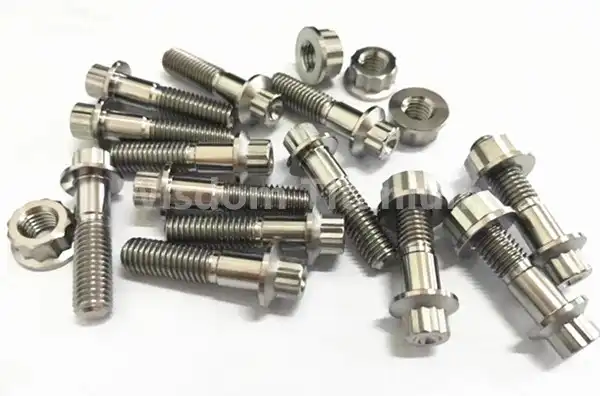
Titanium wheel bolts thread directly into the hub. Studs stay in the hub and take lug nuts. Titanium lug nuts fit vehicles that already have studs. The right choice depends on how the vehicle was designed. A road car built for bolts needs a bolt-style titanium wheel fastener, while a track car with frequent wheel changes often works better with studs and lug nuts. In every case, thread pitch, seat shape, length, and clamp load matter as much as the metal. Below, I compare the three options and show buyers how to specify and source them.
Titanium Wheel Bolts, Studs, and Lug Nuts: What Is the Difference?
How Each Configuration Works?
The thread on a wheel bolt is on the hub because it goes through the wheel and into the hub. In the hub, a stud stays in place. A lug nut holds the wheel in place while it slides over it. Since a lug nut is just the part that fits, it can only be used with screws that are the same size. European sports cars and passenger cars often use bolts.
| Option | Where the thread sits | Typical use |
|---|---|---|
| Wheel bolt | In the hub | Road cars built for bolts |
| Stud + lug nut | Stud in hub, nut on wheel side | Track cars, frequent wheel changes |
| Lug nut only | On existing studs | Cars with compatible studs |
Thread, Seat, and Fit Details
The thread's size by itself never makes a match. The thread sizes on most wheels are M12 x 1.5 or M14 x 1.5, but the hub must also agree on the pitch, length, and contact depth. The point where the bolt and the wheel touch is the seat. Cone, sphere, flat, and washered are some of the shapes. The clamp load might come away if it's not the right form. The bolt hole in the wheel must also be able to fit the shape of the head or nut. As soon as someone buys something, I always ask for a drawing. This way, I don't have to guess what it is called. Retailers don't have to deal with returns this way, and end users are safe.
Where Each Type Fits?
Switching from bolts to studs changes how the hub is set up. Bolts work with cars that were made to accept them. Studs with lug nuts can help if your team takes wheels off a lot. While you thread the first nut, the studs hold the wheel in place. With titanium lug nuts, it's easy to make a car that already has studs look better. There are also bigger sizes. Our Titanium Rear Wheel Nut M48 is a rear wheel bolt that has an M48 thread for when you need a bigger size. Before you buy a conversion, you should always check that it follows the rules of the race and the rules from the manufacturer.
Titanium Wheel Fastener Materials, Strength, and Weight
Grade 5 and Grade 2 Titanium
One more name for grade 5 titanium is Ti-6Al-4V. This is a metal that is very easy to separate (895 MPa). Structural and performance parts are made of it because it is strong, doesn't rust, and has a low density. If you need to use titanium for business, grade 2 is fine enough. Its tensile strength is about 345 MPa. It doesn't rust easily, which is good for chemical processing. However, it's not very strong, so it shouldn't be used for wheel joints that are going to be loaded with heavy things. I always tell people who buy wheel hardware that it should be Grade 5 unless an engineer writes and agrees to a different grade. Always ask for a graded copy of the work.
Titanium Compared with Steel and Aluminum
Steel is about 7.85 g/cm³ dense, while titanium is about 4.4 g/cm³ dense. Because of that gap, the weight is saved. Titanium also doesn't rust, and unlike aluminum, it doesn't damage carbon fiber. Even though Ti-6Al-4V is stiffer than steel (about 114 GPa vs. 200 GPa), steel is still stiffer. It also costs less to use steel. Strength needs care too. According to ISO 898-1, Grade 5 titanium is similar to Grade 8.8 to 10.9 steel. This means that Grade 12.9 steel, which can hit 1200 MPa, can't be used instead of it. And even though aluminum is lighter, engineers need to take a close look at how the wheels are attached.
Benefits and Limits
When used correctly, a titanium wheel fastener lowers the amount of mass that isn't being sprung or turned. To keep it strong, road salt and water don't damage it. People who race, ride motorcycles, go fast, and use the track see the most gain. It doesn't save much to save one nut, so I tell people to look at the whole set of tools. You can only do so much. It costs more, isn't as stiff as high-strength steel, and can hurt when it's tightened. A weaker metal can also get galvanic corrosion from it, so keep them from touching. Every item should be seen as a tried-and-true technical part, not as a replacement for all OEM pieces.
Titanium Wheel Bolts vs. Studs and Lug Nuts: Performance Comparison
Clamp Load and Torque
It's called clamp load when you squeeze the wheel against the hub. It makes the wheel work less well. It's more important to get the load right than what kind of fastener is used. Nuts, bolts, and studs all hold things together. Your threads, the amount of oil you use, the torque value, the seat's shape, and the surface finish can all change how much clamp load a torque makes. In his book on bolted joints, John Bickford says that friction at the threads and under the head takes up most of the force needed to tighten the joint. That's why the torque numbers for parts that are dry and parts that are oily are different. So, I tell my clients to check that a torque value is correct for threads that are dry, oiled, or treated.
Wheel Changes and Hub Wear
When the wheels are off a lot, studs look great. They hold the wheel in place while you tighten the first nut. You won't have to lift the wheel to line it up this way. The nuts take most of the damage to the hub threads. Every time you change wheels that use bolts, you have to put a bolt into the hub. When you cross-thread, you can hurt the hub. But this is often how parts of cars that use bolts are put together. Before I suggest either system, I check to see how often it needs to be fixed. A shop that changes tires twice a year doesn't need to switch to studs.
Decision Guide for Road and Motorsport Use
You can match the seat, length, contact, and pressure of the bolts that came with the car when it was made. Pick studs and lug nuts if you change wheels a lot, as long as the conversion fits the hub, gives the wheel enough room, and doesn't break any racing rules. Titanium lug nuts are best when the right studs are already in place and the thread and seat match. If you want the lowest price, OEM approval, the stiffest material possible, or the most weight, titanium might not be the best choice. The technical rules should also be read by racing users to find out what needs to be checked and when things need to be replaced. The supplier's paperwork and performance tests should be used to make the final choice.
How to Choose and Install a Titanium Wheel Fastener?
Build a Complete Specification
Start with the car: what it is, what it will be used for, the make, model, year, hub type, and wheel shape. Next, look at the thread's pitch, width, length, contact depth, and space. Type of seat and shape of the head or nut should be added. Pick the correct kind of titanium for the job. Before you buy, make sure you have the material certificates, mechanical test results, dimensional inspection records, batch tracking, and torque instructions for the job. It's always better to have a clear scientific picture than a rough idea of the size. Keep a one-page spec sheet with a picture and the size of each item for sellers who work with workshops. That way, the customer can see if it fits without having to read a lot of emails.
Installation Steps and Galling Control
First, clean the hub, the wheel seat, and the threads. First, clean off the rust, paint, brake dust, and other junk. Then, check the threads. The oxide layer on titanium makes threads that fit together rub against each other very hard. This can cause galling or cold welding. For less risk, pros use molybdenum disulfide paste or copper anti-seize. Some buyers also ask for TiN or DLC coats. Make sure you know if the torque number you're given is for dry threads or oiled threads. First, you should tighten each bolt by hand. Then, you can use a calibrated torque wrench to finish. After that, make sure there is full contact, the right wheel fitting, enough pin protrusion, and no binding. It should only be installed by a professional for jobs that are very important for safety or motorsport.
Cleaning, Inspection, and Replacement
To get rid of brake dust, road salt, and grease, use a mild car cleaner and a soft brush. After that, dry the parts. Look for wear that doesn't seem right in the nuts, seats, threads, and heads, as well as galling, cracks, bending, rust, and galling. It's easy to see damage on a smooth surface. Get a new piece and throw away any that are broken or whose history you don't know. Set how often to replace them based on how often you change the wheels, the manufacturer's instructions, and whether you drive on or off-road. This is important because fleets and race teams use written records to keep track of things and plan maintenance.
Buying Titanium Wheel Fasteners for B2B Programs
Writing a Clear RFQ
This is a good RFQ: it lists the type of fastener, the grade of titanium, the thread size and pitch, the measurements, the seat type, the head or nut shape, the surface finish, the amount of metal needed, how it should be packed, and whether a certificate is needed. People who trade often need a mix of sizes in one order, so I write down how many of each size they need and ask early on about minimums. It's important to know how models are approved, how much it costs to make tools for custom forms, how long it takes to make something, where the goods will be inspected, how much they will cost all together when they get there. When you send something to a customer, it needs to be packed cleanly. At customs, packing lists and certificates of origin are also important. In case your clients don't want to talk to you, get an NDA before you show them the drawings.
Quality Checks and Documents to Request
Good checks protect your name when you sell. These are the things I think you should ask for:
• Positive material identification by XRF, which confirms aluminum and vanadium levels for Grade 5.
• Tensile and proof-load testing against the roughly 895 MPa requirement.
• Go/No-Go thread gauges, often in 6g/6H tolerance classes.
• Metallographic checks for brittle alpha-case.
• Dye penetrant inspection for hidden surface cracks.
Before the list is made, make sure everyone agrees on what goes on it. Ask to see proof that they are ISO 9001 compliant, find out what products they use, and be able to keep track of each batch. When parts are polished, they should always look the same. Ask the supplier how they make sure the finish is the same.
Choosing a Dependable Titanium Wheel Fastener Manufacturer
Both the production and the help from suppliers should be checked. As the plant how it makes its threads, whether it rolls them up or cuts them, and how it keeps them from getting hard. Its main office is in Shaanxi Province's Baoji Titanium Valley. In China, this is the biggest and most full titanium industry center. It is also one of the most important places in the world to make titanium. Along with bars, plates, tubes, forgings, and titanium sponge, high-performance titanium wheel fasteners are also made. Wisdom Titanium has been in business since 2016 and is ISO 9001 approved. They make and sell typical and unique CNC parts. Our wheel bolts are made of titanium alloy, which is light and strong. You can get them in any size you need, and the finish is smooth. Steel bars are used to make them, and they are checked before they are sent out.
Conclusion
There are several uses for steel wheel bolts, studs, and lug nuts. Bolts work with cars that are made to fit them. Studs and lug nuts keep wheels on when they come off a lot. Titanium lug nuts make cars better when they have the right studs. It doesn't rust and has a low density of about 895 MPa. However, it's not as stiff as steel and can't be used instead of Grade 12.9 steel. Performance depends on more than just the metal. The clamp load, the correct torque, the seat match, and the anti-galling lubricant are also very important. Titanium wheel fastener options also need to meet these requirements. When you clean and check things, you often find wear and tear early. There is less risk for buyers when they have a full drawing, a clear RFQ, material certificates, and clear quality checks. This helps them find the right product for the job.
FAQ
Is titanium stronger than steel?
Not all the time. It's about the same as Grade 8.8 to 10.9 steel in terms of MPa, but not as high as Grade 12.9 steel, which hits about 1200 MPa. Titanium is better than steel because it is lighter and doesn't rust.
What is the difference between Grade 2 and Grade 5?
Grade 2 titanium is clean enough for business use and is close to 345 MPa. It does a good job of keeping rust away. Grade 5 is Ti-6Al-4V, which is close to 895 MPa and good for building parts.
How do I prevent galling?
Use molybdenum disulfide paste or copper anti-seize to keep the threads clean. Also, make sure you use the right amount of force. There are also people who want coats made of TiN or DLC.
Does titanium work with carbon fiber parts?
Titanium doesn't corrode when it comes in contact with carbon composites like aluminum does, but it does work with them chemically.
What do I send for a quotation?
Send pictures or samples of the thread and seat, along with the grade, the amount, the certificates you need, the package you need, and a note telling them when you need them by.
Request a Titanium Wheel Fastener Quote from Wisdom Titanium
Wisdom Titanium is an ISO 9001-certified business that makes titanium wheel fasteners. They sell polished titanium alloy parts that are strong, light, and can be made in any size. Email your list of different sizes, drawings, and quantities to sales@wisdomtitanium.com. The people on our team will get back to you about fit, samples, and wait time. Ask about an NDA if you need one. Visit wisdomtitanium.com to find out more.
References
- Introduction to the Design and Behavior of Bolted Joints, CRC Press (John H. Bickford), 2007
- Titanium: A Technical Guide, ASM International (Matthew J. Donachie Jr.), 2000
- Materials Properties Handbook: Titanium Alloys, ASM International (Boyer, Welsch, Collings), 1994
- Titanium and Titanium Alloys: Fundamentals and Applications, Wiley-VCH (Leyens and Peters), 2003
- ISO 898-1, Mechanical Properties of Fasteners Made of Carbon Steel and Alloy Steel, ISO, 2013
- ASTM B348/B348M, Standard Specification for Titanium and Titanium Alloy Bars and Billets, ASTM International, 2019