
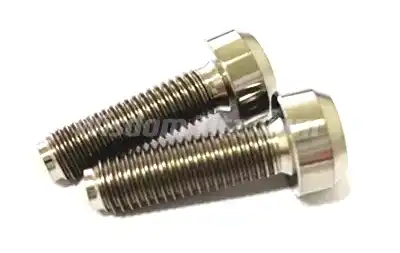
Titanium wheel bolts for wheel spacers are longer Grade 5 fasteners that clamp a wheel and spacer to the hub while cutting weight and resisting rust. A titanium wheel bolt must match the thread, seat type, and length of the spacer setup, because the spacer adds thickness the bolt has to cross. I work with brand owners and engineers who need this fit to be right the first time. This guide covers selection, installation, risks, and sourcing, using our Ti-6Al-4V bolt with 900–1050 MPa tensile strength as a working example.
Why Titanium Wheel Bolts Work with Wheel Spacers?
How a Spacer Changes the Bolt Requirement?
The titanium wheel bolt has to go through the wheel and the spacer before it can reach the hub. This is because the spacer makes the wheel move away from the hub. The bolt needs to be longer because it is thicker. Length doesn't fix the fit by itself, though. I check four things at the same time: the shape of the seat, its tensile strength, how well the threads engage in the hub, and the space behind the hub face. Things get worse when a bolt that is too long hits a brake part. Most bolt-on spacers come with their own studs and nuts, while most slip-on spacers use longer lug bolts. That is why you should start by thinking about the type of system.
Standard, Extended, and Spacer-Specific Bolts
The standard bolts are the same diameter as the wheel that came with it. Bolts that can reach further can make the shanks of slip-on spacers longer. Bolts that are made to fit a certain kind of spacer have a set length and seat. There is no bolt in a stud-and-lug-nut method. A stud is pressed into the hub instead, and a nut is on the outside. Each way has its own pros and cons. With longer bolts, you can keep the look of the factory wheels and not have to change the hubs. Stud systems, on the other hand, help you change wheels more quickly at the track. Seats must match the wheel no matter what path you take. Seats can be cone-shaped, ball-shaped, or flat. It will not clamp evenly if it doesn't.
Who Buys Titanium Wheel Bolts for Spacers?
Mostly, a few types of people buy from me: racing teams that want smaller unsprung mass, wheel brands that sell bolts as a set, dealers who stock for tuning shops, and engineering departments that are writing new rules. People in Europe who buy expensive cars also want wheels that don't rust and look clean. In Italy and the UK, brand owners often want their own labels and packaging to be on the set. So that no one makes a mistake when converting, I think that US shops should show sizes in both millimeters and inches and torque in both lb-ft and N·m.
Titanium Wheel Bolts vs. Steel and Aluminum Alternatives
Weight and Strength Compared
Steel is about 7.85 g/cm³ dense, while Ti-6Al-4V is about 4.43 g/cm³ dense. That makes titanium about 44% lighter in the same space. Between 900 and 1050 MPa, or 130,000 and 152,000 psi, is how strong our Grade 5 titanium wheel bolts are when pulled apart. That range is about the same as steel with property class 10.9, which according to ISO 898-1 must be at least 1,040 MPa. Aluminum, on the other hand, is even lighter at 2.7 g/cm³, and popular metals like 7075-T6 can only stretch about 570 MPa. In heavy spacer systems, I don't think metal should be used unless it's built to work with it. Steel is still the standard for most road cars because it is easy to get.
Corrosion, Galling, and Fatigue
Titanium doesn't get red rust from road salt or brake dust because it forms a steady oxide film. In places like the coast or the snow belt, that means bolts can't be taken off after years. This is a real worry for people in the US who drive on winter roads that have been iced. Titanium has one flaw: steel threads can get stuck in it if it is put together too quickly or when it is dry. Instead of an impact gun, you could use a measured torque wrench and make sure the threads are clean. This will lower the risk. The grain flow follows the thread profile instead of being cut across, which also makes rolled threads last longer.
Cost, Availability, and Titanium Lug Nuts
That is why I don't use titanium as a default. It costs more to buy and work with than steel. I use it for speed, display, or high-end names instead. You can buy steel bolts in your area that work on almost all cars. Titanium lug nuts and bolts can be used with both bolt-through and stud-based wheels. You can't pick one over the other. Before you buy, you should think about how much it will cost all together, how often it has been serviced, and whether the maker will let you make the change. A high-end brand can charge more for a titanium set as long as the box, finish, and marks are all in the right price range.
How to Choose the Correct Titanium Wheel Bolts and Read the Specs?
Fitment Checklist Before You Order
Make sure you start with the whole setup instead of looking for the model and make. Check the brake clearance, the wheel width, the hub thread, the original bolt size, and the year of the car. It's important to check both the thread size and pitch, like M12 or M14, because the specs can change from model to model and year to year. To get the length, add the spacer's width to the wheel's attachment depth. Next, look at the real parts to see how the threads touch and overlap. Last, make sure that the bearing lip, hub bore, and wheel bore are all in good shape. This will keep the whole thing in place. I always tell people to try out a titanium wheel bolt sample on a real wheel and spacer before buying a lot of it.
What Grade 5 Titanium Delivers?
It's known as Grade 5 Ti-6Al-4V and is used to make parts for cars, ships, and medical equipment. Titanium bars, like the ones in ASTM B348, are used to make many kinds of fasteners. But the grade of the material doesn't tell you everything you need to know about a bolt's quality. How it was made, the heat treatment, the shape of the threads, the surface treatment, and the inspection all change the final part. When it comes to wear, rolled threads last longer than cut threads because they keep the grain flow steady. This is because the head is hot-forged. While getting prices, make sure to ask for test papers and records of inspections. This way, the range of tensile strength will be put down instead of being guessed.
Our Gr5 Bolt Specification
When I write core specifications, this is what I use as a guide for spacer programs:
- Material and strength: This is Titanium Gr5 (Ti-6Al-4V), and its strength ranges from 900 to 1050 MPa, or 130,000 to 152,000 psi. Grade 5 can hold the clamping load on a wheel through many changes and heat cycles. Also, road salt and brake dust don't rust it, so bolts stay clean and easy to remove even after years of use.
- Build method: hot-forged head with rolled threads. Instead of being cut, the threads are formed when the head is forged, which also aligns the grain flow. It doesn't just machine a part; it also forges and rolls it. This is important when talking about process quality at a trade show or on a product page.
- Finish and order terms: The finish is PVD gold, the size is M7×24.5, and you need to order at least 200 pieces. Because we need a master sample that has been approved, we can compare each batch to the same gold tone. Brand owners like it when all the bolts in a set match. This is because a finished wheel will show a bolt that doesn't match.
They help you choose who is fit. Check the thread size, seat shape, and length of your own wheel before you buy.
Installation, Torque, and Common Risks of Titanium Wheel Bolts
Step-by-Step Installation
The best way to add wheel hardware is to have a professional do it. This order seems good to me. Each titanium wheel bolt, hub face, spacer, and wheel seat should be checked for damage. It is important to clean every thread and connecting surface. Put the wheel on and make sure that the spacer is flat on the hub. Then, start each bolt by hand so that they don't cross-thread. A calibrated torque wrench should be used to tighten in several diagonal passes. Always use a hand tool for the last pass. Then turn the wheel around to make sure it fits straight and look at the space around the caliper. Write down the date and torque value so that the next service can use them as a guide.
Torque Values Cannot Be Copied
Titanium wheel bolts don't always need as much torque as steel bolts. The torque is different for each width, thread pitch, coating, lubricant, and surface condition. If the surface is dry or oily, the same number of turns will not work as well. For your setup, I think you should use the number that has been accepted by the wheel, spacer, or car engineer. For many spacers, it's also important to re-torque them after a short drive. Write down what the maker tells you to do. Every time a customer sends me measurements, I ask them what torque level they want to use. So, if something goes wrong, I can quickly find it.
Common Problems and How to Prevent Them
If you want to know why most things fail, here is a short list. If the shape of the seat is off, the wheels won't fit right and the bolts will be loaded in different ways. If the bolts are too short, they can damage the hub or brakes. If they are too long, they can damage the threads. Torque values that are too high or too low can damage or break threads and seats if they are mixed up with dry values. There is also a chance that the steel and titanium threads will rub against each other. Having clean threads, the right kind of lube or protection, and a slow tightening speed are all things that will stop it. Check each bolt every time you service your wheels.
Buying, Private Label, and Service Life
Writing a Clear RFQ and Checking the Supplier
What are the titanium grade, diameter, pitch, length, thread tolerance, seat type, effective thread length, finish, number, packing, and paperwork you need? These are all important parts of a good RFQ. Add to your application, like road, track, or show. I look at a supplier's experience of testing, how quickly they can approve samples, how much of an order they require, how long the wait time is, and whether they can help me with exports. That company, Baoji Wisdom Titanium Industry and Trading Co., Ltd., was established in 2016 and is based in the Baoji Titanium Valley in Shaanxi Province, which is the largest titanium industry center in China. Titanium powder, ingots, bars, plates, tubes, and forgings are all in this area. This means that the raw materials are close to where the goods are made.
Private Label Support with NDA Protection
Titanium wheel bolt sets with a brand name need more than just a good part to be sold. They need to be honest and keep things secret. We can laser-mark your logo, make custom packaging, and give you an NDA before you send us your drawings. You can also talk about a design's model level or its exclusivity in a certain region. Usually, it starts with a drawing or sample, then an NDA, then test samples with the brand and packaging, then checks to make sure they look good and are strong, and finally a first order of 200 pieces. If you run more than one model, send us the kit list, and we'll talk about how to pack the items.
Applications, Service Life, and Selection Steps
To make sure that road cars are safe, the parts need to be the right size, not rust, and be carefully put together. On track days, cars drop weight, have their wheels changed a lot, and go through heat cycles. Before the race, you should look at the rules and figure out what kind of pit help you need. Wheels don't have a set service life. It depends on how heavy the car is, how it's driven, the temperature, how well the wheels were installed, and how often they are changed. When you repair your wheels, you should check the bolts and replace any that are galling, cracked, deformed, have damaged threads, or have seat wear. You need to describe the use, check the thread, seat, and length, compare the risks and costs of each choice, request drawings and certificates, and then make sure the fit and torque on a sample before adding models.
Conclusion
Titanium wheel bolts for wheel spacers function best when they are properly fitted. You have to look at the real parts together to make sure they are the right length, thread contact, seat shape, and brake clearance. Titanium Grade 5 is about 44% lighter than steel and aluminum when the same amount of it is used. Plus, it doesn't rust and can reach 900–1050 MPa. But it costs more and can gall if the threads aren't properly cleaned and oiled. It's not just the grade of the material that makes something good. There are also hot-forged heads, rolled threads, a consistent finish, and paperwork that shape the last bolt. When you use a calibrated wrench to apply torque, it has to come from the right value for the job. The bolts must be checked every time the wheels are serviced. Folks who are clear about these things before they place an order protect the quality of the brand and lower the number of mistakes made with fitting.
FAQ
Can I use titanium wheel bolts with wheel spacers?
Yes, as long as the thread, seat, length, and clearance are all correct and the vehicle is able to handle that use. First, fit a sample to see how it fits.
How do I calculate the right bolt length?
Adding the spacer's thickness to the bolt's length will give you the slip-on spacer's length. On the real parts, make sure the threads are tight and the hubs are clear.
Can I copy the steel bolt torque value?
No, the torque depends on the surface condition, the finish, and the size of the thread. Select the number that works for your setup.
How do I reduce galling?
To finish, don't use an impact tool and make sure the threads are clean. Instead, use a coating or lubricant that has been approved then tighten slowly. Use a torque wrench instead.
What documents should I request from a supplier?
For example, you could ask for test certificates, dimension drawings, inspection reports, and tips on how to make things tighter.
Request a Titanium Wheel Bolt Solution for Your Spacer Application
Wisdom Titanium is a company in Baoji that makes titanium wheel bolts and is ISO 9001 approved. Hot-forged heads and rolled threads are what they do. They finish them with PVD gold, mark them with a private label laser, and use an NDA to protect their work. Email sales@wisdomtitanium.com with the thread size, seat type, length, finish, number, and packing needs. Wisdomtitanium.com is another place to learn more. Our team will look over your plans and make models before you place your first order for 200 pieces.
References
- ASTM International, ASTM B348/B348M Standard Specification for Titanium and Titanium Alloy Bars and Billets, 2019
- International Organization for Standardization, ISO 898-1 Mechanical Properties of Fasteners Made of Carbon Steel and Alloy Steel, Part 1, 2013
- ASM International, Materials Properties Handbook: Titanium Alloys, 1994
- ASM International, Titanium: A Technical Guide, 2000
- CRC Press, An Introduction to the Design and Behavior of Bolted Joints, 1995
- Wiley-VCH, Titanium and Titanium Alloys: Fundamentals and Applications, 2003