
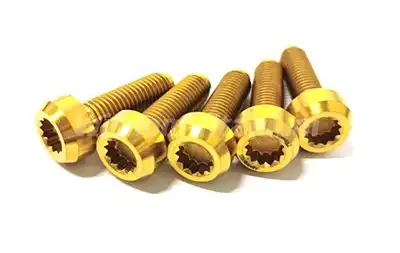
There’s not a single torque value for a titanium wheel bolt. The accurate amount is given by the manufacturer of the vehicle or wheel for your precise wheel, hub, thread and seat, not by the bolt material alone. Torque just estimates clamping force , friction from coatings , lubricants and threads modifies the outcome . Titanium Grade 5 (Ti-6Al-4V) bolts can reach tensile strengths of 900-1050 MPa (130,000-152,000 psi) but still need a verified spec, a calibrated torque wrench, and a star tightening pattern. This tutorial will assist you to confidently source titanium wheel bolt ordering, check fitting, compare materials and discover the proper torque.
I wrote this page for brand owners, engineers, and buyers who specify titanium lug bolts for their own wheel and kit programs. Each section answers a question I hear often.
Titanium Wheel Bolt Torque Specifications: The Core Principles
Torque Is Not the Same as Clamping Force
When I first talk to people about wheel bolt torque, I tell them that the wrench measures twisting effort, not clamp load. The formula T = K × F × d is often used by engineers. The friction factor (K) is equal to T times the bolt diameter, F times the target preload, and K times the torque. It's possible for the clamp force to change even if the wrench reads the same number because K is part of the equation. According to sources on bolted joints, about 90% of the torque that is applied is lost to friction, and only a small portion is used to tighten the bolts. A torque number can't show that a joint is safe by itself.
How Friction, Coatings, and PVD Change the Result?
Titanium and steel don't act the same way when they're loaded. That means that a titanium wheel bolt will stretch more when it is loaded with the same amount of weight as a steel bolt that is loaded with 200 GPa of stress. Titanium also tends to gall, which means that when dry metal slides on metal, threads can get stuck or tear. K factor changes because of the coating on the threads, the surface finish, and the lubricant. One type of PVD gold layer changes the way the head seat and threads move. I think you should check the torque on the finished, coated part instead of a sample that isn't coated. Write down the exact state—whether it's dry or oiled—and make sure it stays the same for every assembly.
What a Specification Should Define?
A buyer who only writes "titanium wheel bolt, M12" is likely to make a mistake. A clear specification lists the type of vehicle or wheel, the thread size and pitch, the length of the bolt, the shape of the seat, the grade of the material, the finish on the surface, and how the installation was done. It also says how much torque there is with a range, if the bolt can be used again, and which studies back up the number. The Gr5 we sell is made of Ti-6Al-4V and has a tensile strength of 900 to 1050 MPa. It has a hot-forged head and threads that are rolled. Your assembly team, test lab, and end customers will all have the same reference when you write these things down in one document. It also makes it easy to compare batches.
How to Determine and Apply the Correct Titanium Wheel Bolt Torque?
Start with the Approved Manufacturer Value
The right number starts with the published specifications of the car or wheel manufacturer. Motorsport use Longer bolts and spacers may vary the requirements, so check it suits your setup. Write down if the number thinks they are dry or lubricated threads. This information can be found in the owner manuals, wheel data sheets or the OEM maintenance manual. The hub lug bolts are worth more than the little bolts (M7 size) that hold the two parts of a modular wheel together, most of the time. Verify that number again with the wheel maker. If there is no value for a custom project, request torque-to-clamp-load and fatigue testing before you go.
Verify Thread, Seat, and Engagement
Then check the fit of the hardware into the hole. The thread size and pitch must be matched, such as M12x1.5 or M14x1.5 for various lug applications. The threads must stay engaged, hence the bolt must be long enough to avoid bottoming out or hitting any of the braking parts. The seat can be flat, circular or spherical in shape. The seat must be the same shape as the wheel so that the bolt can properly center and load the wheel. If you choose the improper seat, it can feel tight because all the weight is on a small touch line. I would urge you attempt a sample fit on an actual wheel and hub before you place a major order. M7×24.5 PVD gold bolt Don’t forget to check your design head height and wheel pocket clearance.
Installation Steps and Mistakes to Avoid
First, clean the hub face, wheel seat, and threads. To start, turn each titanium wheel bolt by hand. Then, use a measured torque wrench to tighten them in a star pattern over and over again. Finishing with an impact wrench is never a good idea because it can go too far. If the wheel maker tells you to, check again after a short drive of 50 to 100 miles. Write down the wrench number, the date, and the condition of the threads. Some mistakes that people often make are using a generic value, mixing dry and lubricated threads, not paying attention to engagement, and mixing seat shapes. Bolts that are longer don't make things safer because they can hit hub parts. If bolts are bent, galled, or rusted, don't use them again. Instead, get new ones.
Titanium Wheel Bolt Strength, Grades, and Material Comparison
Grade 5 Titanium and Its Strength Range
Grade 2 titanium doesn't rust and is easy to shape, but Grade 5, or Ti-6Al-4V, gives performance fasteners the extra strength they need. It has a tensile strength of 900 to 1050 MPa, or about 130,000 to 152,000 psi, and is used in our bolts. There is only one number for tensile strength. If the application could be dangerous, you should ask for each of the yield strength, proof load, shear strength, and fatigue life. ASTM B348 is a common bar-stock standard for the alloy, which is made up of about 90% titanium, 6% aluminum, and 4% vanadium.
Why Hot Forged Heads and Rolled Threads Matter?
The way the product was made has the same effect on life as the grade. The head is shaped by hot forging while the metal flows around the shape. This lines up the grain structure along the part. Instead of cutting away the thread shape, rolling presses it into the bar. This makes the grain follow the thread profile. This makes the wear life longer than cut threads, which break the grain. The heads of our bolts are hot-forged, and the threads are rolled. If a spec sheet says "forged," I think you should ask if the thread was also rolled.
Titanium Compared with Steel and Aluminum
Titanium is about 4.43 g/cm³ dense, while steel is 7.85 g/cm³ dense. That makes each titanium wheel bolt about 40 to 45 percent lighter and makes it very resistant to brake dust and road salt. It costs more, has tighter control over fitment, and has a different friction behavior. For less money, steel has a lot of standard strength classes, like ISO 898-1 property class 10.9, which makes it a good choice for most OEM work. Even though aluminum is lighter, it needs to be carefully engineered because it is not as strong and threads don't last as long. Don't mix this choice with titanium lug nuts, as they have a different way of attaching.
Compatibility, Quality Control, and Documentation
Confirm Compatibility at Every Level
Take a look at the vehicle, wheel, hub, and fastener as a single chain. Different brands of wheels, like BMW, Audi, Volkswagen, Porsche, and aftermarket wheels, can have different thread pitch, seat shape, bolt length, and head size. Even model years within the same brand can be different. Write down the thread diameter and pitch, the overall length and the length of the threads, the seat angle or radius, the head and drive shape, the hub depth, the spacer thickness, and the wheel pocket clearance before you place your order. A dimensional drawing and a test fit find most mistakes quickly. For buyers in the US, give models with both metric and inch notes, and make sure the labels on the boxes match how shops in that country do things.
Documents That Prove the Material and Process
There are paper records that back up the numbers on a goods page. Ask for a material test certificate that lists the chemical make-up and mechanical properties of the material, as well as a certificate of conformity, dimensional inspection reports, and records that show how each lot was made. Ask for the thread gage results and the surface treatment instructions as well. This test report should be kept on file if you print 900–1050 MPa in a catalog or show booth. If your brand needs it, have a third-party lab check the tensile and salt-spray performance. Wisdom Titanium is certified by ISO 9001, and our process includes keeping track of the raw materials we use and inspecting them before they are shipped.
Keeping PVD Gold Consistent Across Batches
A gold finish sells on looks, so color differences between lots are bad for a high-end brand. A thin, hard layer is made by physical vapor deposition (PVD). It doesn't wear off easily, stops galling, and usually lasts longer than anodized color. The PVD gold color of our M7×24.5 bolt is what it is. Approve a master sample, write down the shade target on the purchase order, and then use the same lighting to compare each lot to the master. This will ensure that everything is the same. Because the coating changes friction, you should ask for torque confirmation on the coated parts. Keep records by lot so that you can find any complaint.
Sourcing Custom Titanium Wheel Bolts and Final Selection
Build a Complete RFQ
A complete request for quote saves weeks of work. Specify grade, quantity consumed, size of threads, kind of seat, dimensions, finish, torque condition, annual number, packing, inspection requirements, certificates and times of delivery. We can produce custom parts from your samples, designs or ideas. The minimum quantity of parts you can order is 200. Bring up privacy early for private label projects. Talk about an NDA, laser logo marking and special packaging before you send out samples. Also, check if a model might be unique to your brand. For each quote, not only the unit price, but includes tooling, MOQ, logistics, warranty and technical support.
Choose a Supplier with Proven Capacity
Wisdom Titanium produce titanium fasteners and standard and bespoke CNC parts for aerospace, energy, medicine, marine, automotive, motorcycle and bicycle applications. Our company is situated Baoji Titanium Valley,Shaanxi Province. It is the world's most major titanium production base and China's largest titanium industry cluster. The neighboring chain has bars, plates, tubes, forgings, sponges and ingots. It keeps raw resources near to the factory. We have standard parts and raw materials in stock and check each order during the complete process.
Maintenance, Replacement, and Final Selection Checks
Every time you take a wheel off, check for looseness, thread damage, galling, corrosion, unclean seats. Replace a titanium wheel bolt that is distorted, cross threaded, badly rusted, over torqued, hit hard or has seen numerous race rounds. In the galvanic series titanium is nobler than aluminium. This means that aluminum wheels might rust faster when wet or near salt water. If the coatings or washers or anti-seize are approved and match your torque value it may assist. When you have to select, pick the lightest bolt that will suit your criteria for safety, durability and supply. It should also have matching thread and seat, enough engagement, validated torque and paperwork on file.
Conclusion
The torque value for a titanium wheel bolt is specified by the wheel or vehicle manufacturer, not only the material. This is because the friction, coatings and lubricants vary the amount of clamp force that a wrench setting produces. Titanium Grade 5, tensile strength 900 to 1050 MPa, is roughly 40 to 45 percent lighter than steel. Hot-forged head and rolled threads for durability. Fit is defined by thread, seat, length, and engagement. Quality is demonstrated by material certificates and lot records. Controlled installation, periodic inspections, uniform PVD gold finish and explicit order specs minimize errors and maintain the safety and brand look from batch to batch.
FAQ
Is there one torque value for every titanium wheel bolt?
No, the number varies on the vehicle, wheel, hub, bolt design, friction level, and the manufacturer's instructions.
Can I use the steel bolt torque for titanium?
Not all the time. Titanium has a smaller modulus of elasticity and a different way of reacting to friction, so check the number with the wheel maker or put the clamp load to the test.
Should I use anti-seize on titanium threads?
Since titanium can get stuck, many installers grease the threads. When you use lubrication, friction goes down and clamp force goes up at the same torque. Only use a product that has been allowed for your use, and change the number the way the manufacturer tells you to.
What is the minimum order for the Gr5 M7×24.5 PVD gold bolt?
Our minimum order quantity is 200 items. Send us your drawing or sample, and we'll look it over and see what you need.
Request a Titanium Wheel Bolt Specification Review
Wisdom Titanium can make titanium wheel bolts from samples or drawings you provide. Hot-forged Grade 5 (Ti-6Al-4V) bolts with rolled threads, a PVD gold finish, and a 200-piece MOQ are what we sell. Our team will look over your project after you send sales@wisdomtitanium.com your thread size, seat type, quantity, and torque condition. More information can be found at wisdomtitanium.com.
References
- Bickford, J. H. Introduction to the Design and Behavior of Bolted Joints, CRC Press, 2007.
- Boyer, R., Welsch, G., and Collings, E. W. (eds.) Materials Properties Handbook: Titanium Alloys, ASM International, 1994.
- Donachie, M. J. Titanium: A Technical Guide, ASM International, 2000.
- ASTM International. ASTM B348/B348M, Standard Specification for Titanium and Titanium Alloy Bars and Billets, 2019.
- International Organization for Standardization. ISO 898-1, Mechanical Properties of Fasteners Made of Carbon Steel and Alloy Steel, 2013.
- Machinery's Handbook, 31st Edition, Industrial Press, 2020.