
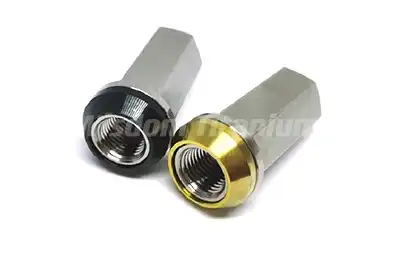
When selecting fasteners for high-performance automobiles, the decision between titanium wheel lug nuts and steel lug nuts isn’t just about cost – it’s about the experience your consumers will have over years of driving. Titanium lug nuts, particularly those manufactured from Grade 5 Ti-6Al-4V alloy, provide a weight reduction of over 45% compared to steel lug nuts, while retaining a tensile strength of 950–1050 MPa. Steel lug nuts are cheaper to start but corrode, seize, and wear out quicker. This essay spells out just where titanium wins, where steel is acceptable, and how to make the proper selection for your product line.
Understanding Titanium and Steel Lug Nuts: Material Properties and Benefits
What Steel Lug Nuts Are Made Of
Standard steel lug nuts are constructed of hardened alloy steel and are often classified as class 8.8 or 10.9. How dense are they ? About 7.85 g/cm^3. Steel is widely utilized in OEM manufacturers because it is inexpensive to produce and easy to machine in large quantities. Steel is fine for the daily driver on dry pavement. But in high-stress or corrosive areas, its weakness becomes extremely apparent very rapidly.
What Makes Grade 5 Titanium Different
Titanium metal Ti-6Al-4V, grade 5, has a density of just 4.43 g/cm³. It can withstand up to 950-1050 MPa, which is roughly the same as Class 10.9 steel hardware. The metal is more structurally stable than pure titanium (Grade 2) in car applications. Contains 6% aluminum and 4% vanadium. Ti-6Al-4V is thus considered to be the only reliable metal for high-performance wheel bolts.
How Material Choice Affects Procurement Decisions
Material correctness is a prerequisite for aftermarket firms that are producing lines of items for racing cars, for luxury SUVs, or for off-road vehicles. To show the material is Ti-6Al-4V, buying teams must either request a Material Test Report (MTR) or employ XRF analysis to undertake Positive Material Identification (PMI) testing. Grade 2 titanium, the cheap kind, can bend under torque and doesn’t have enough Vanadium-Aluminum alloy to properly hold wheels under severe stress. It is normal for a firm purchasing something to examine the grade of a material at the procurement stage before placing an order with a supplier.
Weight Savings and Performance Impact in Commercial Applications
The Numbers Behind Unsprung Weight Reduction
A standard steel wheel lug nut weighs 60 to 80 grams. A titanium wheel lug nut, Grade 5 equivalent normally weighs 30 to 40 grams. That saves 600-800 grams of unsprung spinning mass per vehicle for a complete set of 20 lug nuts. Research into vehicle dynamics has indicated that a 10% decrease in unsprung mass may improve wheel response, reduce stopping distance, and improve suspension response. That’s a genuine advantage you can see in the speed and racing category, not just a marketing story.
Impact on Suspension and Drivetrain Wear
Lighter titanium wheel lug nuts exert less stress over time on wheel bearings, hub faces, and suspension knuckles. Lower micro-vibration fatigue is also good if you take your wheels off and put them back on a lot (track days, fleet trucks, etc.). Less rotational inertia at the hub is a good thing. This means bearings won’t have to be changed as frequently, which saves money and is something fleet maintenance managers prefer to look at when working up overall service intervals.
Why Aftermarket Brands Use This as a Core Selling Point
In the US, aftermarket performance companies usually exploit the reduced weight of titanium fasteners as a primary selling feature on their product websites and at trade exhibitions like SEMA. And it is 40-50% lighter than steel, which is a genuine, quantifiable advantage that engineers, drivers, and automobile fans all understand. It’s a straightforward method to market the items down the line for the purchasing teams.
Corrosion Resistance and Longevity: Protecting Your Investment
How Steel Corrodes Under Road Conditions
Steel lug nuts, exposed to road salt, water, and acidic wheel cleaners, begin rusting within months of installation. In the northern US, roadways are salted in winter, and this may cause corroded lug nuts to adhere to the wheel studs. This may make it unsafe or perhaps impossible to change tires without destroying the stud. This is a recognized safety problem that is addressed in auto service manuals and fleet maintenance bulletins.
How Titanium Forms Its Own Protection
This is grade 5 titanium, which, when exposed to air, naturally forms a stable layer of titanium dioxide (TiO₂). This passive layer is chemically inert, so it won’t be affected by acidic cleaners, road salt, or brake dust. Titanium fasteners don’t lose their thread integrity or surface integrity season after season, especially in coastal locations, high humidity conditions, or off-road circumstances when fasteners are exposed to mud and water.
Maintenance Recommendations for Both Materials
It is a good idea to check the torque on both the steel and titanium lug nuts regularly, particularly after the first 50 to 100 miles following installation. This is particularly critical for titanium, which has a lower modulus of flexibility than steel. If you are using steel studs, a small coating of anti-seize compound can eliminate galling, called "cold welding," when titanium is mated to steel with a lot of force. In areas where there is heavy corrosion, regularly removing and reapplying anti-seize on steel prevents rust seizure.
Long-Term Cost Analysis: Expense vs. Value
Upfront Cost vs. Total Cost of Ownership
Steel lug nuts can range in price from $15 to $40 for a set. A similar set of Grade 5 titanium wheel lug nuts can cost anywhere from $80 to $200 or more, based on the color and shape. There is a real difference up front. But in places where steel lug nuts rust, they usually need to be replaced every two to three years. With proper care, good titanium screws can last the life of the vehicle. Titanium's longer service life makes the difference in total cost of ownership over a 5–7-year car lifecycle much smaller for fleet operators.
The Hidden Costs of Corrosion-Related Failures
To remove seized steel lug nuts, you need to get a professional to do it, which can mean removing studs or damaging the hub. When done by a professional shop in the US, replacing studs can cost $150 to $300 per wheel. When these things happen to a ship, they add up quickly. Titanium almost completely gets rid of this failure mode, which is why specialty vehicle owners and performance shops are taking corrosion-related work costs into account more and more when they decide to switch.
Sourcing Strategy for B2B Buyers
When aftermarket brands place B2B orders, they can keep unit costs low by buying straight from an ISO-certified maker, even if they only order a small amount. Wisdom Titanium has factory-direct prices, a lot of inventory, and items that are ready to ship. Minimum orders start at 100 pieces per SKU. Multiple SKUs can be mixed in a single order. This lets smaller brands try out different configurations without having to worry about large minimum order quantities for a single SKU.
Making the Right Choice: Purchasing and Application Guidance
Sizing, Thread Standards, and Compatibility
Grade 5 titanium lug nuts come in standard thread pitches for cars, such as M12x1.25, M12x1.5, M14x1.5, and M14x2.0. These thread pitches meet DIN 934 and ISO standards. Before ordering, buyers should make sure that the seat type (conical 60°, ball seat, or flat), thread pitch, and hex key size match the requirements for the particular car model. Drawings with dimensions or 3D models in STEP or IGES format make this testing process go a lot faster.
Custom Finishes and Brand Differentiation
PVD-coated black, burned blue gradient, and anodized finishes give aftermarket brands a way to identify their products visually that raw steel can't. Brand-conscious buyers often care about how consistent the finish is across production batches. To keep the color uniform, Wisdom Titanium's surface treatment methods use standard factors and check the quality of each batch. Brands that want to make their products stand out can get custom logo engraving and private-label packaging.
Installation Best Practices
An impact gun should never be used on titanium lug nuts. Instead, you should always use a measured torque wrench. In addition to damaging threads, impact guns can also damage the finish in a way that looks bad. Follow the torque recommendation from the car's maker, which is usually between 80 and 110 ft-lbs, and re-torque after 50 to 100 miles of driving. These steps keep the bolt and the wheel stud safe and make sure they work well for a long time.
Conclusion
Titanium wheel lug nuts are lighter, don't rust, and last longer than steel ones. These are the three things that matter most in performance aftermarket applications. Steel is still a cheap choice for everyday business use, but brands that want to make products for high-performance, racing, or luxury vehicles should use titanium. This is based on real engineering data, not just personal taste. It all comes down to what your people want and what your business stands for. Titanium is the best technical and business pick for most performance-focused brands reading this.
FAQ
1. Can titanium lug nuts gall against steel wheel studs?
Yes, titanium can gall (cold weld) against steel under high friction torque. To prevent this, apply a thin layer of anti-seize compound to the stud threads before installation. Some Grade 5 lug nuts also come with a PVD coating that reduces direct metal-to-metal contact and lowers the risk of galling during torque application.
2. Are Grade 5 titanium lug nuts safe for daily street driving?
Yes. Ti-6Al-4V has tensile strength comparable to Class 10.9 steel hardware. When manufactured from hot-forged billets with rolled threads, Grade 5 titanium lug nuts provide reliable fatigue performance for daily use. Always verify that the product comes with an MTR confirming Ti-6Al-4V composition, not the softer Grade 2 pure titanium.
3. Can I reuse titanium lug nuts after removal?
Yes, titanium lug nuts are fully reusable provided the threads show no visible deformation. Inspect threads carefully after each removal using a thread gauge. Avoid impact gun installation, which accelerates thread wear. With proper care, Grade 5 titanium lug nuts outlast the vehicle they are installed on.
4. What torque specification should I use?
Follow the vehicle manufacturer's factory torque recommendation, typically 80–110 ft-lbs for most passenger and performance vehicles. Re-torque after the first 50–100 miles following installation. Due to titanium's lower modulus of elasticity compared to steel, this re-torque step is important for ensuring proper clamping force retention.
5. How do I verify the titanium grade before purchasing?
Request a Material Test Report (MTR) from the supplier. For high-volume B2B orders, conduct Positive Material Identification (PMI) testing using an XRF analyzer. This confirms the exact elemental composition — specifically the presence of aluminum and vanadium — distinguishing true Grade 5 from inferior Grade 2 material.
Get Factory-Direct Titanium Lug Nuts from Wisdom Titanium
As a company based in Baoji Titanium Valley, Shaanxi Province, Wisdom Titanium is ISO 9001-certified and makes titanium lug nuts. They sell Grade 5 Ti-6Al-4V titanium wheel lug nuts with a minimum order of 100 pieces, factory-direct prices, and an inventory that is ready to ship. We can do private labels, custom finishes, and mixed sales with more than one SKU. Get in touch with us right away at sales@wisdomtitanium.com to ask for examples or a price on production.
References
1. Boyer, R., Welsch, G., & Collings, E. W. (Eds.). Materials Properties Handbook: Titanium Alloys. ASM International, 1994.
2. Peters, M., & Leyens, C. (Eds.). Titanium and Titanium Alloys: Fundamentals and Applications. Wiley-VCH, 2003.
3. Milanese, A. C., & Kunh, L. T. "Corrosion Behavior of Titanium Alloys in Automotive Environments." Corrosion Science, 2011.
4. Society of Automotive Engineers (SAE). SAE J1701: Wheel Nuts — Performance Requirements and Test Methods. SAE International, 2018.
5. Dixon, J. C. Tires, Suspension and Handling. 2nd ed. SAE International, 1996.
6. Donachie, M. J. Titanium: A Technical Guide. 2nd ed. ASM International, 2000.




