
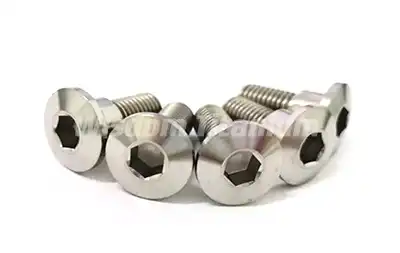
When riders and brands ask which bolt material performs better under braking loads, the answer depends on what you prioritize. Titanium disc brake bolts made from Grade 5 Ti-6Al-4V alloy deliver a tensile strength of 900–1,050 MPa while weighing roughly 45% less than equivalent steel fasteners. Steel bolts, by contrast, offer lower upfront cost and wide availability. For high-end bicycle brands that sell on weight savings and aesthetics, the data clearly favors titanium rotor bolts — and that data can go straight onto your product page.
Understanding Disc Brake Rotor Bolts: Titanium vs Steel
Disc brake rotor bolts are small fasteners, but they carry real structural responsibility. They clamp the rotor to the wheel hub and must withstand repeated shear forces, thermal cycling, and exposure to moisture, salt, and brake dust. Choosing the wrong material means premature corrosion, bolt seizure, or — in a worst-case scenario — rotor detachment.
What Are Disc Brake Rotor Bolts?
Rotor bolts secure the brake disc to the hub flange. A standard disc brake setup uses six bolts per rotor in an IS or centerlock configuration. The bolts must resist both torque and lateral shear during hard braking, making material strength non-negotiable.
Material Overview: Grade 5 Titanium
Grade 5 titanium (Ti-6Al-4V) contains 6% aluminum and 4% vanadium. Its density is 4.43 g/cm³ — about 43% lighter than steel at 7.85 g/cm³. With a tensile strength of 950 MPa and excellent natural corrosion resistance, it performs well in road salt, mud, and high-humidity environments without surface coatings.
Material Overview: Steel Fasteners
Standard steel disc bolt grades (8.8 or 10.9) offer tensile strengths of 800–1,040 MPa at a fraction of the cost. However, steel is significantly heavier and susceptible to rust if the surface finish wears through. For premium bicycle brands building a weight-focused product line, steel's mass penalty and maintenance requirements reduce its appeal.
Key Differences Between Titanium and Steel Disc Brake Bolts
Decisions about purchases depend on facts that can be measured. Here are the most important things for brands that sell to high-end cyclists that show how these two materials compare.
Weight and Strength
A single rotor bolt made of M6 steel weighs about 3.5 to 4 g. The same amount of Grade 5 titanium weighs about 2–2.3 g. This difference adds up to 10–15 g per wheel for a six-bolt rotor setup, which you can say right on the product page. Our fully CNC machined, rolled-thread titanium disc brake bolts have a tensile strength of 900 to 1,050 MPa, which is the same as or higher than most 10.9 steel bolts.
Corrosion Resistance and Lifecycle Cost
To keep them from rusting, steel bolts need to be zinc-plated or given another similar surface treatment. Rust will start when that coating wears off, which it will. Titanium makes a stable oxide layer on its own, and it doesn't rust when it comes into touch with air, road salt, or brake fluid. Titanium disc brake bolts are worth the extra money because they don't need to be replaced as often over a three- to five-year service cycle.
Aesthetics and Brand Differentiation
Black or silver steel bolts are available. Titanium bolts can be anodized in different colors, such as black, gold, rainbow, purple, and burned blue. This is done with electrochemical processes that go below the oxide layer on the surface instead of on top of it. Getting batch-consistent anodized color is hard to do; we'll talk about this in more detail below.
How to Choose the Right Disc Brake Bolts for Your Business Needs?
There's more to choosing the right bolt than just looking at tensile strength charts. If you are looking for parts for a brand-name product line, I suggest you go over these factors first before choosing a supplier.
Application and Volume Segmentation
Make sure the bolt's specs match the type of job. Most of the time, M5 or M6 bolts are used on road and gravel bikes. For extra shear strength, M6 or M8 titanium disc brake bolts are used on trail and enduro bikes. The sizes we have, M6 and M8, are good for most people. For brands that buy 200 to 1,000 pieces of each SKU, mixing colors in the same order batch lowers inventory costs without raising the MOQ.
Screening Criteria for B2B Procurement
The following things set good providers apart from long-term friends you can trust:
- Tensile strength documentation: Request material certificates confirming Ti-6Al-4V composition and 900–1,050 MPa tensile strength. These figures must be printable on your product page.
- Thread quality: Rolled threads — not cut threads — preserve the material's grain structure and improve fatigue life. Confirm this in the manufacturing spec sheet.
- Color consistency: Ask for physical color swatches, not just digital renders. Anodized rainbow and burnt blue finishes involve gradient processes where batch-to-batch variation is the most common complaint.
- Anti-galling recommendation: Titanium-on-titanium or titanium-on-aluminum contact requires an anti-seize compound. A responsible supplier includes this guidance in the installation sheet.
These rules will help you stay away from the most common reasons for returns: thread galling, color fading, and size mismatches.
Supplier Evaluation and Standards Compliance
Brands of well-known bicycle parts like Shimano and SRAM set high standards for documentation and size tolerances. When buying titanium rotor nuts from a third-party maker, make sure they have ISO 9001 certification, ask for REACH/RoHS compliance statements, and make sure you can follow the raw materials all the way through to the finished part. On request, you should be able to get dimensional reports and salt spray test results.
Installation and Maintenance Best Practices for Titanium and Steel Bolts
If installed wrong, even the best bolt will break soon. Both construction workers and end riders need to follow these rules.
Torque Specifications and Tooling
A torque of 4–6 Nm is what most M6 titanium disc brake bolts say they need. If you over-torque titanium fasteners, the threads could get damaged. If you under-torque them, the rotor could move and make noise. Always use a torque wrench that has been adjusted and good Torx or hex bits. Bits that are worn or don't fit right can damage a titanium head more quickly than they would steel.
Anti-Seize and Thread Locker
Before installing the rotor bolts, put a small amount of anti-seize powder or medium-strength thread locker on the threads. This is very important when putting titanium bolts into wheels made of aluminum. The compound stops galvanic cold-welding between different metals and makes removal easy in the future, which is something that both technicians and end users really like.
Routine Inspection Protocol
Every 500 to 1,000 km or after any crash, check the rotor nuts. Look for thread stretching, head curvature, and loss of color. Unlike some single-use stretch bolts, titanium bolts that stay within their dimensions can be used more than once. Keep track of the results of inspections for quality control and guarantee reasons.
Market Insights and Procurement Strategies for Titanium Disc Brake Bolts
As the gravel and enduro bike markets grow, so does the need for lightweight titanium screws. This is because riders are upgrading their parts, and small brands are competing on weight data and finish quality.
Current Market Trends
Grand View Research's research from 2023 says that the global titanium fastener market will continue to grow steadily until 2028. This growth will be driven by uses in aerospace, motorsport, and high-performance cycling. More and more bike brands are putting together "weight kit" packages that include titanium bolts, cages, and other parts to make full upgrade sets. This is a style that works perfectly with our per-bike kit packaging choice.
Bulk Ordering and Customization Options
Ordering in bulk cuts down on the cost per unit and speeds up the wait time for future sales. Our minimum order quantity (MOQ) is 200 pieces, and we can make batches of different colors and sizes up to that point. You can carry five anodized colors with this structure: black, gold, rainbow, purple, and burned blue. You don't have to commit to 200 pieces of each SKU. We suggest that brands getting ready for the European cycling season (February to July) place framework orders in Q4 to make sure they have production slots.
Quality Assurance and Documentation
There are material composition reports and dimensional inspection records for every batch that is sent out. Brands that have their own color schemes or package designs can sign NDA agreements. Documentation for REACH and RoHS compliance is given upon request, which is what is expected in Western European procurement.
Conclusion
Grade 5 titanium disc brake bolts are lighter, more resistant to corrosion, and stand out more visually than steel ones. These features mean that bicycle brands and specialty shops that are building a high-end product line can charge reasonable prices for their goods and get fewer returns over time. It does cost more than steel up front, but your sales team can explain this to customers with the help of tensile strength certificates, measured gram weights, and anodized color swatches.
FAQs
Are Grade 5 titanium rotor bolts strong enough for aggressive trail riding?
Yes. With a tensile strength of 900–1,050 MPa, Grade 5 titanium (Ti-6Al-4V) matches or exceeds the strength of 10.9 class steel bolts. The rolled thread construction also improves fatigue resistance compared to cut threads, which matters on rough terrain.
What sizes are available?
We manufacture titanium disc rotor bolts in M6 and M8, covering the majority of road, gravel, and mountain bike applications.
Can I order multiple colors in one batch?
Yes. Our MOQ is 200 pieces total, and we support mixed-color batches across black, gold, rainbow, purple, and burnt blue anodized finishes.
How do I prevent thread galling during installation?
Apply a thin layer of anti-seize compound or medium-strength thread locker before threading the bolt in. Avoid using worn tooling, and tighten to the manufacturer-specified torque — typically 4–6 Nm for M6 rotor bolts.
Do you provide material certificates and compliance documents?
Yes. We supply material composition reports, dimensional inspection records, and REACH/RoHS compliance documentation. NDA agreements are available for brands with proprietary designs.
Partner With Wisdom Titanium for Your Titanium Disc Brake Bolt Supply
Since 2016, Wisdom Titanium has been making precision titanium fasteners in Baoji Titanium Valley in Shaanxi Province. This is one of the biggest combined titanium production hubs in the world. We are an ISO 9001-certified supplier of titanium disk brake bolts. We offer M6 and M8 Grade 5 bolts in five anodized colors, and you can order mixed batches starting at 200 pieces. We also provide full material documentation and help with kit packaging. To get a sample set, email your requirements to sales@wisdomtitanium.com or go to www.wisdomtitanium.com.
References
- Grand View Research. Titanium Fasteners Market Size, Share & Trends Analysis Report. 2023.
- ASTM International. ASTM B348: Standard Specification for Titanium and Titanium Alloy Bars and Billets. 2019.
- Boyer, R., Welsch, G., & Collings, E. W. Materials Properties Handbook: Titanium Alloys. ASM International. 1994.
- Donachie, M. J. Titanium: A Technical Guide. 2nd ed. ASM International. 2000.
- Shimano Technical Documents. Disc Brake Rotor Installation and Maintenance Manual. Shimano Inc. 2022.
- ISO. ISO 898-1: Mechanical Properties of Fasteners Made of Carbon Steel and Alloy Steel. International Organization for Standardization. 2013.