
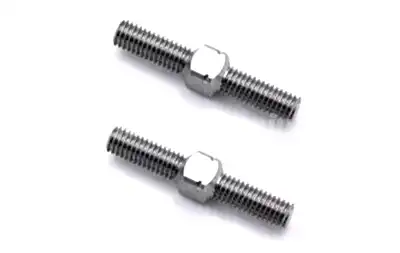
Choosing between titanium turnbuckles and stainless steel options can have a big effect on performance, longevity, and how well the system works when it comes to hardware for important tasks. Titanium turnbuckles are very resistant to rust and have a high strength-to-weight ratio. This makes them perfect for harsh settings where weight reduction and durability are very important. Stainless steel is a cost-effective choice for most uses, but titanium's special properties make it the best choice for aircraft, marine, and high-performance car applications where accuracy and dependability must be maintained.
Understanding Titanium and Stainless Steel Turnbuckles
The choice of material has a big impact on how well a turnbuckle works in a wide range of commercial settings. Because of their different chemical make-up and structure features, each metal has its own benefits that make it better for certain work settings.
Chemical Composition and Material Properties
Titanium turnbuckles are made of Ti6Al4V metal, which is mostly titanium (90%), aluminum (6%), and vanadium (4%). This Grade 5 titanium metal has great mechanical qualities. Its tensile strength can reach 1,170 MPa, and it also resists corrosion very well. The aluminum content makes it stronger and less dense, and the vanadium content makes it easier to shape and work with.
316 or 304 types of stainless steel are usually used for turnbuckles. These grades contain iron, chromium (16–18%), nickel (10–14%), and molybdenum (2–3% in 316 grade). The chromium makes an inactive oxide layer that protects against corrosion. However, this layer may not work as well in chloride-rich settings, where pitting and crevice corrosion can happen.
Turnbuckle Types and Configurations
Modern designs for turnbuckles have different end configurations to meet different connection needs. Eye turnbuckles make loop connections that are safe and work well for rigging, and jaw versions let you put things on flat surfaces in different ways. Different types of hooks make it easy to connect and remove items quickly in temporary setups.
The smooth edges on high-quality titanium turnbuckles make them look better and work better. It's easier to clean and maintain because the surface is smooth, which lowers stress levels. There are two types of threads: UNC (Unified National Coarse) and UNF (Unified National Fine). Fine threads work better in uses that are likely to vibrate.
Surface Treatments and Finishing Options
Titanium gear can be finished in a wide range of bright colors, such as red, blue, black, rainbow, purple, gold, burnt blue, and green. These processes not only make things look better, but they also protect surfaces better and make it easier to find things in complicated setups.
The smooth, polished finish that comes standard on high-quality turnbuckles cuts down on surface roughness to prevent stress peaks and gives the buckles a nice, professional look. This surface preparation is especially useful in marine settings where smooth surfaces don't allow bacterial fouling and make upkeep easier.
Performance Comparison: Titanium VS Stainless Steel Turnbuckles
When you look at operational traits in tough situations, real-world performance differences become clear. Being aware of these performance indicators helps you choose the right material for a given purpose.
Corrosion Resistance in Harsh Environments
Titanium is much more resistant to rust than stainless steel in almost all situations. It works especially well in chloride-rich settings where stainless steel pits. The titanium oxide layer forms on its own and stays stable even when it gets broken. This gives the material self-healing security that stays strong for a long time.
Titanium is resistant to rusting in saltwater, which makes it useful in marine uses. While 316 stainless steel is good for mild marine settings, titanium doesn't change when exposed to saltwater for a long time. This means you don't have to worry about pitting, crevice corrosion, and stress corrosion cracks that can happen to stainless steel parts.
When working with chemicals, there are extra problems that need to be solved, and titanium's chemical inertness is a big help. Acids, bases, and organic chemicals can break down stainless steel over time, but this material doesn't let them. This guarantees consistent performance and gets rid of the risk of exposure from hardware that has rusted.
Strength-to-Weight Performance Analysis
The ratio of strength to weight is an important success measure for apps that care about weight. Titanium alloy Ti6Al4V has tensile strengths that are similar to those of high-strength steels but a density that is about 40% lower. This feature means that a lot of weight can be saved without affecting the structure's strength.
This weight decrease is especially helpful for uses in the automotive and aircraft industries. The use of lighter parts results in better fuel economy, better driving, and lower inertial loads on supporting structures. People who use these benefits in racing get better performance by lowering the unsprung weight and spinning mass.
Maintenance Requirements and Service Life
Maintenance issues have a big effect on the total cost of ownership over long periods of time. Titanium is very resistant to corrosion, so it doesn't need protection coatings or to be replaced often. This means that repair times are shorter and costs for downtime are lower.
Parts made of stainless steel need to be checked for signs of rust on a regular basis, especially in harsh settings. Protective measures like coverings or cathodic protection might be needed to get a good service life. This makes things more complicated and requires ongoing upkeep, which raises the cost of doing business.
Procurement Considerations for Global B2B Buyers
When making strategic procurement choices, it's important to weigh the beginning costs against the long-term operational costs and make sure the supply chain works reliably. When you understand these factors, you can make sure that your procurement plans give you a long-term economic edge.
Cost Analysis and Total Ownership Value
Titanium turnbuckles are more expensive at first than stainless steel options, but a thorough cost analysis shows that they are a great value for demanding uses. The lower total cost of ownership often makes up for the higher price because the service lasts longer and needs less upkeep.
Buying in bulk can cut unit costs by a lot while still making sure there are enough items in stock. Minimum order amounts of 100 pieces allow for cheap prices while keeping inventory costs low. Established providers offer discounts for large orders, which makes the costs more fair for bigger tasks.
Quality Assurance and Certification Requirements
With ISO 9001:2015 approval, you can be sure that your quality control systems will always meet international standards for high-quality manufacturing. Through recorded quality control processes and practices for ongoing growth, this certification gives customers peace of mind that the goods they buy meet certain standards.
Material tracking paperwork confirms the alloy's makeup and mechanical qualities, allowing it to meet industry standards and government rules. Tracking heat lots makes sure that production runs are consistent and makes it easier to look into quality problems if they happen.
Customization Capabilities and Lead Times
Modern production can meet a wide range of customization needs, such as those for special threading, custom measurements, and a certain finish. Advanced CNC cutting makes it possible to keep tolerances very tight while still making production cheap for small amounts.
Standard sizes (M3, M3.5, M4, M4.5, and M5) are kept in stock so that common uses can be delivered quickly. For more specific needs, custom manufacturing is available with reasonable wait times. This adaptability helps with both the need for quick replacements and the planning of project plans.
Application Use Cases: When to Choose Titanium or Stainless Steel Turnbuckles
Based on environmental factors, performance needs, and cost, the best material choice is determined by the unique needs of the application. By understanding these use cases, you can confidently choose materials for a wide range of business uses.
Marine and Offshore Applications
In saltwater settings, corrosion protection is very important, which is why titanium is the best material for important naval hardware. Offshore drilling platforms, yacht rigging, and marine construction projects benefit from titanium's immunity to saltwater corrosion and resistance to marine organism attachment.
Titanium is especially useful for commercial fishing because it lasts a long time in rough seas. The material can stand up to constant contact to saltwater and still hold up under heavy loads. Less upkeep is needed, which means less downtime in faraway offshore areas where getting services is hard and expensive.
Industrial and Construction Applications
When cost is more important than performance, stainless steel options may be used in industrial settings with mild corrosive conditions. Chemical manufacturing plants that work with mild corrosives can use 316 stainless steel well and get a good service life for a lower starting cost.
When structural tensioning is needed in construction, stainless steel is often a good choice because it is cost-effective for short placements or places with little corrosion exposure. The material is strong enough and durable enough, and it's also cheap enough that it can be used for projects that need to stay within their budget.
High-Performance Automotive and Racing Applications
Because titanium is so strong compared to its weight, it is used in racing to improve speed by lowering weight. Suspension parts, frame gear, and body panel fasteners all benefit from having less mass while still being able to hold up under heavy loads.
Titanium gear is being used more and more in high-performance street cars to lower their unsprung weight and make them easier to handle. The material's resistance to wear makes it reliable even when it's put through repeated stress cycles. It also improves the vehicle's mechanics by lowering its rotational inertia.
Aerospace and Defense Applications
Materials that are strong, light, and very reliable are needed in aerospace uses. Titanium turnbuckles meet these needs and also don't rust, which is important for airplanes that fly in a variety of environments, such as those that are exposed to saltwater during naval activities.
Titanium is used in defense because it is not magnetic and can handle high and low temperatures. Titanium is used in military vehicles and equipment to save weight and make sure that it will work reliably in battle situations where failure is not an option.
Making the Right Choice: Decision Support for Turnbuckle Procurement
By systematically comparing the needs of the application with the capabilities of the material, the best purchasing choices can be made that maximize value while still meeting performance goals. This decision strategy looks at the most important things that affect the choice of material.
Performance Requirements Assessment
For most uses, corrosion protection is the most important thing to consider when choosing a material. Titanium solutions are better in places where they will be exposed to saltwater, chemicals, or high humidity, even though they cost more at first. The material's high strength means that it will work well for a long time without breaking down.
The required load must be compared to the strength qualities of the material. Both materials are strong enough for most uses, but titanium is better at resisting wear, which is useful in situations with changing loads. Applications that care about weight clearly benefit from titanium's higher density.
Economic Evaluation Framework
The most accurate way to compare the costs of different products is to use life cycle cost analysis. Even though titanium costs more at first, it usually ends up being more cost-effective in the long run because it lasts longer and needs less upkeep.
Application duration has a big effect on the costs of material choosing. For short-term installations, stainless steel's lower starting cost may be worth it. On the other hand, titanium's long life and low upkeep needs make permanent installations more valuable in the long run.
Supplier Selection Criteria
A manufacturing capacity evaluation makes sure that suppliers can deliver goods that meet certain standards. ISO 9001 certification is a basic way to make sure of quality, but for some uses, you may need unique aircraft or automobile certifications.
Expert advice on choosing materials, writing specifications, and making the best use of applications is part of technical help that makes project completion successful. Well-known companies offer engineering help that makes it easier to find the best answers for difficult problems.
Conclusion
Choosing between titanium and stainless steel turnbuckles depends on how well they meet performance needs and how much they cost. Titanium is very expensive, but it's worth it because it's resistant to rust, lighter, and more reliable over time. Stainless steel is a cost-effective material for reasonable settings that don't need a lot of upkeep. To choose the right materials, you need to think about a lot of things, like the surroundings, the performance needs, and the total cost of ownership. This will help you get the best value and operating success.
FAQ
What makes titanium turnbuckles worth the higher cost compared to stainless steel?
The high cost of titanium turnbuckles is justified by their better resistance to rust, high strength-to-weight ratio, and long service life. Because the material doesn't corrode in cold water or chemicals, it doesn't need to be replaced and doesn't need as much upkeep. Saving weight leads to better performance in areas like aircraft and cars, where less mass makes things more efficient and easier to handle.
Can titanium and stainless steel turnbuckles be used interchangeably in the same application?
Direct replacement needs careful thought about the climate and performance needs, even though both materials can often do similar jobs. The performance of titanium is better in corrosive environments and uses that need to be light, while the performance of stainless steel is good enough in mild conditions and costs less. No matter what material is used, the thread specs and load ratings must match the needs of the product.
How do I verify the quality and authenticity of titanium turnbuckles from suppliers?
Genuine titanium turnbuckles should come with a material approval that lists the alloy makeup (Ti6Al4V), mechanical qualities, and where the materials came from when they were made. Quality management systems that are certified to ISO 9001:2015 make sure they meet foreign standards. Ask for test papers that show the tensile strength, chemical analysis, and measurements. Suppliers with a good reputation back up their material claims and performance standards with full proof.
What thread types work best for different turnbuckle applications?
UNC (Unified National Coarse) threads are easier to install and work better with softer materials or in situations where the contact length is limited. Due to their larger thread contact area, UNF (Unified National Fine) threads have higher tensile strength and work better in situations that are likely to vibrate. In critical tensioning situations where exact load control is needed, fine threads also allow for more accurate correction.
Partner With Wisdom Titanium for Premium Titanium Turnbuckle Solutions
Wisdom Titanium makes high-quality titanium turnbuckle systems that are designed to work in tough industrial settings. Our wide range of products is made from the Ti6Al4V metal and comes in sizes M3 through M5. They have high-quality smooth finishes and bright anodized color choices. We use combined supply chains and advanced production skills to offer high quality at reasonable prices. We are located in Baoji Titanium Valley, which is China's most advanced titanium manufacturing hub.
Our ISO 9001:2015-certified facility keeps a large collection, which lets us deliver standard goods quickly. For customers with specific needs, we also offer full customization services. We can meet a wide range of purchasing needs, from developing prototypes to increasing production levels, as long as you order at least 100 pieces. We also offer both UNC and UNF threading choices. Talk to our engineering team at sales@wisdomtitanium.com about your titanium turnbuckle needs and find out why top makers trust Wisdom Titanium to provide them with titanium turnbuckles that are used in critical situations.
References
- American Society for Testing and Materials. "Standard Specification for Titanium and Titanium Alloy Bars and Billets." ASTM B348-19, West Conshohocken, PA, 2019.
- Boyer, R.R., Welsch, G., and Collings, E.W. "Materials Properties Handbook: Titanium Alloys." ASM International, Materials Park, OH, 1994.
- International Organization for Standardization. "Quality Management Systems - Requirements." ISO 9001:2015, Geneva, Switzerland, 2015.
- Lutjering, G. and Williams, J.C. "Titanium: Engineering Materials and Processes." Springer-Verlag, Berlin, Germany, 2007.
- National Association of Corrosion Engineers. "Corrosion Performance of Titanium Alloys in Marine Environments." NACE Publication 01105, Houston, TX, 2005.
- Society of Automotive Engineers. "Aerospace Material Specification for Titanium Alloy Fasteners." AMS 4967, Warrendale, PA, 2018.