
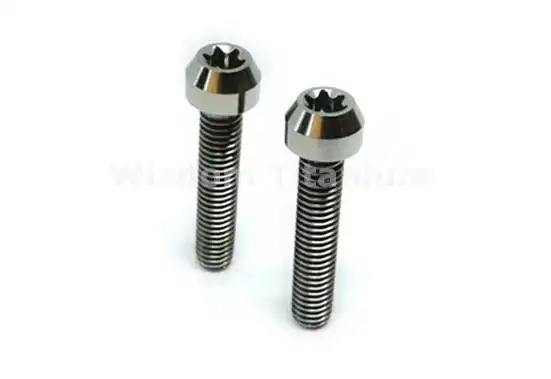
Aerospace fastener selection demands precision that tolerates zero ambiguity. Torx drive geometry offers superior torque transmission and cam-out resistance compared to hex alternatives, making it increasingly standard for aircraft assemblies. However, the relationship between bolt thread size, head diameter, and appropriate Torx socket size follows specific engineering relationships that many specifications engineers misunderstand. This knowledge gap creates costly errors, compromised installations, and potential safety issues when incorrect tooling damages fastener sockets or fails to achieve proper preload.
This comprehensive selection guide establishes a systematic methodology for matching Torx sizes to aerospace titanium Torx bolts based on engineering principles, industry standards, and practical installation requirements.
Torx Size Basics for Aerospace Titanium Bolts
Torx drive geometry employs a six-pointed star pattern where the designation number (T10, T25, T30, etc.) indicates the approximate distance in tenths of a millimeter between opposing points of the star. A T25 Torx socket measures roughly 2.5mm point-to-point, though precise dimensions follow proprietary specifications developed by Camcar Textron, which originated the Torx system in 1967. This numerical designation system creates intuitive size progression; T20 is smaller than T25, which precedes T30, though the increments don't follow perfectly linear relationships as sizes increase beyond T40.
Common titanium Torx bolt sizes in aerospace fastener applications range from T10 through T55, though smaller and larger sizes exist for specialized applications. The progression includes T10, T15, T20, T25, T27, T30, T40, T45, T50, and T55 as standard sizes with T27 and T47 sometimes appearing as intermediate options. Aerospace titanium bolts typically employ T20 through T40, depending on fastener diameter and head style. Miniature fasteners for electronics or sensor mounting might use T10 or T15, while large structural bolts occasionally require T45 or T50. Understanding this size range helps engineers recognize when specifications fall outside normal parameters, potentially indicating errors requiring verification.
Match Torx Size to Your Aerospace Titanium Bolt
Selecting the right Torx size is a balancing act between the physical constraints of the installation space and the mechanical requirements of the joint. It is not merely about choosing a standard size from a catalog; it is about optimizing the connection for the specific loads and environment it will face.
Calculating Drive Size Based on Thread Diameter
A general rule of thumb in aerospace fastener selection is that the drive size should scale with the thread diameter to ensure sufficient wall thickness. For instance, a small M4 fastener might utilize a T15 or T20 drive, while a larger M12 structural bolt would require a T40 or T50 drive. If the drive is too small for the thread size, the head may shear off under load. Conversely, if the drive is too large, it adds unnecessary weight and requires more clearance space, which is often at a premium in modern aircraft design. Our range of titanium torx bolts covers thread sizes from M4 to M30, allowing for precise matching across various sub-assemblies.
Accessibility and Installation Torque Requirements
Aerospace maintenance and assembly often take place in confined spaces where a standard hex key cannot fit. Torx drives excel here because they allow for a straight-line insertion of the driver, unlike hex keys, which often require an angled approach. When matching the size, consider the available "swing angle" and depth. A deeper Torx recess (such as a T30) provides more engagement for the driver, reducing the risk of rounding out the head during high-torque installation. This is particularly important for titanium torx bolts used in engine components, where vibration is constant, and re-torquing may be necessary.
Aerospace-Specific Torx Size Selection Cases
To illustrate how these principles apply in the real world, let us examine three common scenarios in aerospace engineering where the correct Torx sizing is paramount.
Case 1: Avionics and Interior Panels
In the avionics bay or passenger cabin, weight savings are a priority, but so is ease of maintenance. For securing circuit breaker panels or overhead bins, engineers often select titanium torx bolts in the M4 to M6 range with T20 to T25 drives. These sizes provide enough torque to secure the panels against turbulence without the risk of over-tightening and damaging the sensitive electronics or composite panels. The excellent corrosion resistance of Grade 5 titanium ensures that these fasteners will not seize, making future maintenance checks quick and hassle-free.
Case 2: Airframe Structural Components
For structural applications, such as attaching wing skins or fuselage frames, the loads are significantly higher. Here, the focus shifts to sheer strength. Larger diameter bolts, typically M10 to M20, are used with robust T40 to T60 drives. The selection of a larger drive size is critical here to handle the high installation torque required to achieve the necessary preload on the joint. Using a high-quality titanium torx bolt in this context reduces the weight of the airframe while maintaining the structural integrity required for flight safety. The material's ability to operate in temperatures ranging from -250°C to 400°C makes it ideal for the extreme thermal cycling experienced during flight.
Case 3: Engine and High-Vibration Zones
In the engine nacelle, fasteners face extreme heat and relentless vibration. The risk of a standard fastener loosening is high. Torx drives are preferred here for their resistance to vibration-induced loosening. The selection often involves custom sizing to fit specific tooling constraints of the engine manufacturer. Our titanium torx bolts, with their high fatigue resistance, are engineered to withstand these harsh conditions. The precise machining of the Torx head ensures a "fit and forget" reliability, reducing the need for frequent inspections and replacements.
Optimize Your Aerospace Fastener Selection With Baoji Wisdom Titanium
Matching Torx sizes to aerospace titanium bolts requires understanding relationships between thread diameter, head style, installation torque requirements, and industry standards, ensuring reliable tool engagement and proper joint performance. The selection process extends beyond simple size correlations into engineering analysis, verifying socket strength, bit compatibility, and maintenance ecosystem integration. Incorrect size selection creates installation delays, damaged fasteners, and potential safety issues that comprehensive specification procedures prevent through systematic methodology.
Baoji Wisdom Titanium specializes in aerospace-grade titanium Torx bolts manufactured from Grade 5 titanium, delivering tensile strength above 1000 MPa in lightweight construction. Our product range spans M4 through M30 thread sizes with lengths from 6mm to 150 mm, accommodating diverse aerospace applications from miniature electronics mounting through substantial structural attachments. Natural and anodized finishes address both functional and aesthetic requirements while temperature capability from -250°C to 400°C ensures reliable performance across extreme aerospace environments.
Manufacturing excellence from Baoji Titanium Valley leverages China's most comprehensive titanium industrial cluster, providing integrated supply chains from raw material through precision component finishing. This geographic concentration delivers competitive pricing, responsive delivery schedules, and technical expertise supporting aerospace customers globally. ISO 9001 certification ensures systematic quality management with complete material traceability and dimensional verification maintaining specification conformance, critical for aerospace applications.
Engineering support includes Torx size recommendations based on thread diameter, head style, and installation torque specifications. Our experienced technical team assists with fastener selection, provides installation guidance, and recommends appropriate tooling, ensuring successful aerospace assembly operations. Customization capabilities address unique requirements beyond standard catalog offerings when applications demand specialized configurations.
Quality documentation includes material certificates verifying Grade 5 titanium composition and mechanical properties, dimensional inspection reports confirming thread pitch and Torx socket geometry, and conformance statements affirming aerospace quality standards. After-sales support assists with installatio,n troubleshooting, specification clarification, and technical questions throughout aerospace program lifecycles.
For comprehensive aerospace titanium Torx bolt specifications, Torx size selection guidance, or quotations on fasteners optimized for your specific aerospace application, contact Baoji Wisdom Titanium today. Our team stands ready to discuss your requirements and provide solutions combining materials expertise with aerospace manufacturing experience. Send inquiries to sales@wisdomtitanium.com, including thread sizes, head styles, quantity requirements, and application descriptions. Experience professional partnership with titanium specialists who understand that aerospace fastener selection demands precision engineering, quality manufacturing, and comprehensive technical support, ensuring optimal component performance throughout demanding aerospace service environments. Let us demonstrate how properly specified and manufactured titanium Torx bolts from Baoji Wisdom Titanium deliver the reliability, performance, and quality your aerospace projects require.
FAQs
Q1: Can I use a standard steel driver on titanium torx bolts?
A: Yes, you can use a standard steel driver. However, it is crucial to ensure the driver fits perfectly to avoid damaging the Torx head. Because titanium is softer than the steel driver, a poor fit can cause the driver to round out the recess. We recommend using high-quality, precision-machined drivers.
Q2: What is the temperature limit for your titanium torx bolts?
A: Our Grade 5 titanium fasteners are designed to withstand a wide range of temperatures, typically from -250°C to 400°C. This makes them suitable for most aerospace applications, including high-altitude cruising and engine proximity zones.
References
- Camcar Textron. (2019). "Torx Drive System Technical Specifications." Retrieved from Textron Fastening Systems documentation.
- SAE International. (2016). AMS 4928: Titanium Alloy, Bars, Wire, Forgings, Rings, and Drawn Shapes 6Al-4V Annealed. Warrendale, PA: SAE International.
- NASM (National Aerospace Standards Manual). (2020). "Fastener Standards for Aerospace Applications." Aerospace Industries Association.
- Bickford, J.H. (2008). Introduction to the Design and Behavior of Bolted Joints (4th Edition). Boca Raton, FL: CRC Press.
- Donachie, M.J. (2000). Titanium: A Technical Guide (2nd Edition). Materials Park, OH: ASM International.