
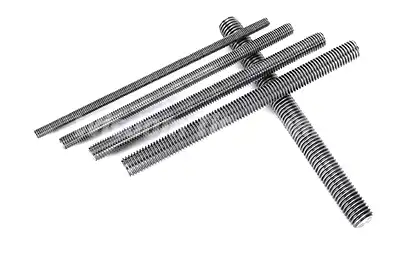
There are worldwide technical standards and material performance indicators that determine the grade of titanium thread rods. This is what makes sure they can be used safely in a variety of situations. Whether it's choosing an engineer or making something in a factory, knowing the basic logic of grading will help you find the right fit.
1. Basis For Classification
1.1 Authoritative classification standards: international and domestic unified norms
The classification of global titanium thread rods mainly follows two core standards. Internationally, based on ASTM B348-11 of the American Society for Testing and Materials (ASTM), this standard specifies in detail the grade, composition and performance requirements of annealed titanium and titanium alloy rods. In China, the GB/T 2965-2023 "Titanium and Titanium Alloy Bar" standard is implemented, which was implemented on April 1, 2024, replacing the old version and adding technical requirements for multiple grades, forming an effective connection with international standards.
It is worth noting that there is a clear correspondence between domestic and foreign grades, such as TA1 corresponding to ASTM Grade 1 and TA2 corresponding to Grade 2, which are completely consistent in terms of chemical composition and mechanical properties, but only have different naming systems. This correspondence makes the selection of transnational projects more convenient.
1.2 Key indicators of grade division: composition and mechanical properties
The essence of grade differences is the difference in material composition and mechanical properties, which directly determine the applicable scenarios of titanium thread rods:
Chemical composition: Pure titanium grade is made of high-purity titanium with just tiny amounts of other metals. Alloy grades are made better by adding metals like aluminum, vanadium, and palladium. For example, Grade 5 has 6% aluminum and 4% vanadium.
Mechanical Properties: The main numbers to look at are tensile strength, yield strength, elongation, and density. The low-strength grade has a tensile strength of around 400–600 MPa, the medium-strength grade has a tensile strength of 600–900 MPa, and the high-strength grade may reach more than 900 MPa.
2. Detailed explanation of mainstream titanium threaded rod grades
After understanding the basis for classification, we focus on the core grades most commonly used in the industry. These grades occupy the main share of the titanium thread rod market due to their outstanding performance and wide applicability, and the characteristics of different grades are the key to selection.
2.1 Pure Titanium Grade (ASTM Grade 1-Grade 4): The basic choice for corrosion resistance
The core advantages of pure titanium grade are excellent corrosion resistance and good processability, with a titanium content of over 99% and almost no alloying elements, making it suitable for scenarios where strength is not required but needs to withstand harsh environments.
① Grade 1 (domestic TA1): Soft and easy to process general-purpose type
As the softest and most ductile grade among pure titanium, its tensile strength is about 480MPa and the elongation can reach 24%. Due to its low processing difficulty and moderate cost, it is often used in chemical equipment, marine structural parts and deep-drawn parts, and can maintain long-term stability in mild corrosive environments.
②Grade 2 (domestic TA2): The most widely used pure titanium grade
Grade 2 has a tensile strength of about 550MPa while retaining excellent corrosion resistance, making it the most widely used pure titanium grade. It is resistant to seawater and industrial chemicals, weighs only 55% of the same specification stainless steel, and is commonly used in marine equipment, medical devices, and architectural decoration.
③ Grade 3-Grade 4: High-strength pure titanium upgrade
As the grade increases, the tensile strength of pure titanium gradually increases, reaching 620MPa for Grade 3 and 760MPa for Grade 4. They are slightly less corrosive than Grade 1 and Grade 2, but have better strength, making them suitable for scenarios that require both moderate strength and corrosion resistance, such as high-strength chemical pipeline connectors and low-temperature environmental structural parts.
2.2 Alloy grades: high-end choices that combine strength and special properties
Alloy grades optimize performance by adding specific elements and have higher strength, heat resistance, or corrosion resistance than pure titanium grades, making them a core choice in aerospace, high-end manufacturing, and other fields.
Alloy grades offer higher strength, heat resistance, or corrosion resistance than pure titanium grades by adding specific elements to optimize performance, making them a core choice in aerospace, high-end manufacturing, and more.
① Grade 5 (Ti-6Al-4V, domestic TC4): "universal alloy" titanium thread rod
Grade 5 is the most widely used grade in titanium alloys, containing 6% aluminum and 4% vanadium, with a tensile strength of up to 900-1100MPa, which is comparable to grade 10.9 high-strength steel, but the specific strength (strength/density ratio) is 2.2 times that of structural steel. With a density of only 4.5g/cm³, it is 45% lighter than stainless steel and can maintain 85% room temperature strength at a high temperature of 350°C, making it suitable for aerospace, automotive suspension, high-end sports equipment, and other scenarios that require extremely high strength and lightweight.
②Grade 9 (Ti-3Al-2.5V, TC11 in China): A balanced choice for medium strength
Grade 9 contains 3% aluminum and 2.5% vanadium, with a tensile strength of approximately 790MPa, which combines good corrosion resistance and welding properties. It is better processable than Grade 5 and relatively low cost, and is commonly used in offshore oil and gas equipment, chemical reactors, and ship connectors, especially for assembly scenarios that require welding.
③ Grade 23 (Ti-6Al-4V ELI): Medical-grade high-purity alloy
As an ultra-low clearance version of Grade 5, Grade 23 has lower oxygen, nitrogen and other impurities, a tensile strength of 1100MPa, an elongation of 8%-10%, and excellent biocompatibility. It is compatible with human tissues and is the material of choice for medical implants such as bone-fixing titanium thread rods, as well as for aerospace critical components where purity is critical.
3: Grade Selection Guide – Matching Core Needs to Specific Requirements
There is no absolute superiority or inferiority among different grades of titanium thread rods; the only difference lies in whether they are suitable for the application scenario. The optimal choice can only be made by considering the usage environment, stress conditions, and cost budget.
3.1 Consider Stress Requirements: Match Strength Grade
- Low strength requirements (tensile strength < 600MPa): Choose Grade 1 or Grade 2, suitable for non-critical connections, such as ordinary chemical equipment parts and decorative components.
- Medium strength requirements (600-900MPa): Prioritize Grade 9 or Grade 3, suitable for automotive manufacturing, machinery equipment, and other scenarios requiring a balance between strength and machinability.
- High strength requirements (> 900MPa): Lock in Grade 5 or Grade 23, for critical load-bearing components in aerospace, medical implants, and high-end equipment.
3.2 Consider the Operating Environment: Resisting Corrosion and Temperature Challenges
- Highly corrosive environments (seawater, acid/alkali solutions): Prioritize pure titanium grades (Grade 1/2) or corrosion-resistant alloys containing palladium and ruthenium (such as Grade 7). These form a stable oxide film, preventing corrosion failure.
- High-temperature environments (>300℃): Choose Grade 5 or Grade 9. They have stronger high-temperature creep resistance and maintain stable performance even at 400℃.
- Low-temperature environments (<-50℃): Pure titanium Grade 2 or Grade 3 offers superior low-temperature toughness, maintaining over 90% impact toughness even in liquid nitrogen environments at -196℃.
3.3 Consider the Cost Budget: Balancing Performance and Economy
- Limited budget, seeking high cost-effectiveness: Grade 2 (pure titanium) or Grade 9 (alloy) are the first choice, widely applicable and reasonably priced.
- Performance priority, sufficient budget: Choose Grade 5 (general-purpose high-strength) or Grade 23 (high-purity) for critical components, offering higher long-term reliability.
- Special requirements (e.g., biocompatibility): No compromise needed, directly choose Grade 23 to avoid safety risks due to inappropriate materials.
- Subheading Four: Typical Application Scenarios and Grade Adaptation Cases
Understanding grade differences requires combining theory with practice. The following adaptation solutions for common scenarios can serve as selection references:
4.Application
4.1 Aerospace Field
- Application Scenarios: Aircraft fuselage connections, engine mounts
- Adaptation Grades: Grade 5, Grade 23
- Core Reason: Balancing high strength and lightweight, reducing fuselage weight by 20%-28%, while withstanding high-altitude low temperatures and vibration loads.
4.2 Marine Engineering Field
- Application Scenarios: Ship deck fixing, offshore platform connectors
- Adaptation Grades: Grade 2, Grade 9
- Core Reason: Extremely strong resistance to seawater corrosion, rust-free even after long-term immersion, and lighter than traditional steel, reducing the load on marine equipment.
4.3 Medical Field
- Application Scenarios: Bone fixation titanium thread rods, implant accessories
- Compatibility Level: Grade 23
- Key Reason: Excellent biocompatibility, no rejection reaction, high strength ensures stable fixation during bone healing.
4.4 Chemical Field
- Application Scenarios: Reactor connections, acid and alkali pipeline fixation
- Level of Compatibility: 1st and 7th grades
- Main reason: It doesn't corrode when exposed to acids or bases, thus it may be used for a long period in complicated chemical environments without the risk of equipment leaking due to corrosion.
Your Reliable Manufacturing Partner: Wisdom Titanium
Wisdom Titanium sells titanium thread rods directly from the factory at low prices and with high quality requirements. Our manufacturing plant, which has been ISO 9001-certified since 2016, makes both standard and bespoke CNC parts for a wide range of industrial uses.
Our full range of products includes high-quality titanium threaded fasteners made from the best raw materials. We have a lot of stock on hand to meet minimum orders of 100 pieces. This guarantees dependable delivery and low prices. Before delivery, each product goes through a strict quality check to make sure it works the same way every time and is the right size.
When you work with Wisdom Titanium, you get the benefit of our skilled research and development teams, who can create unique solutions that meet your exact needs. We have a full stock of raw materials and standard parts, which keeps prices consistent and speeds up delivery times. Mature manufacturing technology, along with thorough process monitoring and a reliable workforce, ensures that products are of high quality and that they are delivered on time.
We are dedicated to providing excellent customer service in addition to making great products. We listen to what our customers have to say and make our goods better all the time to keep up with changing market needs. Our staff has the technical knowledge to help you get the best performance out of your application, whether you need conventional setups or custom-designed solutions.
Email us at sales@wisdomtitanium.com to talk about what you need and find out how our knowledge can help you with your next project.
References
- Boyer, R.R. "An Overview on the Use of Titanium in the Aerospace Industry." Materials Science and Engineering: A, Vol. 213, 1996, pp. 103-114.
- Lutjering, G. and Williams, J.C. "Titanium: Engineering Materials and Processes." 2nd Edition, Springer-Verlag, Berlin, 2007.
- Donachie, Matthew J. "Titanium: A Technical Guide." 2nd Edition, ASM International, Materials Park, OH, 2000.
- Peters, M. and Leyens, C. "Titanium and Titanium Alloys: Fundamentals and Applications." Wiley-VCH, Weinheim, 2003.
- Rack, H.J. and Qazi, J.I. "Titanium Alloys for Biomedical Applications." Materials Science and Engineering: C, Vol. 26, 2006, pp. 1269-1277.
- Banerjee, D. and Williams, J.C. "Perspectives on Titanium Science and Technology." Acta Materialia, Vol. 61, 2013, pp. 844-879.




