
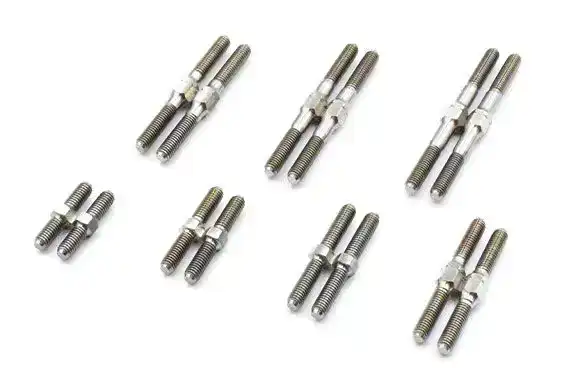
In competitive RC racing, tiny changes often decide a final lap time. Suspension links look simple, yet they control camber, toe, and steering feel. When these links drift out of adjustment, the car becomes hard to predict.
Titanium RC car turnbuckles give you another level of control. They hold alignment under load, survive crashes, and react to fine tuning steps. For brands and serious racers, this is not a cosmetic upgrade. It is a precision tool for repeatable performance.
Baoji Wisdom Titanium designs and manufactures Grade 5 M3 turnbuckles in Baoji, Shaanxi. The city is known worldwide as China’s “Titanium Valley” and hosts a full titanium supply chain. From this base, we support RC manufacturers, option parts brands, and race teams that need stable quality and reliable supply.
Why Titanium RC Car Turnbuckles Matter for Modern Racing?
How suspension links control your RC car
Every adjustable link on your chassis has a job. Camber links set how much the wheels lean in or out. Toe links decide whether the wheels point inward or outward when viewed from above. Together, these angles control stability, corner entry, and tire wear.
Most hobby grade and race grade cars use turnbuckles for these links. Each turnbuckle has right and left hand threads. When you rotate the center section, both rod ends move at once. You change link length without removing any parts, which saves time at the track.
Small length changes cause clear handling differences. A little more negative camber can increase cornering grip. A touch more rear toe in calms the car under power. The key is that the adjustment stays where you set it, run after run.
From plastic to titanium RC car turnbuckles
Many ready to run cars ship with plastic links or mild steel rods. They work for casual driving, but they bend or flex after heavy impacts. Once that happens, left and right sides no longer match, and the setup drifts.
Titanium RC car turnbuckles handle these loads much better. Grade 5 titanium offers high strength with low weight. The material resists permanent bending from side hits and repeated rollovers. As a result, your base setup stays consistent from one race day to the next.
Racers also value precise thread quality. A well machined titanium turnbuckle rotates smoothly under the wrench. You can make quarter turn or even smaller adjustments without play. That level of repeatability is difficult with soft or damaged steel hardware.
Weight, strength, and precision on the track
Grade 5 titanium has a density of about 4.43 g/cm³, roughly 60 percent of steel. When you swap several steel links to titanium, you remove noticeable weight. That reduction happens high on the chassis, where links sit above the roll center.
Lower mass there reduces chassis roll and helps the car transition faster. Steering response becomes more direct, especially in technical sections. Because the turnbuckles stay straight, your camber and toe readings remain accurate. So each wrench movement translates into a predictable handling change.
Lighter links also reduce load on servo gears and ball cups. Hardware wears more slowly because the system sees less inertia in motion. Over a long season, that means fewer failures and more stable race weekends.
Engineering Advantages of Grade 5 Titanium in RC Turnbuckles
High strength-to-weight ratio for consistent handling
The core alloy for our turnbuckles is Grade 5 titanium, also known as Ti‑6Al‑4V. Typical ultimate tensile strength sits around 900 to 950 MPa in many product forms. That level rivals high strength steels, while the material still weighs far less.
In RC use, this strength prevents permanent deformation under cornering and landing loads. The links deflect elastically and recover, instead of taking a set. That behavior keeps suspension geometry stable, even in demanding racing classes.
For OEM customers, this means fewer warranty claims due to bent links. End users gain confidence, because the car returns from crashes with alignment intact. The car feels the same on lap one and lap twenty, which helps drivers refine setups.
Corrosion resistance and long service life
RC cars often run on wet dirt, salted parking lots, or coastal tracks. Steel components start to rust in these environments unless they receive careful care. Corrosion roughens the surface, adds friction in rod ends, and weakens small sections.
Grade 5 titanium forms a stable oxide film that protects the underlying metal. This passive layer renews itself when scratched, so the surface keeps resisting attack. The alloy holds up well in humid air, muddy water, and many chloride environments.
For the RC sector, this translates into long service life with minimal maintenance. Drivers spend less time cleaning hardware and more time driving or testing. For brands, product value increases because parts stay attractive and functional for years.
Why M3 titanium RC car turnbuckles are ideal for tuning
Most 1/10 scale touring, buggy, and drift platforms use M3 threads for turnbuckles. This size balances strength with compact packaging and low mass. It also matches the ball cups and rod ends supplied by leading chassis makers.
Baoji Wisdom Titanium produces titanium RC car turnbuckles with M3 threads in many lengths. Available nominal lengths include 14, 15, 16, 18, 20, 22, 25, 28, 30, 32, 35, 38, 40, 42, 45, 48, and 50 millimeters. This range covers steering links, camber links, and toe links on a wide set of chassis.
Fine pitch M3 threads give very small length changes for each partial rotation. That precision helps when you chase half degree adjustments in camber or toe. With titanium, the threads remain crisp even after repeated adjustments at the track.
Baoji Wisdom Titanium Solutions for RC Titanium Turnbuckles
Specifications of our titanium RC car turnbuckles
Our standard titanium RC car turnbuckles use Grade 5 titanium bar as the base material. We machine them to M3 thread size and supply multiple nominal lengths from 14 to 50 millimeters. The minimum order quantity is 200 pieces, suitable for brands, distributors, or race teams.
Each turnbuckle runs through CNC machining, threading, and surface finishing. We control thread accuracy and concentricity to ensure smooth rotation in ball cups. Dimensional inspection confirms length and thread quality before packing.
Beyond standard sizes, we support custom designs. Customers can adjust wrench flat dimensions, center section shape, or marking style. Our engineers review drawings or samples and help refine them for stable production.
Manufacturing in China’s Titanium Valley
Baoji Wisdom Titanium is located in Baoji, Shaanxi Province. The city is recognized as China’s largest titanium industry cluster and a major global base. It processes a significant share of China’s titanium volume and serves many export markets.
Within this “Titanium Valley,” hundreds of enterprises cover sponge titanium, ingots, bars, plates, tubes, and forgings. Baoji hosts research institutes, testing centers, and national laboratories focused on titanium technology. This ecosystem gives us stable raw material supply and strong technical support.
For RC customers, the location means dependable lead times and consistent alloy quality. The same regional cluster also serves aerospace, marine, and medical sectors. Standards from these industries influence our own practices for small precision parts.
Quality control, R&D, and responsive service
Baoji Wisdom Titanium Industry and Trading Co., Ltd was established in 2016. We operate under an ISO 9001 quality management system and maintain documented procedures. Our team serves aerospace, energy, oil and gas, medical, automotive, motorcycle, bicycle, and other technical markets.
Titanium fasteners and customized CNC parts are our core business. We also work with nickel, tantalum, and zirconium fasteners, plus titanium rods, flanges, and forgings. This broad experience helps us understand different loading cases and design requirements.
Every batch of titanium RC car turnbuckles follows a clear process route. Raw bar stock is verified, machined, threaded, and inspected before shipment. We take customer feedback seriously and adjust designs or tolerances when the market evolves.
In-house R&D allows quick support for new chassis platforms or special torque targets. Our stable production staff and complete raw material inventory help protect your schedule. All steps align with ISO 9001, so traceability and after sales support remain secure.
How to Choose and Apply Titanium RC Car Turnbuckles?
Selecting the right M3 sizes for your chassis
When you plan a project, start from the existing plastic or steel links. Measure pin to pin length at your current neutral setup. Then select a titanium turnbuckle whose threaded length and center section match that envelope.
Our M3 series from 14 to 50 millimeters covers most 1/10 scale needs. Shorter sizes often suit steering and servo links. Medium and longer sizes usually cover upper camber links and rear toe links.
As a design rule, keep thread engagement at least 1.5 times the thread diameter. That means a minimum of 4.5 millimeters engagement for M3 threads. This helps maintain strength in tension and under bending loads.
For OEM or brand customers, we can review CAD data and suggest length combinations. You can also send physical samples, and we will reverse engineer them. This approach shortens development time when you migrate from steel to titanium hardware.
Practical tips for camber and toe adjustment
Once your titanium turnbuckles are installed, accurate adjustment becomes the next focus. For camber, use a simple gauge or phone app with a flat reference. Typical negative camber values for touring and buggy platforms range between one and three degrees.
More negative camber usually increases cornering grip but can reduce straight line traction. Too much also causes uneven tire wear on the inner edge. Adjust in small steps and keep left and right sides equal.
Toe angle works in a similar way but affects stability and steering response. A little front toe out can sharpen turn in. Rear toe in improves straight line stability and reduces spinning under throttle.
Make changes in quarter turn increments on your titanium RC car turnbuckles. After each step, drive several laps and watch both lap times and tire wear. Record settings so you can return to a known safe baseline whenever needed.
From prototype to mass production with Baoji Wisdom Titanium
Many customers begin with a pilot project. They ship two or three reference turnbuckles or a complete suspension assembly. Our engineers measure the parts, confirm material choices, and propose a titanium solution.
After that, we produce samples for test cars or pre production kits. During this phase, teams confirm that lengths, wrench flats, and clearances meet expectations. Any small refinements move into the final drawings before mass production.
With a minimum order quantity of 200 pieces, we support both niche racing brands and larger OEMs. Orders can combine several lengths within one project, depending on your needs. Our logistics team then arranges packing and international shipping from Baoji.
If you want to discuss a new design or request a quotation, you can contact us directly. Please send your drawings, material requirements, and expected quantities to sales@wisdomtitanium.com. Our team will respond with technical feedback and a detailed offer.
FAQs
Q1: Why should I upgrade to titanium RC car turnbuckles instead of steel or plastic?
A: Titanium turnbuckles combine high strength, low weight, and excellent corrosion resistance. Grade 5 titanium provides strength levels similar to many alloy steels, while weighing about 40 percent less. This improves handling response and reduces stress on suspension components. Unlike plastic links, titanium does not creep or deform permanently under normal racing loads. As a result, your camber and toe settings stay stable for more runs and require fewer readjustments.
Q2: Are Baoji Wisdom Titanium M3 turnbuckles compatible with my 1/10 RC car?
A: Our M3 titanium RC car turnbuckles target common 1/10 platforms, including touring, buggy, drift, and on road chassis. Compatibility depends on three main points. First, your car must use M3 ball cups or rod ends. Second, the available lengths, from 14 to 50 millimeters, must match your required pin to pin dimensions. Third, the center section must clear suspension arms and wheels during full travel. We recommend that you share your current link lengths or drawings when you send an inquiry. Our engineers can then help confirm a suitable size combination.
Q3: What information should I include when sending an inquiry to Baoji Wisdom Titanium?
A: Please include several key details so we can prepare an accurate quotation. We suggest the following checklist:
- Target application and scale, for example 1/10 touring car or 1/8 buggy.
- Required thread size (M3) and specific lengths or drawings.
- Estimated annual quantity and first batch quantity, at or above 200 pieces.
- Any surface finish, marking, or packaging requirements.
- Special performance needs, such as extra clearance or specific torque capacity.
References
- EuroRC. “RC Car Setup Guide: 6 Settings That Actually Improve Handling.” Accessed February 8, 2026.
- AMain Hobbies. “Understanding RC Wheel Adjustment: Camber, Caster, and Toe.” Accessed February 8, 2026.
- Chalco Titanium. “Ti‑6Al‑4V Grade 5 Titanium Material Data Sheet.” Accessed February 8, 2026.
- RCJaz. “HUDY 992350 Titanium Adjustable Turnbuckle 50mm M3 L/R (2).” Product page, discussing titanium weight reduction versus steel.
- The People’s Government of Shaanxi Province. “Cradle of Titanium Goes from Strength to Strength.” News release on Baoji’s titanium industry cluster.