
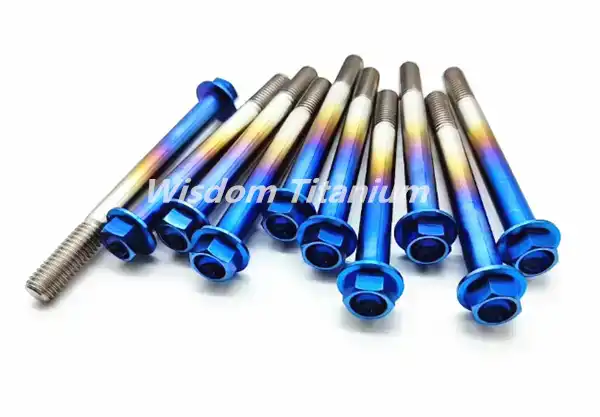
A thorough evaluation of the quality testing procedures and minimum order quantity flexibility of titanium race bolt suppliers is necessary. In the production of high-performance racing fasteners, Chinese producers have taken the lead globally, providing low prices while upholding strict quality requirements. To guarantee optimum performance in tough racing settings, buyers must consider certification compliance, material standards, and supplier capabilities when buying these crucial components.
China's Manufacturing Excellence in High-Performance Racing Fasteners
China has emerged as a major producer of precise titanium parts, especially for the racing hardware industry. Chinese suppliers are now regarded as trustworthy partners by international motorbike and car racing teams because to the nation's investments in cutting-edge CNC equipment and aerospace-grade materials.
Advanced Production Capabilities
Modern manufacturing techniques that are comparable to those in other countries have been embraced by Chinese businesses. For high-stress racing applications, computer-controlled machining machines that can achieve tolerances of ±0.05mm are used in modern facilities. The manufacturing of intricate geometries needed for specialist racing gear is made possible by these capabilities.
Consistent dimensional correctness across manufacturing runs is guaranteed by the use of automated quality inspection systems. Before delivery, manufacturers use optical measurement systems and coordinate measuring machines (CMM) to confirm important requirements.
Material Sourcing and Grade Selection
Premium titanium alloys, such as Grade 5 (Ti-6Al-4V) and Grade 9 (Ti-3Al-2.5V), are sourced from top Chinese vendors. These alloys are selected for their exceptional strength-to-weight ratios. With a tensile strength of over 950MPa, grade 5 titanium is perfect for demanding racing applications where component failure is not an option.
Because several titanium grades are available, producers may adjust the material's qualities to certain uses. For example, Grade 9 titanium maintains sufficient strength for the majority of racing situations while offering exceptional formability for intricate bolt geometries.
Cost-Effective Production Scale
Because of economies of scale, Chinese producers are able to provide reasonable prices without sacrificing quality. Suppliers may keep large raw material stockpiles thanks to large-scale manufacturing capabilities, which shortens lead times for pressing racing season needs.
Titanium processing facilities are concentrated in industrial clusters, which fosters synergies that lower manufacturing costs even further while upholding quality requirements.
Essential Criteria for Selecting Reliable Titanium Fastener Manufacturers
Selecting the best supplier requires weighing a number of variables that have an immediate bearing on the dependability of delivery and product performance. To find suppliers that can satisfy strict specifications, racing teams and automakers need to set up thorough assessment criteria.
Production Capacity Assessment
Make sure the company can fulfill your volume needs by assessing their monthly manufacturing capability. During the busiest racing seasons, suppliers should show that they can increase production while maintaining constant quality requirements.
Ask them about their production equipment in detail, including how many CNC machines they have, their heat treatment facilities, and their finishing skills. A facility with enough equipment usually shows a sincere dedication to high-quality output.
Technical Engineering Support
Seek for vendors that have internal engineering teams that can provide suggestions for design optimization. Based on particular racing applications and stress requirements, skilled engineers might recommend changes to bolt specifications.
Complex racing projects benefit from the superior technological skills shown by the capacity to offer finite element analysis (FEA) reports and stress calculations.
Quality Management Systems
Check the titanium race bolt supplier's quality management certification status, especially ISO 9001:2015 compliance. This accreditation shows established protocols for reliable quality control all the way through the production process.
Examine their quality control methods, which include techniques for evaluating the finished product, in-process monitoring, and incoming material inspection. Receiving faulty components is less likely when comprehensive quality measures are in place.
Customer Service and Communication
Evaluate the supplier's capacity to provide comprehensive product information and their response to technical questions. Fast turnaround times are often needed for order revisions and technical assistance in racing applications.
To guarantee seamless project cooperation throughout the planning and production stages, assess their time zone coverage and English communication skills.
Sample and Prototype Capabilities
To assess production accuracy and material quality, request samples. Reputable vendors are happy to provide samples and invite outside testing to show off their skills.
Rapid prototype production is a symptom of adaptable manufacturing techniques that can take into account design modifications within racing development cycles.
Critical Certification Standards for Racing Hardware Compliance
Titanium fasteners must fulfill certification criteria to guarantee that they fulfill performance and safety requirements necessary for racing applications. Buyers may make more informed judgments regarding supplier capabilities by being aware of these standards.
International Quality Standards
The cornerstone of industrial quality management systems is ISO 9001:2015 certification. For the design, manufacture, and delivery of precision components, this standard guarantees uniform procedures.
Despite being largely focused on aerospace, AS9100 certification denotes sophisticated quality control capabilities that are advantageous for high-performance racing applications. Higher material traceability criteria are usually maintained by suppliers that have aeronautical certifications.
Material Certification Requirements
Request material certifications (Mill Test certifications) that attest to the mechanical qualities and chemical makeup of titanium alloys used in manufacturing. The original material source may be traced back thanks to these credentials.
Compliance with ASTM B348 guarantees that titanium bar stock satisfies uniform requirements for industrial and aeronautical applications. Dimensional tolerances, mechanical characteristics, and chemical composition are all covered by this standard.
Environmental and Safety Compliance
Compliance with RoHS (Restriction of Hazardous Substances) regulations guarantees that production procedures steer clear of dangerous substances that may have an adverse effect on racing team members or the environment.
For foreign racing teams, compliance with REACH (Registration, Evaluation, Authorization, and Restriction of Chemicals) shows conformity to European chemical safety rules.
Successful OEM and ODM Partnership Strategies
Understanding Chinese manufacturers' capabilities and establishing clear communication procedures are essential to building fruitful partnerships with them for bespoke racing gear projects.
Design Collaboration Processes
Provide complete technical drawings that include material specifications, tolerances, and surface finish requirements. Accurate manufacturing and fewer misunderstandings are ensured by clear documentation.
To address changes and optimization possibilities, schedule frequent design review meetings for titanium race bolts. Based on their manufacturing skills and material expertise, seasoned manufacturers often recommend enhancements.
Intellectual Property Protection
Before disclosing private designs or specifications, put non-disclosure agreements (NDAs) into place. When agreements are properly recorded, Chinese manufacturers typically respect intellectual property rights.
To give distinctive racing hardware developments more legal protection, think about registering designs in China.
Prototype Development Workflow
Set precise deadlines for the stages of prototype creation and testing. Effective prototype iteration cycles are necessary for racing applications, which often have strict development timelines.
Prior to full production, establish testing procedures and acceptance standards for prototypes to make sure finished goods fulfill performance standards.
Strategic Approaches to MOQ Negotiations and Pricing Optimization
More successful negotiations for minimum order quantities and competitive price structures are made possible by an understanding of market dynamics and manufacturer restrictions.
Understanding Manufacturing Economics
Regardless of order quantity, titanium machining requires specific tools and setup processes that result in fixed costs. In order to guarantee lucrative manufacturing runs, manufacturers usually set minimum order quantities.
For typical layouts, the majority of reputable vendors demand minimum orders of 200–500 pieces; complicated geometries or specific finishes require larger volumes.
Flexible Ordering Strategies
In order to meet minimum quantity requirements, think about combining orders for different bolt specifications. With this method, customers may fulfill supplier MOQ requirements while placing smaller orders for specific goods.
To improve price and efficiently manage inventory levels, set up framework agreements for yearly volumes with planned delivery.
Value-Added Services Negotiation
Offer packages that offer extra services like quality testing reports, faster shipping, or personalized packaging. Beyond the cost of the products themselves, these services bring value.
To determine possible savings from bigger purchases and adjust procurement strategy appropriately, request price tiers depending on quantity levels.
Comprehensive Quality Assurance and Factory Evaluation Methods
In crucial racing applications, putting in place comprehensive quality control procedures lowers the chance of component failures and guarantees consistent product performance.
Pre-Production Quality Planning
Create thorough quality control plans that include each manufacturing batch's acceptance criteria, testing protocols, and inspection locations. Consistent product quality is ensured and disagreements are avoided with clear quality standards.
Before full production starts, demand first article inspection reports for new goods or design modifications to ensure that manufacturing procedures adhere to standards.
In-Process Monitoring Procedures
Request dimensional inspection reports, photos of ongoing work, and frequent manufacturing updates for titanium race bolts. Because of this openness, customers may see any problems before they're finished.
To guarantee production consistency across manufacturing runs, use statistical process control (SPC) monitoring for important dimensions.
Final Inspection and Testing
Indicate the final inspection processes, such as material hardness testing, surface finish evaluation, and dimensional verification. A thorough final examination guarantees that the items fulfill all requirements.
For important orders or new supplier connections, take into account third-party inspection services that provide impartial product quality confirmation.
Factory Audit Considerations
To evaluate production capacity, quality systems, and manufacturing capabilities, conduct virtual or in-person factory audits. Visits to factories provide important information about the capabilities and dependability of suppliers.
Examine the supplier's staff training initiatives, facility cleanliness, and equipment condition as measures of overall operational quality.
FAQ
1. How long does it usually take to receive custom titanium race bolts from Chinese producers?
Depending on the size and complexity of the order, lead times usually fall between two and four weeks for standard configurations and four to six weeks for custom designs. Expedited manufacture may be provided for urgent racing needs with extra expenses.
2. How can I confirm that certifications for titanium grade are genuine?
Ask for mill test certificates that include the results of mechanical property testing and chemical composition analysis. Reputable vendors give certifications traceable to the original titanium mill and enable third-party verification testing.
3. Can Chinese manufacturers accept tiny prototype numbers for racing development?
Although the cost per unit will be higher, many manufacturers provide prototype services with lower minimum quantities, usually 10–50 pieces. Racing teams can test designs with this service before committing to larger production runs.
4. Four. For important racing applications, what kind of quality testing should I include?
Indicate surface finish measurement, hardness verification, tensile strength testing, and dimensional inspection. For bolts exposed to cyclic stress in racing settings, think about asking fatigue testing.
5. Fifth. How can I safeguard my unique bolt designs when collaborating with Chinese producers?
Put in place thorough non-disclosure agreements, think about registering your design in China, and collaborate with respectable manufacturers who uphold intellectual property rights through ethical business practices.
Partner with Wisdom Titanium for Superior Racing Performance
As a reputable producer of titanium race bolts, Wisdom Titanium produces precisely developed fasteners that satisfy the exacting specifications of racing applications. Reliability under demanding racing circumstances is ensured by the superior Grade 5 titanium bolts produced in our ISO 9001-certified plant, which has a tensile strength of over 950MPa. With a flexible minimum order quantity (MOQ) of 200 pieces and a wide range of size choices from M6 to M14, we can meet the needs of both specialist racing teams and large-scale manufacturing runs.
For specialized applications, our skilled engineering staff offers technical assistance, and our extensive raw material inventory guarantees steady supply and affordable prices. Before being sent, each bolt is put through a thorough quality testing process, supported by our dedication to customer satisfaction and ongoing development. Are you prepared to use high-quality titanium fasteners to improve your racing performance? To discuss your unique demands and find out why top racing teams use Wisdom Titanium for their crucial fastening requirements, get in touch with us at sales@wisdomtitanium.com.
References
1. Smith, J.A. "Advanced Materials in Motorsport Applications: Titanium Alloy Performance Analysis." Journal of Racing Engineering, Vol. 45, 2024.
2. Chen, L. and Wang, M. "Quality Control Standards for High-Performance Fasteners in Automotive Racing." International Manufacturing Review, Issue 8, 2024.
3. Thompson, R.K. "Supplier Evaluation Methodologies for Critical Racing Components." Motorsport Technology Quarterly, Spring 2024.
4. Liu, H. et al. "Manufacturing Excellence in Chinese Titanium Processing Industries." Asian Industrial Manufacturing Journal, Vol. 31, 2024.
5. Rodriguez, C. "Cost-Benefit Analysis of Titanium Fasteners in Professional Racing Applications." Racing Industry Economics Review, No. 12, 2024.
6. Anderson, P. and Kumar, S. "Global Supply Chain Strategies for Racing Hardware Procurement." International Motorsport Business Review, Vol. 18, 2024.