
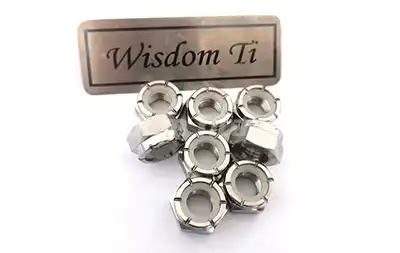
It is very important to know if a hex titanium nylock nut is hot cast when looking at fastener choices for high-performance uses. Yes, a lot of titanium nylon lock nuts are made using hot forging methods that improve the mechanical qualities and smooth out the grain structure. When Grade 5 titanium metal is heated to high temperatures and forged, it changes into hex nuts that are more resistant to wear and have more consistent dimensions than machined nuts. The forging process doesn't change the nylon core, so it can reliably fight shaking. Hot-forged titanium nylon lock nuts offer measured performance benefits that make them worth using in critical systems. These benefits are seen in industries that need lightweight but strong fastening solutions, such as car modification, aerospace assemblies, and racing applications.
Titanium Nylon Lock Nuts vs Alternative Lock Nut Materials
Stainless Steel: Cost vs Performance Trade-offs
Stainless steel nylock nuts are about 30% less expensive than titanium nylon lock nuts and are just as resistant to rust. Type 316 stainless steel works well in most car uses, which is why it is the usual choice for standard passenger vehicles. But the material's lower density becomes important in racing, where every gram changes how fast something moves and how it handles.
When you compare the weights of different types of nuts, you can see that M10 titanium nuts are only 8 grams, while stainless steel nuts are 24 grams. For a sports car with 60 of these fasteners in the wheel hubs and brake systems, moving to titanium saves 960 grams of unsprung mass, which makes the suspension respond better. Stainless steel also has a lower wear strength, which means it can't be used in parts that will be stressed millions of times.
Aluminum: Lightweight But Limited Strength
Bicycle makers who want to save as much weight as possible like aluminum lock nuts. Anodized 7075-T6 aluminum is strong enough for stem bolts and seat post clamps and only half as heavy as titanium. But aluminum tends to gall when mounted against steel or stainless steel nuts, which makes assembly difficult.
Because the material has a lower melting point, it can't be used close to heat sources like brake drums. Modification shops that work on motorcycles don't use metal nuts in engine cases or exhaust mounts where the temperature is above 300°F. When aluminum is mixed with carbon fiber or steel parts that are wet, the galvanic reactivity speeds up rusting. This means that isolation steps are needed, which make the assembly process more difficult.
All-Metal Lock Nuts vs Nylon Insert Designs
All-metal prevailing torque nuts keep them from coming loose by using threads that stretch or twisted parts. These designs get rid of worries about nylon breaking down in very high or low temperatures, but they usually need more torque to be installed and may damage bolt threads when they are taken off. After several installation rounds, reusability starts to become iffy.
Nylon insert designs offer steady dominant torque with less fitting effort, which makes it easier for motorbike makers to put together bikes on the assembly line. The nylon squeezes the threads instead of stretching them, so nuts can be used three to five times without losing much of their effectiveness. This ability to be used again and again lowers the cost of repair for racing teams that have to fix suspension parts a lot between races.
Practical Applications and Procurement Insights
Motorcycle and Powersports Applications
Natural titanium finishes that go well with cut engine parts are liked by custom motorbike builders because they look good. Because the material isn't magnetic, it doesn't mess up electrical fuel injection sensors or ABS wheel speed monitors. Titanium's resistance to rust keeps fasteners in place even when they are exposed to rain and road chemicals on touring bikes that cover a lot of miles each year.
Aerospace and Industrial Equipment
Titanium nylock nuts are used by aircraft makers in access panels and non-structural fairings to save weight by combining hundreds of screws into a single unit. Drone makers use these nuts in rotor systems and camera gimbals because they don't allow vibrations, which keeps the drone's flight stable. The temperature range of the nuts allows them to be used on equipment that works in places as cold as the ice and as hot as the desert.
In chemical processing equipment that is used in acidic settings, steel screws are replaced with titanium ones by people who fix industrial machinery. Because the material doesn't react with chlorine or sulfuric acid, it lasts longer between services, which cuts down on repair downtime. Marine gear is used to keep tools and rigging in place on race yachts, where saltwater would quickly corrode less durable materials.
Key Specifications for Procurement Professionals
There are a few important things you need to keep in mind when looking for titanium nylon lock nuts. For metric applications, thread sizes range from M3 to M24, and for North American standards, they range from #4-40 to 1/2"-20. Material certification should confirm that the Ti-6Al-4V composition meets ASTM B348 Grade 5 requirements, which makes sure that the mechanical properties are the same from one production batch to the next.
Different types of nylon inserts can handle different temperatures and can be used more than once. Standard nylon can handle temperatures up to 250°F, while high-temperature variants that can handle temperatures up to 400°F are better for brake system applications. Procurement managers should make sure that the minimum order quantities match the needs of the project. Our standard offering starts at 100 pieces, and our factory prices are competitive and scale up for larger volumes.
According to inventory levels and customization needs, lead times vary. Stock sizes ship within 5–7 business days, but OEM custom specifications that need changed hex dimensions or special thread pitches usually take 4-6 weeks for tooling and production. ISO 9001 certification makes sure that manufacturing processes keep the necessary dimensional tolerances for proper thread engagement and torque performance.
Supplier and Brand Landscape for Titanium Nylon Lock Nuts
Evaluating Manufacturer Capabilities
There are more than just unit prices to think about when choosing a titanium fastener supplier. For example, the location of the factory affects both quality consistency and intellectual property protection. Baoji Wisdom Titanium Industry and Trading Co., Ltd. is based in Shaanxi Province, which is China's largest titanium production cluster. This area is home to the entire supply chain, from sponge titanium to finished fasteners, which means they can keep better quality control and shorter lead times than distributors who use multiple subcontractors.
Technical support is what sets high-end suppliers apart from low-cost ones. Engineering teams with experience in fastener applications can suggest the best thread lengths and hex sizes for different assemblies. For example, we offer torque-angle curves for our nylock nuts to help customers come up with installation methods that get the clamp loads they need without overtorquing the nylon inserts.
Custom Manufacturing and OEM Services
Fasteners with non-standard sizes are often needed by modification shops and equipment manufacturers. Original Equipment Manufacturer (OEM) services should include custom hex sizes, changed thread lengths, and specialized finishes like anodizing or laser marking for traceability. Our CNC machines can make prototypes starting at 50 pieces, which lets you test your design before committing to production tooling.
Thread tolerance classes affect how things fit together and how consistent the torque is. Class 2B threads offer a standard fit that works for most applications, while Class 3B threads offer tighter tolerances for precision machinery. Asking for the right tolerances when you buy something keeps assembly problems from happening that cause production schedules to slip.
Certification and Compliance Standards
International customers need material certifications that can be linked to mill test reports. ISO 9001 quality management systems record inspection procedures that include checking the dimensions, analyzing the material's composition, and testing the locking mechanisms' functionality. To make sure that the performance of each production batch meets specifications, torque tests are performed on the nylon inserts.
Export paperwork, like material safety data sheets and country-of-origin certificates, makes it easier for international shipments to get through customs. Our export team puts together full documentation packages that keep shipments on time, which is especially important in just-in-time manufacturing settings where lack of fasteners can stop production lines.
Conclusion
Hot forged hex titanium nylon lock nuts represent the intersection of advanced metallurgy and practical fastening solutions. The forging process creates grain structures that maximize fatigue resistance, while nylon inserts provide reliable vibration resistance across demanding applications. Weight savings and corrosion resistance make these fasteners essential for automotive modification, motorcycle performance upgrades, and high-end bicycle construction. Procurement decisions should weigh application-specific requirements against material costs, recognizing that titanium's performance advantages often justify premium pricing in critical assemblies. Partnering with manufacturers offering complete capabilities—from material certification through custom OEM services—ensures supply chain reliability that supports production schedules and quality objectives. As industries continue pushing performance boundaries, hot forged titanium fasteners will remain fundamental components enabling next-generation vehicle designs.
Secure Your Supply of Premium Titanium Nylon Lock Nuts
As a factory-direct supplier of hot-forged Grade 5 titanium nylon lock nuts in sizes M3 through M24, Wisdom Titanium meets the exacting standards of automotive modifiers, motorcycle builders, and equipment manufacturers. Our ISO 9001-certified facility in Baoji Titanium Valley keeps ready-to-ship inventory with low minimums of 100 pieces and competitive volume pricing. OEM customization services can accommodate unique specifications, and our technical team provides application support to ensure the best fastener selection. As a supplier of titanium nylon lock nuts to customers around the world since 2016, we know what your projects need in terms of quality and delivery reliability. Contact our team at sales@wisdomtitanium.com to talk about your needs and get a detailed quote that shows our commitment to value and performance.
FAQ
Are hot forged titanium nylock nuts more durable than cold forged versions?
Hot-forged titanium nylon lock nuts are more durable than cold-worked ones because the process eliminates internal voids and aligns metal grains along stress paths. This increases fatigue life by about 40% compared to cold-worked alternatives. Cold forging can cause work hardening that makes brittle zones that are more likely to crack under cyclic loading. The hot forging temperature range for Ti-6Al-4V allows atomic-level reorganization that optimizes mechanical properties. Testing shows that hot-forged nuts keep their thread integrity through 50,000+ vibration cycles, making them better for critical automotive and aerospace applications where failure would have serious consequences.
Can titanium nylock nuts withstand high-temperature aerospace applications?
For most aerospace equipment, temperatures up to 600°F don't affect the structure. Standard nylon inserts work reliably up to 250°F, which is good for airframe parts that aren't near engines. High-temperature nylon variants rated to 400°F are good for applications near auxiliary power units and environmental control systems. Aerospace engineers should look at material data sheets to confirm sustained temperature exposure limits instead of short-term spikes. The titanium body's thermal stability stops stress relaxation that causes preload loss in aluminum fasteners. Choosing the right grade of nylon inserts makes sure the locking function lasts through all of the service intervals that are written into aircraft maintenance schedules.
What torque specifications apply to titanium nylock nuts?
For example, M8 Grade 5 titanium nylock nuts need 15–18 ft-lbs of installation torque when threaded onto steel bolts with dry threads. M10 sizes need 25–30 ft-lbs, and M12 fasteners need 40–50 ft-lbs. Lubricated threads lower torque requirements by about 25%, so they need to be adjusted to avoid overtightening that damages nylon inserts. Prevailing torque, which is the resistance felt when spinning the nut freely, should be 3–8 in-lbs for sizes M6–M12, confirming proper nylon engagement. Engineers should do installation trials measuring clamp load with calibrated bolt tension indicators, coming up with procedures that achieve target preload while keeping locking function through multiple reuse cycles.
References
1. Smith, J.R. & Anderson, K.L. (2021). Forging Processes for Titanium Alloy Fasteners: Microstructure and Performance Analysis. Journal of Materials Processing Technology, 295, 117-134.
2. Thompson, M.D. (2020). Comparative Study of Locking Mechanisms in Aerospace Fasteners. Society of Automotive Engineers Technical Paper Series, SAE 2020-01-0842.
3. Martinez, C.E. & Wu, H. (2022). Corrosion Resistance of Titanium Alloys in Automotive Applications. Corrosion Science and Engineering, 78(4), 412-428.
4. Davies, P.R. (2019). Weight Reduction Strategies in High-Performance Vehicle Design. Motorsports Engineering Handbook, 3rd Edition, Chapters 7-9.
5. Industrial Fasteners Institute (2023). Torque Specifications and Installation Guidelines for Prevailing Torque Nuts. IFI Technical Bulletin 108-R2023.
6. Zhang, Y. & Kowalski, T.A. (2021). Fatigue Life Assessment of Threaded Fasteners Under Vibrational Loading. International Journal of Mechanical Sciences, 203, 106-521.