
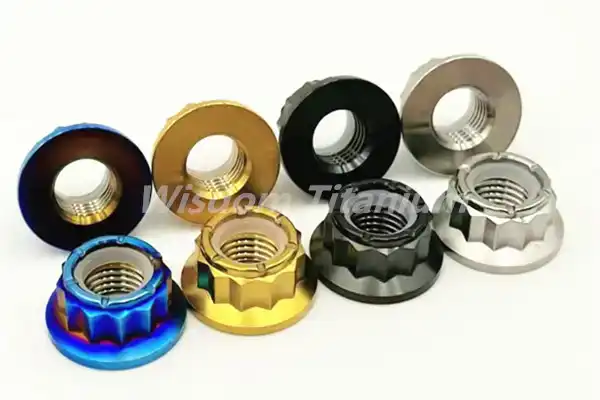
In modern industry, a loose fastener is more than a nuisance. It can stop a production line, damage equipment, or even cause a safety incident. When vibration, corrosive media, and weight limits come together, ordinary steel nuts struggle. In that gap, the titanium nylock nut has become a reliable solution for engineers worldwide.
Baoji Wisdom Titanium, based in China’s well‑known “Titanium Valley” in Shaanxi Province, focuses on producing titanium fasteners that stay tight under harsh working conditions.
Why Titanium Nylock Nuts Are Ideal for Anti‑Vibration Fastening?
How Nylock Technology Prevents Loosening Under Vibration
A nylock nut, sometimes called a nylon insert lock nut, has a small ring of nylon pressed into the nut’s collar. When the nut is tightened, the mating bolt thread cuts slightly into that nylon ring. This creates friction and a prevailing torque that resists rotation. Unlike spring washers or split lock washers, the locking function is built into the nut itself and does not rely only on clamping force.
Under continuous vibration, such as on engines, pumps, or high‑speed rotating equipment, standard nuts can back off step by step. The nylon insert in a nylock nut grips the bolt thread and slows that microscopic movement. As a result, the joint stays secure for a longer time, and maintenance intervals can be extended. This effect is especially valuable in locations that are difficult or costly to access.
In many industrial tests, nylock designs have shown better resistance to self‑loosening than simple hex nuts with washers. Independent studies, including work cited by fastener standards bodies such as ISO and ASTM, have confirmed that prevailing‑torque locknuts reduce the risk of vibration‑induced loosening when properly applied and not overheated.
Why Titanium Makes the Nylock Design Even Better
The nylon insert provides the locking effect, but the base material of the nut decides how well the joint handles weight, corrosion, temperature, and fatigue. Here, titanium has several natural advantages. Its strength‑to‑weight ratio is very high, which means that a titanium nylock nut can replace a stainless steel nut, reduce weight, and still keep similar mechanical strength.
Titanium also forms a stable oxide film on its surface once exposed to air. This dense oxide layer protects the underlying metal from many acids, chlorides, and salt spray. In marine, offshore, or chemical plant environments, this corrosion resistance translates into longer service life and less risk of seized or rusted threads. Where steel fasteners can suffer from pitting, galling, or hydrogen embrittlement, titanium holds up far better.
Another benefit lies in non‑magnetic and low thermal expansion properties. Sensitive sensors, medical devices, and high‑frequency electronics often require non‑magnetic hardware that does not distort magnetic fields or instrument readings. Titanium nylock nuts meet that need while maintaining mechanical security under temperature changes that could loosen other materials.
Balancing Locking Strength, Reuse, and Temperature Limits
Engineers sometimes ask how often a nylock nut can be reused. In general, any nylock nut, whether titanium or steel, loses part of its locking torque each time it is installed and removed. The nylon ring deforms permanently. For critical joints, it is better practice to treat nylock nuts as limited‑use components and replace them after a set number of cycles or at planned overhaul.
Temperature is another design factor. At high temperatures, nylon softens,s and its locking effect fades. Many datasheets suggest keeping nylock nuts below about 120 °C to 135 °C, depending on the nylon grade. Titanium itself can withstand far higher temperatures, but the nylon insert cannot. For hot zones, metal locknuts or all‑metal prevailing‑torque designs may be more suitable. In cold environments, however, titanium nylock nuts continue to lock well and resist brittle failure, which suits aerospace and polar applications.
When the right temperature range is respected and torque is applied correctly, titanium nylock nuts deliver a useful balance: strong vibration resistance, lower weight, excellent corrosion protection, and reliable long‑term clamping force.
Industrial Applications and Design Choices for Titanium Nylock Nuts
Where Engineers Use Titanium Nylock Nuts in Real Projects
Titanium fasteners are no longer limited to experimental aircraft or racing prototypes. They appear across many industries where vibration, corrosion, and weight interact. Some common application fields for the titanium nylock nut include:
In aerospace and aviation, titanium lock nuts secure structural panels, engine attachments, landing gear components, and control system linkages. Every kilogram saved can translate into fuel savings or additional payload. At the same time, aerospace hardware must endure strong vibration, repeated load cycles, and sometimes aggressive de‑icing chemicals. Titanium’s fatigue resistance and corrosion performance answer those needs.
In high‑performance automotive and motorcycle systems, especially racing and performance tuning, titanium nylock nuts are used on suspension arms, brake systems, exhaust mounts, and engine accessories. They help reduce unsprung mass, improve handling response, and maintain tight joints under braking and cornering vibration. Motorcyclists and cyclists also favor titanium hardware for its strength and striking surface finishes.
Marine and offshore project teams choose titanium lock nuts for pump skids, subsea instruments, valves, and structures exposed to seawater and splash zones. In these locations, corrosion can be rapid. Standard carbon steel hardware needs frequent replacement and creates maintenance costs. Titanium’s natural resistance to saltwater means fewer interventions and higher long‑term reliability.
In the chemical, energy, oil, and gas sectors, titanium fasteners are used where media may be acidic, chlorinated, or contain hydrogen sulfide. Equipment such as heat exchangers, reactors, and pipeline accessories can gain longer service life with titanium nylock nuts, especially when combined with titanium flanges, rods, and forgings from the same supply chain.
Choosing Flange, Hex, and Customized Forms
Baoji Wisdom Titanium manufactures several configurations of titanium nylock nuts to suit different joint designs and torque transfer requirements. The main styles include:
The hex nylock nut is the most common form. It uses a standard six‑sided profile that works with regular wrenches or sockets. This format is suitable for general machinery, pipe supports, brackets, and any place that uses standard hex bolts.
The 12pt flange nylock nut uses a 12‑point head and an integrated flange. The twelve‑point geometry allows finer positioning of the wrench in tight spaces, which helps in aerospace and automotive assemblies where access is limited. The built‑in flange spreads clamping force over a larger area, reduces surface pressure, and often removes the need for a separate washer.
Hex flange nylock nuts combine the familiar hex head with a wide flange base. This style is popular on engine mounts, sheet metal joints, and composite structures. The flange stabilizes the joint, reduces the risk of pull‑through, and improves resistance to loosening when the clamped material is softer, such as aluminum or composites.
In many projects, standard dimensions are not enough. Engineers may need special thread pitches, non‑standard heights, weight‑reduced reliefs, or custom drive profiles. Wisdom Titanium supports customized titanium nylock nut designs through CNC machining and in‑house R&D support. Customers can send drawings, 3D models, or even physical samples for reverse engineering and joint optimization.
Surface Finishes, Colors, and Identification
While function is the first priority, surface appearance also matters. It can help identify material grade, project stage, or torque sequence. It can also enhance the visual impact of high‑end products like performance motorcycles, bicycles, and racing engines.
Baoji Wisdom Titanium provides titanium nylock nuts in a wide range of colors and finishes, including black, red, gold, burnt blue, green, blue, rainbow, and natural titanium color. These colors are achieved through surface treatments such as anodizing of titanium, which not only provides visual variety but also reinforces the protective oxide film.
Color coding can improve assembly efficiency and maintenance safety. For example, one color may denote a specific torque range or maintenance interval, while another color could indicate a different alloy or location in the system. By combining color with part marking, traceability improves across the entire life cycle of the equipment.
Why Baoji Wisdom Titanium Is a Reliable Partner for Titanium Nylock Nuts?
Located in China’s Titanium Valley with a Complete Supply Chain
Baoji Wisdom Titanium Industry and Trading Co., Ltd operates in Baoji, Shaanxi Province. This region is widely recognized as “China’s Titanium Valley,” one of the largest and most comprehensive titanium industry clusters in the world. Hundreds of titanium enterprises form a dense industrial ecosystem that covers titanium sponge production, melting into ingots, rolling into plates, drawing tubes, and forging complex shapes.
For customers, this location offers a practical benefit: a complete and stable supply chain for titanium materials. Raw titanium rods used for a titanium nylock nut can be sourced quickly, with better batch control and traceability. From primary metallurgy to final machining and surface finishing, each step can be monitored to comply with ISO 9001 quality systems and relevant industry standards.
Baoji’s titanium industry supplies aerospace, marine engineering, petrochemicals, medical implants, energy, and defense sectors. Frequent participation in international titanium conferences and standardization work has given local companies broad technical experience. Wisdom Titanium draws on this environment and applies it to both standard fasteners and custom CNC components.
Quality Control, Service, and How to Start an Inquiry
Good fasteners do not come from machining alone. They are the result of controlled processes from raw material selection to packing. Wisdom Titanium maintains a complete inventory of raw materials and standard parts with stable pricing, which reduces lead time and supply risk for recurring orders.
Mature production technology, stable staff, and full‑process inspection help ensure that each titanium nylock nut meets specification. All operations follow ISO 9001 guidelines, including document control, calibration of measurement tools, and handling of non‑conforming products. For industries with stricter demands, additional documentation packages can be provided upon request.
Service does not end at delivery. Customer questions about installation torque, coating choices, or material selection are treated seriously and answered by experienced technical staff. Over time, this feedback loop has allowed Wisdom Titanium to adapt product lines to the real conditions seen in the field, instead of only to theoretical design data.
If you are considering titanium nylock nuts for a new project or want to replace existing steel fasteners, you can send drawings, technical requirements, or even photos of current assemblies for evaluation. To get a detailed quote or more information, please contact: sales@wisdomtitanium.com.
When sending an inquiry, it helps to include:
- Drawing or standard (ISO, DIN, ASME) reference
- Size, thread type, and strength class if needed
- Expected working temperature and environment
- Required quantity and delivery time
- Preferred style (12pt flange, hex flange, hex) and color
With this information, Baoji Wisdom Titanium can respond faster, propose optimized designs if suitable, and provide a competitive quotation that matches both technical and budget targets.
FAQs
Q1: In which situations should I choose a titanium nylock nut instead of a standard steel lock nut?
A: Choose a titanium nylock nut when vibration, corrosion, and weight limits come together. Typical cases include aerospace structures, marine and offshore equipment, racing automotive or motorcycle systems, and chemical process installations. In these environments, titanium offers high strength with low weight and superior corrosion resistance. The nylon insert adds reliable anti‑vibration locking, so the joint stays tight longer and maintenance intervals can be extended.
Q2: What information should I prepare before sending an inquiry to Baoji Wisdom Titanium?
A: Before you contact us, try to prepare basic technical data: nut style (12pt flange, hex flange, hex), thread size and pitch, any relevant standard, expected working temperature, and environment, such as seawater or chemicals. It is also helpful to specify the required quantity, delivery time, and preferred color finish. Drawings or 3D models, if available, can speed up evaluation.
Q3: Are titanium nylock nuts suitable for very high‑temperature applications?
A: The titanium base material can withstand high temperatures, but the nylon insert cannot. Above roughly 120 °C to 135 °C, depending on the nylon grade, the locking torque of the insert drops sharply. For joints that operate in that higher range, all‑metal lock nuts or other high‑temperature locking methods are usually better choices. For ambient or moderately elevated temperatures with vibration, titanium nylock nuts work very well.
References
- ISO 2320:2015 – Prevailing torque type steel hexagon nuts – Functional properties.
International Organization for Standardization. - ASTM F468 – Standard Specification for Nonferrous Bolts, Hex Cap Screws, and Studs for General Use.
ASTM International. - Donachie, M. J. (2000). Titanium: A Technical Guide (2nd ed.). ASM International.
- Leyens, C., & Peters, M. (Eds.). (2003). Titanium and Titanium Alloys: Fundamentals and Applications.
Wiley‑VCH. - European Industrial Fasteners Institute (EIFI) – Technical notes on vibration loosening and locking devices for threaded fasteners.