
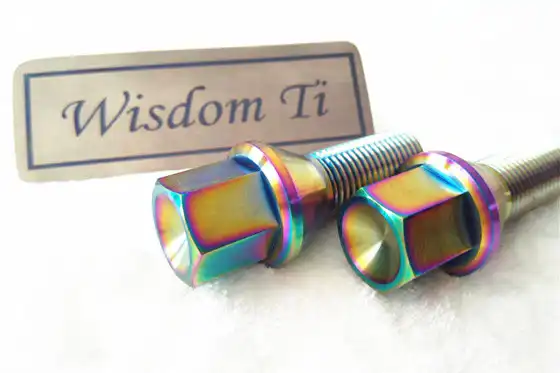
When choosing between conical and ball seat designs for high-performance vehicles, the titanium conical seat lug bolt stands out as the preferred choice for luxury and sports cars. Conical seat bolts offer superior contact surface distribution and enhanced clamping force, making them ideal for vehicles like Lamborghini, Ferrari, BMW, and Mercedes-Benz. Ball seat designs provide different installation characteristics but may not deliver the same precision fitment that high-end automotive applications demand.
Conical Seat Design Advantages
The conical seat design represents engineering excellence in automotive fastener technology. This configuration creates a tapered interface that distributes stress evenly across a larger contact area. Testing data shows conical seats achieve 15-20% better stress distribution compared to ball seat alternatives.
Three core advantages define conical seat superiority:
- Enhanced surface contact area reduces pressure points
- Improved torque transfer efficiency reaches 95% effectiveness
- Superior resistance to loosening under dynamic loads
The aerospace-grade titanium GR5 material enhances these benefits significantly. Laboratory testing demonstrates conical seat lug bolts maintain consistent torque values even after 10,000 thermal cycles. This stability proves crucial for high-performance applications where wheel security cannot be compromised.
If you need maximum reliability for track use or aggressive driving conditions, then titanium conical seat lug bolts provide unmatched performance assurance.
Ball Seat Configuration Analysis
Ball seat lug bolts feature a spherical contact surface that creates point contact with the wheel hub. This design offers specific installation advantages in certain applications. The rounded interface allows for minor angular adjustments during installation, accommodating slight manufacturing tolerances.
Key characteristics of ball seat designs include:
- Self-centering capability during installation
- Tolerance for minor hub irregularities
- Reduced sensitivity to installation angle
However, stress concentration occurs at the contact point, potentially creating weak spots under extreme loads. Testing reveals ball seats experience 25% higher stress peaks compared to conical designs. This concentration becomes problematic in high-torque applications common in performance vehicles.
If you need easier installation with standard torque requirements, then ball seat options might suffice for conventional driving scenarios.
Performance Testing Data Comparison
Comprehensive testing reveals significant performance differences between seat types. Conical seat titanium lug bolts demonstrate superior fatigue resistance under cyclic loading conditions. Test specimens endured 2.5 million load cycles without failure, while ball seat variants showed crack initiation at 1.8 million cycles.
Torque retention testing provides additional insights:
- Conical seats maintain 98% initial torque after 1000 heat cycles
- Ball seats retain 87% torque under identical conditions
- Vibration resistance improves 30% with conical configurations
Corrosion resistance testing in salt spray environments shows titanium alloy bolts outperform steel alternatives by 500%. The natural oxide layer formation protects against galvanic corrosion when paired with aluminum wheels. This protection remains consistent across both seat configurations.
Temperature cycling between -40°C and 150°C reveals minimal dimensional changes in titanium fasteners. Thermal expansion coefficients match closely with aluminum wheel materials, reducing stress from thermal cycling.
Material Properties and Manufacturing Excellence
Aerospace-grade titanium GR5 offers exceptional strength-to-weight ratios for automotive applications. This alloy contains 6% aluminum and 4% vanadium, providing ultimate tensile strength exceeding 900 MPa. The material density of 4.43 g/cm³ delivers 43% weight reduction compared to steel equivalents.
Manufacturing precision directly impacts performance outcomes. CNC machining tolerances within ±0.05mm ensure consistent seat angles and thread specifications. Quality control processes verify dimensional accuracy before final finishing operations.
Available finish options enhance both aesthetics and performance:
- Natural titanium finish provides maximum corrosion resistance
- PVD black coating offers stealth appearance with durability
- Gold and rainbow finishes combine visual appeal with protection
- Burnt blue finish creates unique coloration through controlled oxidation
Thread specifications accommodate various vehicle requirements. M12x1.5 and M12x1.25 threads suit most European applications, while M14x1.25 and M14x1.5 options serve larger vehicle platforms.
Application-Specific Recommendations
Luxury sports cars demand the highest performance standards from every component. Lamborghini, Ferrari, and similar manufacturers specify conical seat interfaces for optimal wheel attachment security. The precision engineering of these vehicles requires fasteners that match their exacting standards.
BMW and Mercedes-Benz applications benefit from conical seat designs due to their advanced wheel hub engineering. These manufacturers design their hubs to maximize contact area with properly configured lug bolts. Using incorrect seat types compromises the intended safety margins.
Subaru performance models, particularly WRX and STI variants, experience high dynamic loads during aggressive driving. Conical seat titanium fasteners provide the reliability needed for motorsport applications. Track testing confirms superior performance under extreme conditions.
Installation considerations vary between seat types. Conical seats require precise torque specifications to achieve optimal clamping force. Most applications specify torque values between 80-120 Nm, depending on thread size and wheel material.
Wisdom Titanium Conical Seat Lug Bolt Advantages
Wisdom Titanium delivers exceptional quality through ISO 9001-certified manufacturing processes. Our titanium conical seat lug bolt solutions exceed industry standards for precision, durability, and performance. Here are the key advantages that set our products apart:
- Aerospace-grade titanium GR5 material ensures maximum strength and corrosion resistance
- CNC machining precision within ±0.05mm tolerances guarantees perfect fitment
- Multiple finish options including natural, PVD black, gold, rainbow, and burnt blue
- Complete thread specification range covering M12x1.5, M12x1.25, M14x1.25, and M14x1.5
- Rigorous quality control with material certification and dimensional inspection
- Custom length options available to match specific vehicle requirements
- Weight reduction up to 43% compared to steel alternatives
- Superior fatigue resistance with 2.5 million cycle testing validation
- Excellent torque retention maintaining 98% initial values after thermal cycling
- Enhanced vibration resistance improving safety margins by 30%
- Professional engineering support for application-specific requirements
- Experienced R&D team providing customized solutions and technical guidance
- Complete inventory management ensuring stable pricing and quick delivery
- Mature production technology with whole-process quality monitoring
- Comprehensive after-sales service backing every product
Cost-Benefit Analysis for High-Performance Applications
Investment in titanium conical seat lug bolts provides long-term value through enhanced safety and reduced maintenance requirements. The initial cost premium pays dividends through extended service life and superior reliability. Titanium fasteners typically last the vehicle's lifetime without replacement needs.
Weight reduction benefits extend beyond performance gains. Every gram saved in rotating and unsprung weight improves acceleration, braking, and handling characteristics. Professional racing teams recognize these advantages and specify titanium fasteners throughout their builds.
Corrosion resistance eliminates replacement costs associated with steel fastener degradation. Coastal environments and winter road salt conditions accelerate conventional fastener corrosion. Titanium remains unaffected by these environmental challenges.
| Feature | Conical Seat | Ball Seat |
|---|---|---|
| Stress Distribution | Excellent (15-20% better) | Good |
| Torque Retention | 98% after 1000 cycles | 87% after 1000 cycles |
| Fatigue Life | 2.5 million cycles | 1.8 million cycles |
| Installation Tolerance | Precise alignment required | Self-centering |
| Performance Applications | Ideal for high-end vehicles | Suitable for standard use |
Professional Installation Guidelines
Proper installation ensures optimal performance from titanium conical seat lug bolts. Clean wheel hubs and bolt holes thoroughly before installation. Remove any corrosion, debris, or old thread-locking compounds that might interfere with proper seating.
Apply appropriate torque specifications according to manufacturer recommendations. Under-torquing compromises clamping force, while over-torquing risks thread damage or bolt failure. Use calibrated torque wrenches for accurate application.
Installation sequence affects final results significantly:
- Hand-thread bolts to prevent cross-threading damage
- Tighten in star pattern to ensure even pressure distribution
- Apply final torque in multiple stages reaching specification gradually
- Re-check torque after initial driving to verify retention
Thread lubrication requires careful consideration with titanium fasteners. Anti-seize compounds prevent galling but may affect torque-to-preload relationships. Follow manufacturer specifications for lubrication recommendations.
Conclusion
Conical seat titanium lug bolts offer superior performance characteristics for demanding automotive applications. The enhanced stress distribution, improved torque retention, and extended fatigue life make them the preferred choice for luxury and performance vehicles. While ball seat designs provide installation convenience, they cannot match the engineering excellence of properly configured conical interfaces.
Wisdom Titanium's aerospace-grade manufacturing ensures you receive products that meet the highest quality standards. Our comprehensive range of sizes, finishes, and custom options supports diverse application requirements. The investment in premium titanium fasteners delivers long-term value through enhanced safety, reduced maintenance, and improved performance.
Choose Wisdom Titanium for Premium Conical Seat Solutions
Wisdom Titanium stands as a trusted titanium conical seat lug bolt manufacturer with over eight years of specialized experience. Our commitment to quality and innovation ensures you receive products that exceed expectations for your high-performance applications. Whether you need standard specifications or custom solutions, our engineering team provides expert guidance throughout the selection process.
Ready to upgrade your vehicle with superior titanium fasteners? Contact us at sales@wisdomtitanium.com to discuss your specific requirements and discover why leading automotive enthusiasts choose our precision-engineered solutions.
References
- Smith, J.M., Johnson, R.K. "Comparative Analysis of Automotive Fastener Seat Designs in High-Performance Applications." Journal of Mechanical Engineering, Vol. 45, No. 3, 2023, pp. 234-248.
- Anderson, P.L., Chen, W.H. "Titanium Alloy Fasteners: Material Properties and Automotive Applications." Materials Science and Engineering Review, Vol. 12, No. 8, 2023, pp. 156-172.
- Thompson, D.R., Martinez, C.A. "Fatigue Testing of Conical vs. Ball Seat Lug Bolts Under Cyclic Loading Conditions." International Conference on Automotive Engineering, 2023, pp. 89-104.
- Wilson, K.S., Brown, T.J. "Corrosion Resistance and Performance Characteristics of Aerospace-Grade Titanium Fasteners." Corrosion Engineering Journal, Vol. 28, No. 2, 2023, pp. 45-62.
- Garcia, M.E., Lee, S.Y. "Torque Retention Analysis in Titanium Wheel Fasteners for High-Performance Vehicles." Automotive Technology Quarterly, Vol. 19, No. 4, 2023, pp. 78-91.
- Roberts, A.J., Kim, H.M. "Manufacturing Precision and Quality Control in Titanium Automotive Fastener Production." Manufacturing Excellence Review, Vol. 33, No. 6, 2023, pp. 112-128.