
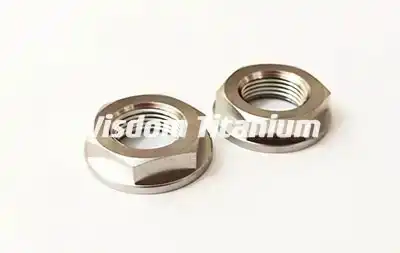
A titanium jam nut is a thin hex nut that you tighten against a standard nut to lock the pair in place. A lock nut is a single fastener with its own locking feature, such as a nylon insert or a deformed metal thread. The main difference is where the locking comes from. A jam nut locks through a second nut and friction, while a lock nut holds on its own. Our Grade 5 titanium jam nuts are short, light, and strong, so they suit tuning cars and racing cars.
Titanium Jam Nut vs Lock Nut: What Is the Difference?
Definitions and Basic Design
If you take a look at a normal nut with the same thread size, it's longer than a titanium jam nut. This is how we make our Titanium Jam Nuts. They are made of Grade 5 titanium and are short and light. A lock nut is a separate part that locks itself when it's put together like a puzzle. You can find prevailing-torque nuts that are made of metal, nuts that have serrations, and nuts that have slots that are used with cotter pins. To lock, titanium jam nuts need to be pushed against either another jam nut or a threaded part. That's why I tell my clients not to think of them as swaps that happen right away. Take a look at the standard, the preload, and the vibration load first.
How a Jam Nut Locks a Joint?
When you push two nuts against each other, they lock together. To begin, I tighten the main nut until it feels just right. I put the titanium jam nut on the bolt or screw as it gets close to the main nut. I hold the main nut still with one wrench and tighten the jam nut with the other. The two nuts press on the threads in different directions, which makes it harder to turn because of more friction. It's important to have the right tools, clean threads, and the right amount of pressure. Titanium threads that can get stuck should be oiled with anti-seize or an approved lubricant if the design lets you.
Benefits and Limits of Titanium
Titanium is nice because it is light and doesn't rust. Most steel is about 7.85 g/cm³ dense, but Grade 5 (Ti-6Al-4V) is only 4.43 g/cm³ dense. In other words, a Grade 5 part of the same size is 44% lighter. A layer of oxide forms on titanium that keeps it safe from water and road salt. But the limits are real. The metal itself doesn't provide any torque, its threads can get stuck, and it costs more than steel. To handle hard vibration, you need a way to lock that you have tried out on a real joint. Also, a thin nut can't hold as much thread-stripping load as a full nut because it has fewer threads that are engaged.
Titanium Jam Nut vs Steel, Stainless Steel, and Aluminum Locking Solutions
Steel and Stainless Steel Lock Nuts
You can get steel lock nuts for a low price and they are strong. Because of this, they can be used to fix heavy machinery and other things. When price and load capacity are more important than weight, choose them. They're heavy, and if you don't cover them, they rust. Steel that doesn't rust as quickly is heavy and can gall. Nylon-insert nuts made of steel or stainless steel can only handle a certain temperature, which is usually around 250°F (120°C). It is important to do this near brakes and engines. A titanium jam nut doesn't have any plastic in it, so heat can't soften an insert. Finally, Grade 5 Titanium stays strong at temperatures that are much higher than what nylon can handle.
Aluminum Locking Options
Anodized aluminum nuts are cheap, light, and look good in different colors. Strength is what you give up. Titanium Grade 5 can handle higher temperatures and has a higher tensile strength than aluminum. The threads on aluminum are also softer. Every time you race, if you tune the same rod end or adjustment, the soft threads can separate or wear out. In some states and standards, Grade 5 Titanium can hold up to 950 MPa of tension, which is a lot more than most aluminum alloys can handle. Aluminum is a good metal for trim and covers that don't need to be strong. Titanium is my first choice for heavy parts.
Weight, Cost, and Total Value
It's not just the price per piece. Titanium has many benefits that can be tested, such as being lighter, less likely to rust, and looking more expensive. It doesn't save much weight to lose one nut. When you look at a full car with lots of adjusters, you save a lot of mass. People who race keep track of every gram. Compare the locking method, service conditions, tools, repair needs, and papers to find the best choice. If the part needs a real prevailing-torque nut, steel might be the best material. Titanium is a good choice if the joint works with a thin nut.
Titanium Jam Nut Grades, Specifications, and Dimensions
Grade 5 vs Grade 2 Titanium
Titanium Grade 2 is clean enough to buy. It's not as strong, but it shapes well and doesn't rust. About 6% of Grade 5 is aluminum and 4% is vanadium. It is much stronger, so it works well for parts that feel the weight of things when they are loaded. ASTM B348 is often on the lists of people who buy titanium because it covers both bars and billets. Cut to Grade 5 size, the titanium bar we use to make our titanium jam nuts. Do not buy a fake alloy. Instead, get a material certificate and check that it matches the grade you bought. The word "titanium" doesn't do it justice.
Thread, Size, and Height
The thread type (inches or metric), pitch, thread class, height, across-flats size, chamfer, and surface condition are all important parts of a good buy spec. A key Titanium Jam Nut is different because of its height. Base ISO 4035 says that thin nuts are not as long as full nuts. An M10 thin nut is only 5 mm tall, while an ISO 4032 M10 nut is about 8 mm tall. Less long parts, like rod-end adjustments, are lighter and can fit more places. The drawing tells us exactly what size jam nuts you need, so send us your thread and height needs. Before you say yes, you should get pictures and know how much each piece weighs. You can also weigh a sample to be sure that the amount of weight you'll save is correct.
Polished, Anodized, and PVD Finishes
We can smooth, anodize, or PVD coat the outside of titanium jam nuts to give them a different look. Metal looks clean and shiny after being polished. Titanium gets a thin oxide film when it is anodized. As the film thickness changes, its color changes. This means that it can be used for both brand parts and cosmetic builds. PVD coating puts on a thin film that gives the thing color and a hard surface in a vacuum chamber. When you pick a color, make sure it's the right thread class for the finish you want. We'll look at it on a sample first and confirm the color and finish you want.
How to Choose a Titanium Jam Nut and Where to Use It?
Start with the Joint Requirement
Do not start with the material, but with the joint. Figure out what's most important to you: cost, vibration, weight, space, corrosion, making the same adjustments over and over, or heat. Instead of a thin titanium jam nut that hasn't been tested, the engine, chassis, and moving parts need a tried-and-true way to lock them together. Next, see what the environment is like. This should include things like humidity, chemicals, changes in temperature, road salt, and contact with other metals. After that, write down how many times you change the part. Titanium can be adjusted many times if you grease the threads. A titanium jam nut will make the joint compact and hold the setting. Choose a lock nut when the joint needs built-in thread retention.
Tuning Car and Racing Car Uses
People who tune and race cars use titanium jam nuts to keep threaded fasteners in place. People often put them on rod ends, tie-rod adjusters, camber and toe links, and end links that can be moved. People who race like how short and light it is because there isn't much space around the suspension hardware. Titanium doesn't rust, so it's a good material for parts that get wet from washing, rain, or road salt. There is more heat, impact, and regular maintenance when you race, so I think you should test a new nut on your own setup before the race. It is important to check the torque after the first run and every time you service the vehicle.
Motorcycle, Bicycle, and Industrial Uses
Titanium jam nuts that are very thin are used for more than just cars. These are also used in robots, aerospace hardware, motorbikes, and bicycles because they are light and don't take up much room. Businesses that have to follow the rules often ask for things like material certificates, lot tracking, and first-article approval. We work with people in the medical, electronics, chemical, marine, automotive, motorcycle, and bicycle industries, so we know what kinds of paperwork people need. When the design calls for a certified prevailing-torque or mechanical locking nut, you should never use a jam nut.
Buying Titanium Jam Nuts for OEM and B2B Projects
Supplier Checks and Quality Records
Check a supplier's titanium jam nut grade, their ability to machine, their thread inspection capability, quality system, and their export packaging. Wisdom Titanium is Baoji Wisdom Titanium Industry and Trading Co., Ltd, an ISO 9001-certified manufacturer and supplier of standard and customized CNC parts, founded in 2016. Because we do our own research and development, the prices of our basic parts and raw materials remain stable. Also, we check every product as it's being made and again before it's sent out. When parts come in, you should check them with accurate gauges and ask for material certificates and inspection reports. Look at how much each service charges for landed cost. The cost of tooling, paperwork, shipping, the minimum order, and the risk of delivery are all part of this.
Why Baoji Titanium Valley Matters?
Our company sits in the Baoji Titanium Valley in Shaanxi Province. The largest and most complete titanium industry cluster in China is here. It is one of the most influential titanium production bases in the world. As part of the local industry chain are titanium sponge, ingots, bars, plates, tubes, forgings, and high-performance titanium alloys. That means you are close to suppliers that work with Grade 5 rod stock. We also make fasteners out of nickel, tantalum, and zirconium, and we supply titanium rods, flanges, and forgings. This means you can work with one partner to build a wider product line.
Samples, MOQ, and Quote Details
Getting quotes goes faster when you know what you want. We develop parts from your drawing, sample, or idea. Here is what I need:
- Thread and size: Send the thread type, pitch, thread class, across-flats size, and height. Add a 2D drawing or 3D model if you have one. If you only have a sample, please send us clear pictures along with caliper measurements of the thread and height, as well as the mating part. Those will help us.
- Material and finish: Tell us the grade you need, which is Grade 5 for these nuts, and choose polished, anodizing, or PVD coating. You can specify any color target you have in mind. Please let us know ahead of time if you need a material certificate or an inspection report, so we can plan the paperwork before production starts.
- Quantity and delivery: Our MOQ is 200 items. Tell us your order quantity, yearly forecast, destination, and target delivery date. A forecast helps us plan raw material ahead of your busy season, and a clear date lets us quote a lead time you can plan around. Mention a race season or product launch if one applies.
Conclusion
A Titanium jam nut and a lock nut solve different problems. To lock, you press a jam nut against a standard nut. They are thin and light. A lock nut, on the other hand, holds things in place with its own retention feature, like a nylon insert or prevailing-torque thread. Grade 5 Titanium is about 44% lighter than steel, and it resists corrosion and heat. However, it costs more, its threads can gall, and it adds no locking force by itself. Steel, stainless steel, and aluminum each fit other loads and budgets. It's important to think about the joint, thread standard, height, grade, finish, vibration, and temperature when making a selection. As long as the joint has been tested, the short, light design is best for tuning and racing builds.
FAQ
Is a Titanium Jam Nut self-locking?
No. A Titanium Jam Nut has no built-in prevailing torque. To lock it, you need to push it against a standard nut and tighten the pair in the right order. For a joint with heavy vibration, test the setup on the real part or choose a certified lock nut instead.
Why choose Grade 5 over Grade 2 for racing?
Grade 5 (Ti-6Al-4V) gives much higher strength than commercially pure Grade 2, which is what most buyers order for high-load parts. This means that even a short, thin nut can carry a useful load. Grade 2 resists corrosion and forms easily, so it suits lighter duty. For tuning and racing hardware, I recommend Grade 5.
What is the MOQ, and which finishes can I choose?
Our MOQ is 200 items. Surface options are polished, anodizing, and PVD coating. Email us with your thread size, height, finish, and quantity, and we will confirm the details with you.
Request a Titanium Jam Nut Quote from Wisdom Titanium
Wisdom Titanium is a titanium jam nut manufacturer in Baoji with in-house R&D, and a stocked supply of raw materials. Our MOQ is 200 pcs, and you can choose polished, anodizing, or PVD coating. Email your drawing or sample details to sales@wisdomtitanium.com, or visit wisdomtitanium.com to start your quote.
References
- ASTM B348/B348M, Standard Specification for Titanium and Titanium Alloy Bars and Billets, 2019
- ISO 4035, Hexagon Thin Nuts, Chamfered (Style 0), 2012
- ASME B18.2.2, Nuts for General Applications: Machine Screw Nuts, Hex, Square, Hex Flange, and Coupling Nuts (Inch Series), 2015
- Materials Properties Handbook: Titanium Alloys, ASM International, 1994
- Titanium: A Technical Guide, ASM International, 2000
- Introduction to the Design and Behavior of Bolted Joints, CRC Press, 2007