
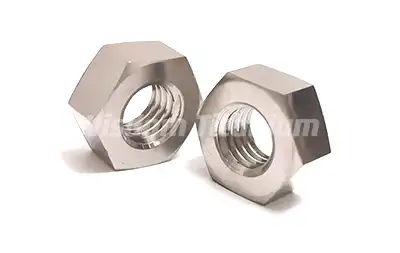
The safety and lifetime of equipment depend directly on how reliable fasteners are in industrial production, high-end equipment, and other industries. Because of their unique material benefits, titanium hexagonal nuts are now the best choice for severe situations. This article will go into great detail about this high-performance fastener, covering everything from its fundamental features and how to choose it to how to install and maintain it and how it may be used in different industries. This will help you quickly learn how to use it in real life.
I. Basic Understanding: What is a Titanium Alloy Hexagonal Nut?
To use titanium alloy hexagonal nuts effectively, it's essential to understand their core definition and classification logic to avoid confusion during selection.
1.1 Core Definition
A titanium alloy hexagonal nut is a hexagonal fastener made from titanium or titanium alloy through precision machining. It works with bolts, using threaded engagement to secure components. The hexagonal structure design allows for easy tightening with a wrench while maintaining stability after tightening, making it suitable for various scenarios requiring reliable connections. It is one of the common basic components in industrial production.
1.2 Main Classifications
There are two primary types of titanium hexagonal nuts: industrial pure titanium and titanium alloy. Grade 1 and Grade 2 models of industrial pure titanium are available. Grade 5 Ti-6Al-4V and Grade 23 Ti-6Al-4V ELI are examples of alloy titanium. Different grades focus on different things when it comes to strength and corrosion resistance, so they may be used in different ways. It follows globally acknowledged standards for specifications, such as ISO 4032, DIN 934, and ASTM B18.2.4.1M. The thread sizes range from M1.6 to M64, and the pitches range from 0.35mm to 6mm. This meets the needs of most industrial installations.
II. Core Characteristics: Why are Titanium Alloy Hex Nuts the Preferred Choice?
The benefits of titanium alloy hex nuts come from the fact that the material is unique. It makes a big difference in critical performance areas compared to traditional fasteners like steel and aluminum alloys, making it a great choice for high-end uses.
2.1 Strong and light
The density of titanium alloy is just 4.5 g/cm³, which is 56% of the density of steel. A titanium hexagonal nut with the same specs is more than 40% lighter than a steel nut. An M12 titanium nut, for instance, weighs around 8g, while a steel nut weighs about 18g. At the same time, its specific strength, which is the ratio of strength to density, is as high as 260 kN·m/kg, which is much higher than that of stainless steel and aluminum alloys. This allows for a big drop in the overall load on equipment while keeping the strength of the fasteners' connections. It flawlessly meets the two needs of "weight reduction" and "reliability."
2.2 Better Resistance to Corrosion
One of the best things about titanium hexagonal nuts is that they don't rust. Titanium alloy can withstand the erosion caused by several corrosive substances, such acids, salt water, and chemicals used in industry. It can last more than 2000 hours in salt spray tests without getting red rust, and its resistance to corrosion is 20 times that of stainless steel. This feature lets it work in humid and corrosive places like chemical and marine facilities without any extra coating protection. This means that it may run for its whole life without needing any maintenance, which cuts down on future maintenance expenses by a lot.
2.3 Very good stability and resistance to high temperatures
Titanium hexagonal nuts may work well at a wide range of temperatures. Standard versions work well over a wide range of temperatures, from -253 to 315 degrees Celsius. Grade 5 titanium alloy models can handle temperatures up to 550 degrees Celsius, making them ideal for high-temperature equipment, engines, and other particular uses. Also, their low modulus of elasticity (110GPa) makes them good at handling variations in size induced by thermal cycling. This keeps threads from coming loose when the temperature changes and makes sure that equipment works properly for a long time.
2.4 Adaptability to Special Applications
Titanium alloy hexagonal nuts can be used for more than just ordinary industrial purposes. Some grades, like Grade 23, are very biocompatible, which means they won't trigger rejection responses in people and may be utilized in medical devices. At the same time, they are completely non-magnetic, so they won't mess with the functioning of sensitive electronic devices. This means they may be used safely in situations where precise magnetic requirements are needed, including MRI machines and precision instruments.
III. Selection Guide: How to Precisely Match Your Fastening Needs?
Selection of the appropriate type is crucial to ensuring the effective use of titanium hexagonal nuts. It requires a comprehensive assessment of the operating environment, load requirements, and installation conditions to avoid inappropriate selection due to blind choice.
3.1 Selection Based on Operating Environment
Different operating environments place significant differences in the performance requirements of fasteners. In highly corrosive environments such as marine and chemical plants, Grade 7 (Ti-0.15Pd) or Grade 5 models should be prioritized, as they offer the best corrosion resistance and can withstand harsh media for extended periods. For high-temperature environments such as equipment cavities and engines, Grade 5 models are recommended, as their high-temperature resistance ensures stable strength even at 550℃. In the medical field, Grade 23 models with biocompatibility are necessary, while non-magnetic pure titanium Grade 1 or Grade 2 models are suitable for electronic equipment to avoid magnetic interference with equipment operation.
3.2 Selecting the Nut Based on Load Requirements
The type of load directly determines the strength of the nut. For static load scenarios such as building structures and fixed supports, Grade 2 pure titanium nuts are sufficient, with a tensile strength ≥440MPa and a more cost-effective option. However, for dynamic load scenarios such as high-speed rotating equipment and vibrating machinery, Grade 5 nuts must be selected. These nuts have a tensile strength ≥895MPa and fatigue resistance up to 10⁷ cycles, far exceeding that of ordinary steel nuts. They effectively cope with the wear and tear caused by repeated loads, preventing connection failure.
3.3 Selecting the Right Model According to Specifications and Standards
Specification matching is the foundation of successful installation. First, the thread size and pitch must be completely consistent with the mating bolts. For example, an M12 bolt should be paired with a nut with a 1.75mm pitch; otherwise, effective engagement will not be achieved. Second, pay attention to the nut's width across flats and thickness to ensure it fits the installation space. For example, an M12 nut has a width across flats of approximately 19mm, and its thickness varies between 5-30mm, requiring selection based on the actual installation space. Furthermore, prioritize products conforming to international standards such as ISO and DIN. These products have dimensional tolerances controlled within ±0.01mm, offering stronger performance consistency and reducing compatibility issues during installation.
IV. Installation and Maintenance: Key Operations for Extending Service Life
When you install titanium hexagonal nuts correctly and take care of them scientifically every day, you can get the most use out of them and avoid problems or a shorter lifespan caused by inappropriate use.
4.1 Steps for Installing the Core
Before installation, you need to do some pre-treatment. Get rid of grease and dirt from threads and mounting surfaces. In places where things corrode, titanium washers or insulating coatings can stop galvanic corrosion from happening when various materials touch one other. Use a calibrated wrench with an accuracy of ±3% to avoid applying unequal force since regular wrenches aren't precise enough, which might damage the nut or threads. It's very important to regulate the torque; use the right amount of torque for the nut. An M12 Grade 5 nut with an MAO coating should have a torque of 90 to 100 N·m, for example. Over-tightening might change the shape of the threads and make the tightening action less effective. First, tighten the bolts, and then the nuts. This is the best way to do it. If there isn't much room to install anything and you have to start tightening from the bolt head, the torque should be at least the top limit to make sure the tightening power is strong enough.
4.2 Common Mistakes Made During Installation
When putting anything together, don't make these typical blunders. Use cetyl alcohol lubricant to lower frictional damage between threads and make it easier to take things apart when they are hot or need to be taken apart often. Titanium alloys have a low elastic modulus, which means that if you tighten them too much, the threads can quickly change shape, which makes the fastener less reliable. So, you have to follow the recommended torque exactly. Also, don't touch fasteners made of different metals, like steel and aluminum, because the difference in potential between the two metals might promote electrochemical corrosion and make the nut wear out faster.
4.3 Ways to Take Care of Things Every Day
Regular inspections, at least once every 6 to 12 months, are part of daily maintenance. Pay close attention to thread wear, surface corrosion, and variations in preload to quickly spot any issues. In places where there is a lot of corrosion, like marine and chemical facilities, cleaning and maintenance are needed once a year. However, titanium alloys don't need any extra coating since they are already resistant to corrosion. For dynamic load situations, it is best to replace every 3 to 5 years. In static load situations, the service life can be properly extended depending on test findings to make sure the connection stays trustworthy.
Wisdom Titanium specializes in manufacturing premium titanium hex nuts that meet the demanding requirements of automotive, aerospace, and high-performance applications. Our comprehensive product range includes Grade 2 and Grade 5 titanium nuts in sizes from M3 to M30, manufactured to DIN 934 standards with polished and anodized surface finishes available. Contact us at sales@wisdomtitanium.com to discuss your specific requirements and discover how our expertise can support your success.
References
1. Standard Handbook of Titanium and Titanium Alloy Fasteners*, China Standards Press, 2021 Edition
2. ASTM B18.2.4.1M-2017, *Mechanical Properties Standard for Titanium Alloy Hexagonal Nuts
3. ISO 4032:2013, *Hexagonal Nuts, Product Grades A and B
4. Application Research of Titanium Alloys in Extreme Environments, Journal of Mechanical Engineering*, 2020, Vol. 15
5. DIN 934:2016, Technical Conditions for Carbon Steel and Alloy Steel Hexagonal Nuts