
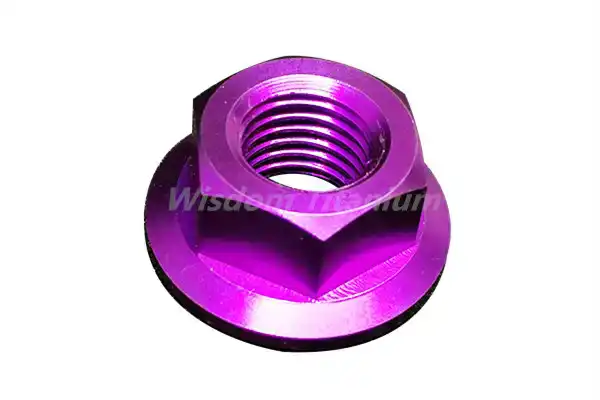
For projects that will be used in harsh places like chemicals and the ocean, it is very important to get the right fasteners. Titanium flange nuts are now the best choice for contractors and engineers who work with saltwater, harsh chemicals, and high temperatures all the time. There is a lot of information in this article about why titanium works better in these harsh conditions than other materials. Plus, it talks about different fields where titanium is used and how buying these strong fasteners will save you money in the long run.
Excellent Corrosion Resistance of Titanium In Marine and Chemical Environments
Titanium is by far the best material for resisting damage from saltwater and harsh chemicals. One thing about it makes it very resistant to corrosion: when it comes in contact with water or air, it forms a strong oxide layer. This small shield protects the metal below from being attacked because it can't be broken through.
What is it about titanium that makes it useful in the ocean? Titanium doesn't crack and rust like stainless steel does in places with a lot of chloride. It stays strong even after being in seawater for a long time. It is very strong because the oxide layer that protects it can be fixed quickly if it gets damaged. So the salt and water that are always coming at it can't hurt it.
Titanium flange nuts are strong enough to be used in chemical plants that are always hot and full of harsh chemicals. They can handle a lot of acids, bases, and organic compounds that would quickly break down less strong materials. Ti is strong, light, and doesn't react with other chemicals. For important fastening jobs in corrosive environments, this makes it a great choice.
Applications of Titanium Flange Nuts in Marine and Coastal Engineering
Titanium flange nuts come in very handy in a lot of marine and coastal situations. Deep sea oil and gas platforms depend on these strong fasteners to protect important parts from the rough sea. Titanium flange nuts can be used to connect pipes and building joints because they are strong and don't rust. Because of how bad things are, they will last a long time.
Companies that produce things for the ocean also utilize titanium fasteners since they function so well. Heat exchangers, pump housings, and propeller shafts on ships and submarines can all use ti-ne flange nuts. These pieces need to be able to handle the stress, corrosion, and continual shaking that come with working on the water. Titanium is the greatest material for these demanding jobs because it doesn't wear down readily.
Because they are close to saltwater, coastal sites like desalination plants and tidal energy projects can have a number of problems. In this scenario, titanium flange nuts are particularly significant since they maintain the structure sturdy and stop it from having to shut down for a long time because of broken fasteners. These buildings can last for decades with no maintenance since they can withstand corrosion from both air and water.
Long-Term Cost Savings from Using High-Resistance Titanium Fasteners
The upfront cost of titanium flange nuts may be more than that of ordinary fasteners, but the savings over time are huge. Because titanium lasts longer in places where it can rust, it takes less care and is cheaper to repair. Titanium fasteners can sometimes last longer than the equipment they are mounted on, which implies that service is always available throughout the entire project.
Consider the hidden costs that come with fastener failure in key situations. Unplanned downtime, emergency repair, and possible safety issues can quickly cost a lot of money. Companies can lower these risks by buying titanium flange nuts. They can also relax knowing that their tools are safe with the best fasteners on the market.
Also, titanium's small weight helps save fuel in transportation applications and lowers the weight of structures in static installations. This can lead to a chain reaction of economic savings, such as lower transportation costs and less need for foundations in construction projects.
We at Wisdom Titanium know how important it is to have high-quality fasteners for your projects. Our titanium flange nuts are made to work well in the toughest conditions, where they will not rust and are very strong. Our products come in sizes from M4 to M48 and can handle temperatures from -250°C to 600°C, making them flexible enough to fulfill a wide range of industry applications.
Don't let cheap fasteners damage your maritime or chemical processing equipment. For long-lasting performance and peace of mind, choose Wisdom Titanium's flange nuts. Please email us at sales@wisdomtitanium.com to find out more about how our titanium solutions can help your project or to get a quote. Let's work together to use titanium to make your project last even longer.
FAQs
Q1: How do titanium flange nuts perform compared to stainless steel in marine environments?
A: Titanium flange nuts are much better at resisting corrosion in saltwater. Stainless steel can get pitting and crevice corrosion, while titanium makes a self-healing oxide layer that protects it for a long time.
Q2: Are titanium flange nuts suitable for high temperatures?
A: Yes. Grade 5 titanium flange nuts work well in temperatures from cryogenic to around 600°C. This makes them good for use in aerospace, chemical, and high-performance settings.
Q3: What surface finishes are available for titanium flange nuts?
A: Common finishes include polished, anodized, and PVD coating. These options enhance appearance, wear resistance, hardness, or provide color customization depending on application needs.
Q4: How do titanium flange nuts help reduce weight?
A: Titanium flange nuts can be up to 45% lighter than steel fasteners of similar strength, helping reduce overall system weight and improve efficiency in weight-sensitive applications.
Q5: Which industries benefit most from titanium flange nuts?
A: Key industries include marine, offshore oil and gas, aerospace, chemical processing, medical, and renewable energy, where corrosion resistance, strength, and low weight are critical.
References
- Schutz, R. W., & Thomas, D. E. (1987). Corrosion of titanium and titanium alloys. ASM Handbook, 13, 669-706.
- Donachie, M. J. (2000). Titanium: A Technical Guide. ASM International.
- Boyer, R., Welsch, G., & Collings, E. W. (1994). Materials Properties Handbook: Titanium Alloys. ASM International.
- Yamada, M. (2007). An overview on the development of titanium alloys for non-aerospace application in Japan. Materials Science and Engineering: A, 213(1-2), 8-15.
- Peters, M., Kumpfert, J., Ward, C. H., & Leyens, C. (2003). Titanium alloys for aerospace applications. Advanced Engineering Materials, 5(6), 419-427.