
Actually, titanium works really well for exhaust parts and has become the best material for high-performance cars, motorsports, and aircraft. If you compare titanium exhaust bolts to steel screws, especially those made from Ti-6Al-4V (Grade 5) titanium metal, they are 45% lighter, can withstand extreme temperatures, and will not rust in the air. These features get rid of the problem of "seizing" or "rust-welding" that usually happens with exhaust gear, so it can be taken apart without any problems, even after years of being exposed to high temperature changes and road salt.
Titanium Exhaust Bolts: Properties and Benefits
What Makes Titanium Exhaust Bolts Unique?
Titanium exhaust bolts are a special kind of bolting gear that was made to make putting together and maintaining exhaust systems easier. Bolts made of titanium are mostly Grade 5 titanium (Ti-6Al-4V), which has 6% aluminum and 4% vanadium to improve its mechanical qualities. These are different from bolts made of stainless steel or zinc-plated steel. In addition to having a tensile strength of over 900 MPa, this metal is also very flexible and hard to break. The material's natural oxide layer grows back right away after being scratched, protecting it from rust and galvanic breakdown even when other metals are present.
Titanium's low thermal expansion rate is due in part to its unique crystalline structure. This means that these bolts don't change much in size when they are heated and cooled. This feature stops the tiny movements and fretting wear that usually make regular bolts loose in links between the manifold and the header and between the turbocharger and the flange.
Core Advantages Over Traditional Steel Fasteners
Unmatched Corrosion Resistance: Titanium has the best corrosion resistance of any metal because it makes a solid, adhering oxide film (TiO₂) that stops water, chloride ions, and acidic exhaust condensates from getting into the base metal. Because it doesn't rust, it doesn't need protective layers like zinc plating or cadmium, which break down in hot temperatures.
Superior Strength-to-Weight Ratio: Titanium screws have a density of only 4.51 g/cm³, which is almost half that of steel. This means that they decrease rotating and unsprung mass in key chassis areas. Racing teams use this weight saves to improve power-to-weight ratios and driving qualities, especially when exhaust is routed under the body.
Thermal Stability Beyond 600°C: Grade 5 titanium stays structurally sound at constant temperatures of up to 600°C, which is much higher than what Grade 8.8 or 10.9 steel bolts can do. This resistance to heat stops annealing, thread galling, and stress release in high-flow exhaust pipes and turbocharger installs.
Elimination of Seizure Risk: The lack of iron content and the creation of a lubricious oxide layer make thread galling much less likely to happen during installation. More importantly, titanium bolts can be removed even after thousands of heat cycles. This stops the disastrous bolt snapping off that needs expensive helicoil repairs or manifold replacement.
Because of these benefits, titanium exhaust hardware is very useful for shops that modify cars, race teams, and high-end makers who need reliable parts that work well and don't cost a lot to maintain over time. The material's track record in flight fasteners, where failure can have disastrous effects, gives buying workers in the car industry more trust as they look at their supplier choices.
Performance and Practical Considerations for Titanium Exhaust Bolts
Real-World Performance in Harsh Exhaust Environments
Titanium exhaust bolts are very strong even when they are exposed to chemicals, vibrations, and sudden changes in temperature that are common in modern exhaust systems. Independent testing by car research institutions shows that Grade 5 titanium keeps more than 90% of its tensile strength at 400°C, while steel fasteners of the same type lose a lot of strength above 300°C. In turbocharged engines, where manifold temperatures regularly rise above 850°C and exhaust gas temperatures get close to 1000°C during long periods of high-load operation, this thermal performance becomes very important.
The low coefficient of thermal expansion (8.6 × 10⁻⁶/°C) of the material is similar to that of cast iron and aluminum alloy pipes. This means that there is less differential thermal stress, which can break or loosen regular bolts. Racing teams that compete in endurance events really like this dimensional stability because it keeps the clamp load constant during long race runs with lots of wide-open engine pulls and cooling cycles with less speed.
Selecting Appropriate Titanium Grades and Specifications
When selecting exhaust fasteners, people in charge of buying things need to be able to tell the difference between commercial-purity titanium (Grades 1-4) and the stronger Ti-6Al-4V (Grade 5) metal. Grade 5 is still the standard for exhaust uses because it has better mechanical qualities and doesn't creep when loaded for a long time. Buyers should check the certifications of materials by looking at mill test records (MTRs), which show the chemical make-up, heat treatment settings, and mechanical testing results. Reputable makers make sure that ASTM B348 bar stock standards are met by giving full tracking to raw material batches.
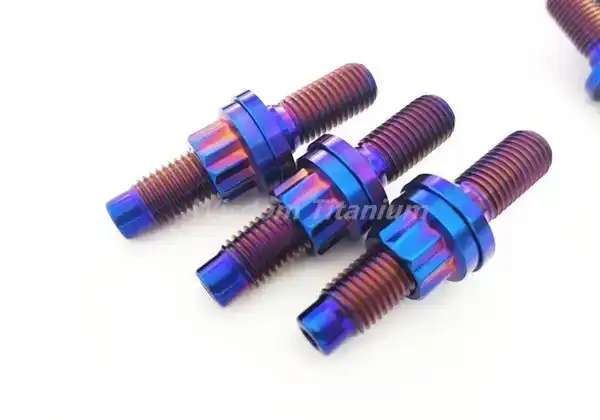
Our stud, 12-point nut, and washer sets are made from Grade 5 titanium rod stock that has been carefully checked for quality before it is shipped. These parts come in two different sizes, M8×1.25×45 and M10×1.25×45/54. They can also be made to order in different sizes to fit certain manifold flange shapes. The natural titanium finish is the most resistant to rust, while the burnt blue anodized finish makes the product look different and makes fitting easier.
Installation Best Practices and Torque Specifications
When titanium exhaust hardware is installed correctly, it works better and lasts longer. Titanium screws must be tightened to the exact manufacturer's standards, which are usually 60–70% of the torque values used for steel hardware of the same type. Steel bolts can handle some over-torquing because they are more flexible. Using a measured torque wrench keeps the threads from breaking and makes sure that the clamp load is spread evenly across the gasket surfaces.
Copper or nickel-based anti-seize products should not be used on titanium because they can cause galvanic damage. To keep threads and bearing surfaces smooth, use a thin film of high-temperature molybdenum disulfide paste or a titanium assembly lube. This method lowers friction coefficients and raises the connection between torque and tension, which makes sure that the preload is reliable and galling doesn't happen.
Thread pitch and head arrangement are the main factors that determine whether or not a new exhaust system will work with an old one. When compared to normal hex nuts, our 12-point flange nuts have more wrench engagement points. This makes it less likely that the nuts will round off while being installed in tight areas. The built-in washer design evenly spreads the clamp load and makes up for the uneven flange surfaces that are common on aftermarket headers and OEM manifolds.
Application Case Studies and Use Scenarios
Motorsport and Performance Automotive Applications
Teams in major racing series use titanium exhaust bolts on all engines, whether they are naturally aspirated or forced-induction. When a well-known GT3 racing team switched from stainless steel to Grade 5 titanium hardware for their exhaust system bolts, the weight dropped by 3.2 kilograms, which is the same as taking out almost half a gallon of fuel. More importantly, the team stopped having to fix seized turbocharger mounting studs in the middle of the season, which cut down on maintenance downtime and kept them from having to pay expensive DNF fines.
Titanium's ability to resist heat also helps high-performance street cars. Titanium studs can be removed for turbocharger upgrades or wastegate service even after 50,000 miles of aggressive driving, according to owners of turbocharged sports cars. This is in contrast to traditional steel studs, which often need to be removed destructively by cutting and installing helicoils. This ease of maintenance is especially helpful for fans who often change the boost levels or replace exhaust parts.
Aerospace and Heavy Equipment Sectors
Titanium exhaust fasteners have been used for decades in aircraft auxiliary power units (APUs) and environmental control systems. However, most of the demand comes from the car industry. The material has been shown to be reliable in commercial aviation, where fastener failure can lead to catastrophic safety events. This is strong evidence for people who buy things for cars who are judging the material's trustworthiness.
Heavy machinery workers in the marine and offshore drilling industries are choosing titanium parts for exhaust systems that will be exposed to salt spray and brackish water more and more. Equipment maintenance logs from offshore supply boats show that titanium exhaust fasteners keep their torque integrity and ability to be removed after five years of service, while stainless steel versions need to be replaced every 18 months because corrosion damages the threads.
Procurement and After-Sales Considerations for Titanium Exhaust Bolts
Verifying Supplier Credibility and Material Authenticity
There are a lot of low-quality titanium fasteners on the market around the world, so strict source checking procedures are needed. Teams in charge of buying things should ask for certificates of materials that include a study of their chemical make-up, test results for their mechanical properties, and proof that they have been heated. Legitimate Grade 5 titanium has unique magnetic properties—it should react less to magnetic tests than steel, but it can still be told apart from widely pure titanium grades by testing their hardness.
We keep a full stock of raw materials from authorized titanium rod makers that can be tracked back to the batches that were made in the smelter. Before we ship our products, they go through a number of quality checks, such as measuring to make sure they are the right size, checking the surface finish, and using a thread gauge. Our ISO 9001 certification guides this quality assurance system, which makes sure that products act the same way throughout all production runs.
Custom Manufacturing and Technical Support
For specialized uses, non-standard fastener designs are often needed to work with different flange patterns, thread specs, or head styles. Custom CNC machining services for titanium exhaust parts are available from our experienced engineering team. They work from customer sketches, samples, or rough ideas. This feature is especially useful for making prototypes, making only a few cars, and making speed goods for aftermarket use that need custom fastener solutions.
Technical help goes beyond the initial product specifications and includes fitting instructions, torque suggestions for specific uses, and checking to see if the product will work with current exhaust systems. Our team helps buying professionals choose the best titanium exhaust bolts based on performance needs and price limits, making sure that the right material grades and configurations are used for each application's mechanical and thermal needs.
Conclusion
Titanium exhaust bolts have measured performance benefits in hard automobile, racing, and industrial settings where steel fasteners don't work well. Because the material is very strong for its weight, doesn't rust, and stays stable at high temperatures, it doesn't fail in common ways like seizure, oxidation, or thermal degradation. The higher starting cost needs to be explained, but the longer service life, guaranteed removability, and less upkeep work make the total cost of ownership very appealing for uses that need to work well. Buyers of titanium hardware should give more weight to sellers who can show that their materials can be tracked, they have quality certifications, and they have a lot of technical knowledge. This will help make sure that the parts they buy are real Grade 5 titanium that meets the needs of the particular application.
Source Titanium Exhaust Bolt Solutions from a Trusted Manufacturer
Since 2016, Baoji Wisdom Titanium Industry and Trading Co., Ltd. has served car, racing, and industrial clients around the world. It is based in Baoji Titanium Valley in Shaanxi Province, which is China's biggest and most complete titanium industry center. As an ISO 9001-certified titanium exhaust bolt supplier, we focus on making Grade 5 titanium stud, nut, and washer assemblies in normal sizes (M8×1.25×45, M10×1.25×45/54) and in any other combination you can think of. Our full stock of approved raw materials, advanced CNC production skills, and strict quality control standards ensure that our products always work well and arrive on time. We accept bulk orders with a minimum of 100 pieces and offer full expert help during the whole buying process. Visit wisdomtitanium.com or email sales@wisdomtitanium.com to talk about your specific titanium exhaust bolt needs and get full product specs that are made to fit your needs.
FAQ
Can titanium exhaust bolts be reused after removal?
Yes, titanium exhaust bolts that have been put correctly can usually be used more than once, as long as the threads stay undamaged and the correct torque is used during reinstallation. The material doesn't easily gall or form oxide, so it can be removed reliably even after long periods of high-temperature use. This is different from steel nuts, which often become stuck forever. Before using again, carefully check the threads for signs of damage or deformation, and replace any screws that show signs of wear or changes in size.
What torque specifications should be used for titanium exhaust hardware?
Titanium screws need less force than steel bolts of the same size because the two materials have different properties and friction factors. As a general rule, 60–70% of the torque standard for Grade 8.8 steel bolts of the same size should be used. For specific uses, check with the manufacturer's suggestions. The right amount of lubrication and thread contact length have a big impact on the best torque values.
How do I verify authentic Grade 5 titanium material?
Reliable sources give mill test results that show the chemical makeup (about 6% aluminum and 4% vanadium) and mechanical properties that meet ASTM B348 standards. Magnetic response testing (Grade 5 titanium has a weaker magnetic pull than steel) and Rockwell hardness testing (HRC 30-36) are two ways to check the physical integrity of something. During the buying process, make sure you get material certifications and tracking paperwork to make sure the alloy makeup is real.
References
1. Boyer, R., Welsch, G., & Collings, E.W. (1994). Materials Properties Handbook: Titanium Alloys. ASM International.
2. Donachie, M.J. (2000). Titanium: A Technical Guide, 2nd Edition. ASM International.
3. Schutz, R.W. & Thomas, D.E. (1987). "Corrosion of Titanium and Titanium Alloys." Metals Handbook, 9th Edition, Volume 13: Corrosion. ASM International.
4. Peters, M., Kumpfert, J., Ward, C.H., & Leyens, C. (2003). "Titanium Alloys for Aerospace Applications." Advanced Engineering Materials, Volume 5, Issue 6.
5. ASTM International. (2020). ASTM B348-20: Standard Specification for Titanium and Titanium Alloy Bars and Billets. West Conshohocken, PA.
6. Lutjering, G. & Williams, J.C. (2007). Titanium, 2nd Edition: Engineering Materials and Processes. Springer-Verlag Berlin Heidelberg.