
When compared to conventional steel and aluminum alternatives, titanium fasteners for automotive applications are the superior option for applications requiring high performance. Superior strength-to-weight ratios, outstanding corrosion resistance, and extraordinary longevity in harsh environments are all provided by titanium. For high-end automotive applications, racing settings, and luxury car manufacture, titanium offers unparalleled performance advantages that make it worth the investment, even if steel is more affordable and aluminum gives considerable weight reductions.
Material Properties: The Foundation of Fastener Performance
The material composition of automobile fasteners has a significant impact on their performance. Every material has unique qualities that affect overall dependability, maintenance needs, and vehicle performance.
Grade 5 titanium (Ti-6Al-4V), which has a tensile strength more than 950 MPa, is used in titanium alloy fasteners. Titanium bolts' exceptional strength-to-weight ratio makes them perfect for demanding automotive applications where performance is directly impacted by weight reduction.
Depending on the grade, steel fasteners, especially high-strength varieties, have exceptional tensile strength between 800 and 1200 MPa. However, they suffer considerable weight penalties because to their density of 7.8 g/cm³, which is substantially higher than titanium's 4.4 g/cm³.
With a density of around 2.7 g/cm³, aluminum fasteners provide lightweight options; yet, its tensile strength normally reaches its maximum at 310–380 MPa. Their usage in high-stress automotive applications is limited by this restriction.
Titanium automobile hardware is the best option for competitive advantages if you require high strength with low weight for racing applications.
Weight Reduction Impact: Performance Gains Through Material Selection
Performance gains in automotive applications are closely correlated with weight reduction. In racing situations and performance upgrades, the connection between fastener material and vehicle dynamics is very noticeable.
Particularly in wheel assemblies and braking systems, lightweight fasteners greatly reduce unsprung weight. When compared to their steel counterparts, titanium wheel bolts may lower rotational mass by up to 60%, which enhances handling responsiveness and acceleration.
Research indicates that titanium fasteners for automotive applications may save around 40–50 grams per bolt when used in place of steel lug bolts. This amounts to over one kilogram of unsprung weight savings for a standard 20-bolt wheel assembly.
Titanium fastener use has a comparable positive impact on engine bay applications. In intake manifolds, valve covers, and accessory mounts, titanium screws and bolts save engine weight overall while preserving structural integrity during heat cycling.
Custom titanium fasteners provide quantifiable advantages in acceleration and cornering dynamics if you want the best power-to-weight ratios for track performance.
Corrosion Resistance: Long-term Reliability in Harsh Environments
For cars to last a long time, corrosion-resistant fasteners are crucial, especially in areas where roads are exposed to salt or near the shore. The lifetime of components and maintenance expenses are directly impacted by material choices.
Titanium has remarkable corrosion resistance due to the protective oxide layer it naturally generates. This passive layer ensures long-term protection without the need for further coatings or treatments since it regenerates when damaged.
For steel fasteners to withstand corrosion, protective coatings like galvanization or zinc plating are necessary. Over time, these coatings deteriorate, causing rust to accumulate and perhaps failing in crucial applications.
Through oxidation, aluminum provides a reasonable level of corrosion resistance; nevertheless, when aluminum fasteners come into contact with dissimilar metals in automobile assemblies, galvanic corrosion becomes an issue.
Titanium fasteners are appropriate for exhaust applications and harsh weather circumstances where steel and aluminum may fail because they retain their integrity throughout temperature ranges of -250°C to 600°C.
Despite their higher initial prices, titanium alloy fasteners provide greater long-term value if you require fasteners that remain reliable in corrosive environments without the need for maintenance interventions.
Strength and Durability: Critical Performance Under Stress
In automotive applications, high-strength fasteners need to be able to tolerate vibration, temperature cycling, and dynamic stresses. Fatigue resistance and operational dependability are directly impacted by material qualities.
Because it can sustain millions of stress cycles without failing, grade 5 titanium has remarkable fatigue resistance. This feature is essential for mounting hardware for brake callipers and wheel lug bolts that are exposed to continuous dynamic stress.
Comparative testing demonstrates that titanium fasteners for automotive retain 90% of their initial strength after 10 million fatigue cycles, while equivalent steel fasteners exhibit 15–20% strength deterioration under the same circumstances.
Between steel (200 GPa) and aluminum (69 GPa), titanium's modulus of elasticity (114 GPa) offers the most flexibility, preventing the concentration of stress and the spread of cracks.
Advanced manufacturing techniques used in aerospace fastener technology, which has been modified for automotive applications, improve grain structure and do away with stress risers that are often seen in traditional fastener manufacture.
Performance fasteners made of titanium provide unparalleled dependability under harsh circumstances if you want fasteners that can withstand fatigue failure in high-vibration racing scenarios.
Cost Analysis: Investment Value Across Material Options
Fastener materials have quite diverse initial procurement prices, while total cost of ownership estimates show more complex value propositions for various automotive applications.
For automotive-grade hardware, steel fasteners have the lowest initial pricing, usually between $0.50 and $2.00 per piece. However, the frequency of replacements due to fatigue and corrosion raises long-term costs.
In performance applications where every gram counts, the weight benefits of aluminum fasteners balance higher material costs, resulting in moderate price of $1.00 to $4.00 per piece.
Depending on complexity and finishing requirements, titanium nuts and bolts generally cost between $5.00 and $25.00 per piece, which is a greater initial investment. However, in crucial applications, their durability and performance advantages often outweigh their costs.
Because component dependability eliminates expensive failures during race events when DNF results far outweigh material savings, racing teams often chose titanium despite cost increases.
Steel fasteners provide sufficient performance if you require affordable solutions for non-critical applications, but investing in titanium makes sense for assemblies that are performance-critical.
Application-Specific Recommendations: Matching Materials to Requirements
Depending on operating circumstances, stress levels, and performance requirements, different automotive systems need different fastener qualities. The choice of material should be in line with the requirements of the particular application.
Titanium is particularly advantageous when used in wheel assembly applications. Wheel studs and lug bolts made of titanium minimize unsprung weight while offering exceptional fatigue resistance, which is crucial for high-performance driving situations.
Extreme temperature cycling and stress are experienced by brake system components. Titanium-based heat-resistant fasteners remain intact at high temperatures when steel could have problems with thermal expansion.
Titanium fasteners for automotive engine bay installations must be resistant to vibration, heat cycling, and chemical exposure. In these harsh conditions, titanium intake manifold hardware and valve cover bolts provide long-term dependability.
Materials resistant to corrosive gasses and high temperatures are required for exhaust system applications. In exhaust settings, titanium-based rust-proof fasteners minimize the requirement for new steel hardware.
Steel fasteners may be used economically while still meeting performance requirements for body panels and interior applications where weight reduction offers little advantage.
Custom titanium fasteners designed for particular needs provide the best performance and dependability if you need specialist fastener solutions for harsh automotive applications.
Wisdom Titanium: Your Trusted Partner for Premium Automotive Fastening Solutions
Leading provider of titanium fasteners for automotive applications, Wisdom Titanium provides precisely developed solutions that satisfy the exacting needs of automakers, race teams, and performance fans all over the globe. Every titanium bolt, screw, and specialty fastener we manufacture is of constant quality thanks to our ISO 9001-certified production procedures.
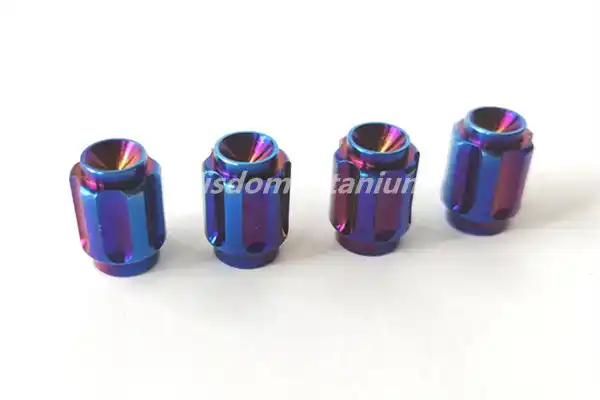
Titanium wheel nuts, lug bolts, engine bay kits, exhaust system hardware, and valve stem caps made of Grade 5 titanium are all part of our extensive product line. To ensure tensile strength over 950 MPa and dimensional correctness that satisfies automotive industry requirements, every component is put through a thorough quality testing process.
Wisdom Titanium offers full customisation for special automotive applications with sizes ranging from M2 to M36 and a variety of finishing choices, including as PVD coating, anodizing, and burned finishes. Our skilled R&D staff works with customers to provide customized fastener solutions that maximize efficiency and save expenses.
For both conventional and special titanium automobile hardware, consistent prices and dependable delivery dates are guaranteed by thorough inventory management. Our extensive quality control procedures and advanced manufacturing technologies ensure product consistency throughout high-volume orders, which are crucial for automobile assembly lines.
Find out how using high-quality titanium fastener solutions might improve your car projects. To discuss your unique needs and get comprehensive technical data for our automotive fastener product lines, send an email to sales@wisdomtitanium.com.
References
1. American Society for Testing and Materials. "Standard Specification for Titanium and Titanium Alloy Fasteners." ASTM F467-19, Annual Book of ASTM Standards, 2019.
2. Society of Automotive Engineers. "Fastener Performance Requirements for Automotive Applications." SAE J429, Surface Vehicle Standards, 2018.
3. Boyer, Rodney R. "An Overview on the Use of Titanium in the Aerospace Industry." Materials Science and Engineering: A, Vol. 213, No. 1-2, 1996.
4. International Organization for Standardization. "Mechanical Properties of Fasteners Made of Carbon Steel and Alloy Steel." ISO 898-1:2013, Technical Specifications, 2013.
5. Materials Properties Handbook: Titanium Alloys. ASM International Handbook Committee, Materials Park, Ohio, 1994.
6. Automotive Engineering International. "Advanced Materials in Modern Vehicle Construction: Weight Reduction Strategies." Society of Automotive Engineers Publications, Vol. 127, 2019.