
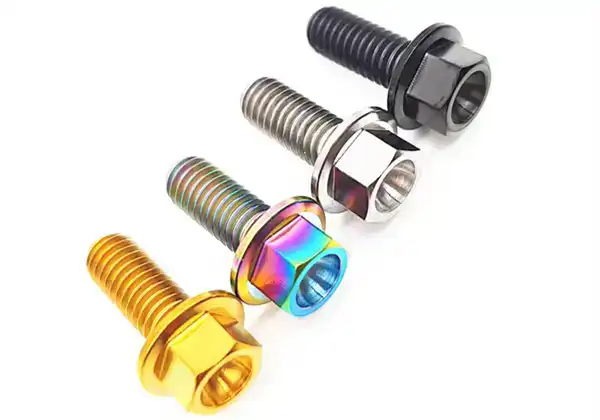
The ultimate in fastening technology, titanium flange bolts combine remarkable strength-to-weight ratios with superior corrosion resistance in demanding industrial applications. From realistic size considerations and B2B procurement techniques to Grade 5 titanium specs and DIN 6921 requirements, this comprehensive book covers it all. Knowing titanium flange bolts' capabilities will change the way you approach crucial fastening applications, whether you're a precision machinery builder in need of specialized specifications, a racing team in need of high-performance fasteners, or an automobile manufacturer looking for lightweight solutions.
Titanium Flange Bolt Fundamentals
Titanium fasteners' special mix of qualities has transformed contemporary technical applications. These specialty bolts, in contrast to conventional stainless steel substitutes, retain noticeably lower weight profiles while providing outstanding performance in harsh conditions.
These fasteners differ from traditional hex head bolts due to their flange configuration. By dispersing load across larger surface areas, the integrated flange functions as an integrated washer. This design offers better clamping force distribution without requiring separate washers. This feature is very useful to racing teams when fastening important brake parts under extreme stress.
Perhaps the most convincing benefit is corrosion resistance. Titanium's inherent oxide layer, which offers self-healing protection against exposure to seawater, is very beneficial for marine applications. When developing airplane components that are subjected to harsh atmospheric conditions, aerospace experts depend on this similar feature.
Grade 5 titanium (Ti-6Al-4V) has strength properties that provide a minimum tensile strength more than 950 MPa. With weight reductions of around 40%, this performance level is on par with or better than many steel substitutes. When improving performance automobiles, automotive modification companies take use of this advantage to achieve quantifiable gains in handling and acceleration.
Material Grades and Specifications Deep Dive
Because it strikes the ideal mix between strength, workability, and affordability, grade 5 titanium alloy (Ti-6Al-4V) is the material of choice for industrial fastener applications. With 6% aluminum and 4% vanadium, this alpha-beta alloy has a microstructure that offers remarkable mechanical qualities.
The aluminum component lowers density while increasing strength. Vanadium additions provide superior stability at high temperatures and enhance hardenability. Because of these qualities, Grade 5 is especially appropriate for automobile braking systems, which have difficult working conditions due to mechanical stress and thermal cycling.
Fatigue resistance becomes crucial in cyclic loading applications. Excellent fatigue strength is shown by grade 5 titanium, which under high cycle settings usually retains 50–60% of its ultimate tensile strength. Manufacturers of bicycles take use of this characteristic when creating lightweight frames for competitive cycling.
Grade 5 titanium's biocompatibility creates new business prospects. These alloys are increasingly being specified by medical device makers for surgical tools and implanted devices. This adaptability shows the material's wide range of possible uses outside of conventional industrial areas.
Critical Sizing Guidelines for Optimal Performance
When choosing titanium fasteners, thread requirements must be carefully taken into account. While unique thread pitches cater to specific needs, standard metric threads (M4 to M48) are suitable for the majority of industrial applications. Increased tensile area is possible with fine pitch threads, but exact machining tolerances are needed.
Grip length, thread engagement, and safety considerations must all be taken into consideration when calculating length. For titanium applications, the minimum thread engagement required by DIN 6921 standards is usually 1.5 times the nominal diameter. In order to guarantee dependability under severe loading circumstances, racing applications often go above and beyond these minimums.
Flange diameter selection impacts load distribution and joint integrity. The flange diameter is maintained at around 2.2 times the nominal bolt diameter by standard ratios. Larger flanges could be needed for custom applications in order to meet certain sealing needs or bearing stress restrictions.
Head height considerations affect tool clearance and joint profiles. Low-profile applications, notably in automobile brake assemblies, benefit from decreased head heights while retaining appropriate driving engagement. For socket head cap screws, hex drive parameters usually adhere to ISO 4762 standards.
Tolerance specifications become critical in precision applications. H7 tolerance grades provide excellent fit characteristics while maintaining reasonable manufacturing costs. Tighter tolerances may be justified in aerospace or medical applications where precision becomes paramount.
Industry-Specific Application Strategies
Automotive applications span from OEM production to high-performance modifications. Automakers increasingly specify titanium fasteners for weight-critical components, particularly in electric vehicle applications where every gram impacts range performance. Brake caliper mounting represents a prime application, combining weight savings with thermal stability.
Racing environments demand maximum performance under extreme conditions. Formula racing teams rely on titanium fasteners throughout suspension systems, where unsprung weight reduction directly improves handling characteristics. The vibration resistance of properly torqued titanium joints provides reliability advantages over traditional materials.
Motorcycle manufacturers target specific performance benefits for Titanium flange bolts. When accelerating, sprocket mounting bolts are subjected to high torque loads, and brake disc fasteners have to endure temperature cycling. Improved power-to-weight ratios are made possible by the lightweight characteristics without compromising durability.
Strict certification compliance is necessary for aerospace applications. Certain lot traceability and material certification paperwork are often required by commercial aviation requirements. In coastal operational situations, where exposure to salt accelerates the breakdown of traditional fasteners, the corrosion resistance proves beneficial.
Marine applications benefit from exceptional saltwater resistance. Yacht builders specify titanium fasteners for critical rigging and deck hardware applications. The material's noble characteristics prevent galvanic corrosion when coupled with other marine-grade metals.
Industrial machinery applications focus on reliability and maintenance reduction. Chemical processing equipment particularly benefits from titanium's chemical inertness. Maintenance intervals can be extended significantly compared to conventional stainless steel fasteners in corrosive environments.
Surface Treatments and Finishing Options
Anodized coatings provide both practical and visual advantages. Thin oxide coatings produced by type II anodizing improve corrosion resistance and provide potential for color labeling. Medical device manufacturers often specify colored anodizing for component identification purposes.
PVD coatings deliver superior wear resistance in demanding applications. Titanium nitride coatings provide golden coloration while significantly increasing surface hardness. Racing applications benefit from reduced galling tendencies during assembly and disassembly operations.
Surface roughness specifications impact both appearance and functionality. For the majority of applications, Ra values between 0.8 and 1.6 μm provide the best cost-performance ratio. For aeronautical or medical applications that need improved cleanability, smoother surfaces could be required.
Passivation treatments enhance corrosion resistance in certain conditions. Nitric acid passivation encourages the production of a homogeneous oxide layer while eliminating surface impurities.This treatment becomes particularly important when machining operations have introduced surface stresses or contamination.
Chemical etching can provide enhanced surface area for adhesive bonding applications. Aerospace manufacturers sometimes specify etched surfaces when titanium fasteners must interface with bonded composite structures. The increased surface energy improves adhesion characteristics significantly.
Partner with Wisdom Titanium for Superior Fastening Solutions
Since 2016, Wisdom Titanium has been a reliable provider of titanium flange bolts with ISO 9001 certification. Our extensive inventory, which includes M4 to M48 diameters and lengths ranging from 10mm to 200mm, is made from quality Grade 5 titanium in accordance with DIN 6921 specifications. Our skilled R&D team gives specialized attention to custom specifications, guaranteeing that your particular application needs are precisely addressed.
Stable pricing and dependable delivery schedules are ensured by our extensive raw material inventory and sophisticated manufacturing equipment for titanium flange bolts. Precision equipment builders, automakers, and racing teams rely on our quality control procedures and prompt customer support. Our technological know-how guarantees top performance for your vital applications, whether you need ordinary fasteners or specially designed solutions.
Discover the Wisdom Titanium edge with our dedication to client pleasure and ongoing development. To explore your needs for titanium fasteners and learn how our solutions may improve product performance while lowering total cost of ownership, send us an email at sales@wisdomtitanium.com.
Conclusion
For applications requiring remarkable strength, resistance to corrosion, and weight reduction, titanium flange bolts are the best option. Making well-informed procurement choices that result in quantifiable performance gains requires an understanding of material grades, size requirements, and application-specific concerns. These cutting-edge fasteners provide dependability benefits that support their premium status in the market, whether they are used in aerospace applications or car racing. For your crucial fastening applications, working with recognized suppliers guarantees access to guaranteed quality while keeping your total cost of ownership low.
References
1. Boyer, R.R. "An Overview on the Use of Titanium in the Aerospace Industry." Materials Science and Engineering: A, Vol. 213, 1996.
2. Donachie, Matthew J. "Titanium: A Technical Guide, 2nd Edition." ASM International, 2000.
3. Lutjering, Gerd and Williams, James C. "Titanium, 2nd Edition: Engineering Materials and Processes." Springer-Verlag Berlin Heidelberg, 2007.
4. Peters, Manfred et al. "Titanium Alloys for Aerospace Applications." Advanced Engineering Materials, Vol. 5, No. 6, 2003.
5. Rack, Henry J. and Qazi, Junaid I. "Titanium Alloys for Biomedical Applications." Materials Science and Engineering: C, Vol. 26, 2006.
6. Veiga, C. et al. "Properties and Applications of Titanium Alloys: A Brief Review." Reviews on Advanced Materials Science, Vol. 32, 2012.