
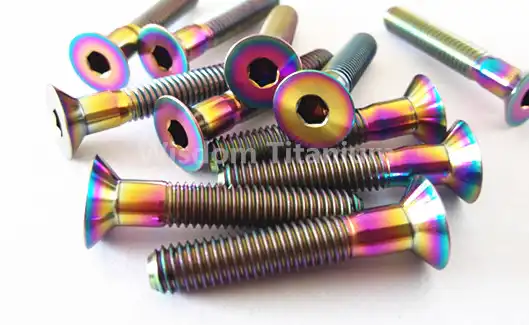
Titanium countersunk head bolts are the go-to option for discriminating engineers and manufacturers when endurance and accuracy are combined in industrial applications.These specialized fasteners combine a flush-mounted design with the exceptional properties of titanium alloy to provide both greater functionality and visual appeal. Unlike traditional steel fasteners, countersunk titanium screws provide an unmatched strength-to-weight ratio while maintaining outstanding corrosion resistance throughout a range of operating circumstances. The tactical advantages, technical specifications, and practical applications that make these lightweight fasteners indispensable for modern manufacturing processes are all covered in depth in this comprehensive book.
Key Parameters and Technical Specifications
The performance characteristics of titanium bolts are significantly influenced by the quality of the material and the precision of the production process. Grade 5 titanium bolts (Ti6Al4V) are the industry standard for high-stress applications because of their exceptional fatigue resistance and tensile strength of 950 MPa. To accommodate various assembly requirements, these aviation fasteners typically have diameters between M3 and M20 and lengths between 6 and 100 mm.
Because titanium countersunk head bolts can tolerate temperatures as high as 400°C, they are suitable for demanding industrial settings. Dimensional stability and superior performance under dynamic loads are ensured by the hardness level of 34 HRC. Manufacturing standards like ISO, DIN, and ASME conformance provide consistent quality and worldwide compatibility.
Polished, anodized, or PVD coatings are examples of surface treatment alternatives that improve performance and appearance. Depending on the needs of a particular application, thread configurations may support either complete or partial thread designs. Flush installation is made possible by the countersunk head design, which lowers aerodynamic drag in automobile applications while maintaining a neat, polished look.
Strategic Benefits for Industrial Applications
In several sectors, the use of titanium alloy bolts results in quantifiable performance gains. Fuel economy in automotive and aerospace industries, where every gram counts, is directly impacted by weight reduction advantages. By removing the need for repeated replacement cycles, corrosion-resistant fasteners save operating downtime and long-term maintenance expenses.
Marine grade bolts, including titanium countersunk head bolts, excel in saltwater environments where traditional fasteners fail prematurely. Titanium fasteners are perfect for medical device applications because they are biocompatible, and electronic equipment assembly benefit from their non-magnetic characteristics. In tough industrial settings where frequent exposure to acids, alkalis, and solvents occurs, chemical resistance prolongs service life.
For applications where safety is critical, the precision production process ensures consistent thread engagement and torque requirements. Fatigue-resistant properties prevent fractures from propagating under cyclic loading conditions, which are particularly important in vibrating machinery and transportation equipment.
Comparative Analysis: Wisdom Titanium vs. Market Alternatives
Wisdom Titanium stands out because to extensive quality control methods and customization choices that few competitors can match. Our ISO 9001-certified manufacturing process ensures constant material quality and dimensional accuracy in every production batch.Generic vendors often sacrifice material traceability, but we keep thorough records from the procurement of raw materials to the final inspection.
Beyond simple dimensions inspections, quality assurance also involves surface finish validation and mechanical property verification. Field failures that could lead to expensive recalls or safety incidents are avoided by this meticulous approach. Our products stay up to date with evolving industry requirements by incorporating consumer feedback into ongoing improvement initiatives.
Optimization Strategies for Maximum Performance Benefits
Precision countersunk bolts provide maximum performance potential when installed correctly. To avoid over-tightening or under-tightening situations, torque standards must be in line with material characteristics and thread engagement requirements. Thread locker compounds may be necessary in high-vibration environments, though titanium's natural galling resistance often eliminates this requirement.
Surface preparation of mating components ensures optimal load distribution and prevents stress concentrations. To obtain complete contact area and avoid early loosening, the countersunk angle must perfectly match the shape of the bolt head. Galvanic corrosion is avoided when titanium fasteners come into contact with other metals due to material compatibility concerns.
The particular working environment and loading circumstances should be taken into consideration at regular intervals of inspection. Regular inspection ensures continued reliability in critical applications, despite the remarkable fatigue resistance of titanium threaded fasteners. Replacement schedules are often longer than those of steel alternatives, providing long-term cost benefits.
Storage and handling procedures preserve material properties and surface finish quality. Performance may be hampered by contamination by cutting fluids or other substances, therefore appropriate packing and inventory control are crucial. Applications with large temperature ranges should take temperature cycling effects into account.
Conclusion
Both short-term project success and long-term operational dependability are impacted by the choice of titanium countersunk head bolt provider. From the selection of raw materials to final delivery, Wisdom Titanium is dedicated to perfection, making sure every fastener satisfies strict requirements. Our comprehensive inventory management system maintains conventional configurations easily accessible while our skilled engineering team develops customized solutions for unique applications.
Strict testing protocols and quality certifications provide the confidence needed for critical applications in the automotive, industrial, and aerospace sectors. Since 2016, we have shown expertise in producing titanium hardware, so we understand the nuances that distinguish great performance from just adequate solutions. Our customer-focused approach includes timely technical support and flexible production scheduling that adapts to evolving project requirements.
Discover the impact that meticulous production and committed support have on your next project. Get in touch with us at sales@wisdomtitanium.com to talk about your particular needs and see why top manufacturers use Wisdom Titanium as their go-to supplier for titanium countersunk head bolts.
FAQ
1. What makes Grade 5 titanium superior to other grades for countersunk bolts?
Grade 5 titanium (Ti6Al4V) offers the finest combination of strength, weight, and corrosion resistance for demanding applications. Because of its exceptional fatigue properties and 950 MPa tensile strength, it outperforms Grade 2 titanium in high-stress scenarios and exhibits higher corrosion resistance than steel alternatives.
2. How do titanium countersunk bolts perform in high-temperature applications?
Since these fasteners maintain their mechanical properties and structural integrity at temperatures of up to 400°C, they are suitable for exhaust systems, turbine assemblies, and other high-heat applications where conventional fasteners would fail or often need to be replaced.
3. What surface finish options provide the best performance for specific applications?
While anodized coatings improve corrosion resistance in maritime conditions, polished finishes are effective for general applications. For high-friction applications, PVD coatings provide exceptional wear resistance. The decision is based on particular operational circumstances and aesthetic standards.
References
1. American Society for Testing and Materials. "Standard Specification for Titanium and Titanium Alloy Bars and Billets." ASTM B348-19, 2019.
2. Boyer, Rodney R. "An Overview on the Use of Titanium in the Aerospace Industry." Materials Science and Engineering: A, vol. 213, no. 1-2, 1996, pp. 103-114.
3. Donachie, Matthew J. "Titanium: A Technical Guide." ASM International, 2nd Edition, 2000.
4. International Organization for Standardization. "Fasteners - Mechanical Properties of Corrosion-Resistant Stainless Steel Fasteners." ISO 3506-1:2009.
5. Lutjering, Gerd, and James C. Williams. "Titanium Engineering Materials and Processes." Springer-Verlag Berlin Heidelberg, 2nd Edition, 2007.
6. Society of Automotive Engineers. "Aerospace Material Specification: Titanium Alloy Bolts and Screws." SAE AMS 4967N, 2018.