
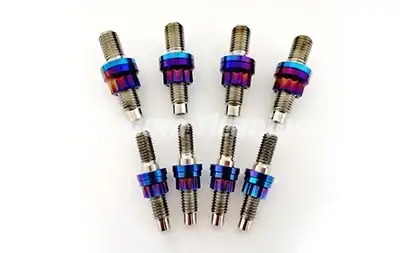
Under normal conditions, titanium exhaust bolts made from the Ti-6Al-4V (Grade 5) alloy usually last more than 10 to 15 years in car and motorcycle uses. Normal steel screws rust and break after three to five years, but these high-performance parts stay strong even after being exposed to acidic exhaust gases and extreme temperature changes (up to 500°C). Titanium naturally forms an oxide layer that keeps it from rusting when it comes in contact with aluminum or cast-iron manifolds. This gives them a longer useful life and removes the common maintenance problem of snapped studs during removal.
Understanding Titanium Exhaust Bolts and Their Service Life
What Makes Titanium Grade 5 the Optimal Choice?
We've seen over and over again in client projects that Ti-6Al-4V alloy is the best material for titanium exhaust bolts. This aerospace-grade material is made up of 6% aluminum and 4% vanadium. Its composition makes it both flexible and strong, with a tensile strength of over 900 MPa. The crystalline structure of the metal keeps the grain boundaries from rusting even when it comes into contact with sulfuric acid condensates that are found in exhaust settings. OEMs choose Grade 5 for turbine flanges or manifold connections because it meets the most important technical challenge: it must be able to keep its clamping power over thousands of heat-expansion cycles without permanently deforming.
We make the stud-and-12-point-nut design with built-in washers at Wisdom Titanium so that the load is spread out evenly across the flange surfaces. This design for the joint keeps stress from building up, which can cause weak materials to microcrack. These fastener kits come in two sizes, M8×1.25×45 and M10×1.25×45/54, and can be customized to fit a wide range of needs, from small motorcycle heads to heavy-duty diesel turbo installs. The burnt blue finish option lets maintenance teams see how much heat was exposed during service, which is helpful for inspections.
Core Factors Influencing Operational Longevity
Three things in the surroundings have a direct effect on how long titanium exhaust bolts stay clamped. Different metals expand at different rates when heated and cooled. For example, aluminum heads expand faster than steel screws, causing shear stress at the thread surfaces. Titanium's temperature expansion coefficient (8.6 μm/m·K) is closer to that of aluminum alloys (23 μm/m·K) than it is to that of stainless steel (17 μm/m·K), which means that less mechanical stress builds up. Because of this similarity, race teams say that no bolts have failed during any season of competition.
The second way something breaks down is through corrosive attack from tailpipe condensates. During cold-start conditions, sulfur molecules and water mist mix to make acidic solutions. Standard types of stainless steel corrode in cracks where they meet threads, making them less able to hold weight. Within hours of placement, our Grade 5 titanium forms a strong TiO2 passive layer, making a shield that can't be broken down by pH changes between 3 and 11. The third issue is fatigue caused by vibration, which is a big problem in motorcycle uses where engine pulses go straight through rigid mounting points. Titanium's fatigue limit is about 510 MPa, which is much higher than 304 stainless steel's limit of 240 MPa. This means that these bolts can withstand millions of stress reversals without starting to crack.
Titanium Exhaust Bolts vs. Other Materials: Impact on Service Life
Comparative Material Performance Analysis
To understand material selection, you need to look at how different metals react to stresses in the exhaust system. Carbon steel is cheap to buy, but it oxidizes quickly above 300°C, making iron oxide scale that locks threads and makes them swell. When people try to remove something, they often end up with broken shanks stuck in tapped holes. This means that expensive helicoil fixes or manifold replacements are needed. Maintenance shops have spent 4 to 6 hours trying to get a single stuck screw out of a cylinder head. That's a lot of time that costs money and makes customers unhappy.
Grades 304 and 316 of stainless steel make it less likely to rust, but they also make it more likely that metal will gall. The work-hardening property makes thread surfaces cold-weld during installation torqueing, which can be a problem in blind-hole situations. Anti-seize chemicals help for a short time, but they lose their usefulness after 18 to 24 months because they carbonize at high exhaust temperatures. Aluminum bolts aren't strong enough for high-clamp-load situations, and they lose their shape when heated for a long time, which means they can't be used for important exhaust joints.
Titanium Grade 5 takes the best qualities of earlier grades and gets rid of the weaknesses that are unique to that material. Its non-magnetic qualities keep modern cars with lots of sensors from being affected by electromagnetic interference. The natural silver finish and burnt blue heat treatment options make the installations look good when they are left out in the open on handmade bikes and show cars. Even though titanium has higher unit costs, procurement managers like that its lifetime economics favor it when they figure out the total costs of ownership, which include installation labor, repair frequency, and system downtime.
Total Cost of Ownership Considerations
Surprisingly low costs are found when you look at the costs over 100,000 kilometers of service intervals. Because they rust, steel exhaust studs that cost $2 a set need to be replaced every 50,000 kilometers, which adds up to $4 in hardware costs. Adding $150 for work for each replacement event brings the total cost to $304. Our titanium stud kit, which costs $45 and lasts the same amount of time without needing to be replaced, only needs $150 in fitting work, for a total cost of $195. The $109 savings per vehicle multiplies significantly across fleet operations managing hundreds of units.
Even more dramatic returns can be seen in racing applications. Competition engines are taken apart a lot so that they can be inspected and tuned differently. Titanium exhaust bolts can be taken off and put back on 15 to 20 times without losing their threads, but steel hardware needs to be replaced every 3 to 4 times. A professional racing team that takes care of five bikes throughout the season saves between $800 and $1,200 just on fastener costs. This is on top of the huge savings from not having to deal with technical problems during races.
Procurement Considerations for Titanium Exhaust Bolts
Customization Options and Order Specifications
Finding titanium exhaust bolts means finding a balance between standardization and needs that are unique to the application. The M8×1.25×45 and M10×1.25×45/54 sizes in our core catalog cover about 75% of car and motorbike uses. Custom size can handle different manifold widths, spacer needs, or thread pitches that aren't standard, which can happen when restoring an old car. Engineering support helps buyers choose the right screw lengths by taking into account the needs for nut contact, gasket compression, and flange stack-up limits.
The choice of finish affects both how something looks and how it works. The natural titanium finish keeps the silver-gray look of the raw material, making it perfect for cost-effective hidden installations. Depending on the temperature and length of time of oxidation, burned blue heat coloration can produce unique shimmering colors running from gold to purple to deep blue. This finish does two things: it makes open systems look nice, and it also shows how much heat is being exposed during service checks. Minimum order amounts of 100 pieces make it possible for repair shops with multiple clients to buy them cheaply, while still being available to race teams with small fleets.
Pricing Structure and Value Analysis
To figure out how much titanium exhaust bolts cost, you have to look at more than just the unit costs. The cost of raw materials changes with the world market for titanium sponge, but prices have stayed the same over the past few years as production has grown. Grade 5 metal costs more than widely pure grades because it needs to be processed in a more complicated way and uses more expensive alloying elements. Prices for similar stainless steel screws should be about 8–12 times higher for buyers. The price difference will get smaller as buyers place bigger orders, thanks to economies of scale.
When evaluating source quotes, it's important to pay attention to the parts and services that are included. Our stud-and-nut-with-washer kits include everything you need to put something together, so you don't have to worry about compatibility or find other parts. Clear breakdowns of material prices, machining fees, and finishing processes are all part of pricing clarity. Larger orders usually get 12–15% discounts thanks to volume discount structures. Annual supply deals for OEM uses get even more discounts and get production scheduled ahead of other orders.
Conclusion
In conclusion, titanium exhaust bolts made from Grade 5 metal have long service lives that make up for their high price by lowering upkeep costs and making the bolts more reliable. The material's natural resistance to corrosion, fatigue strength, and temperature stability solve the main problems that steel bolts have in exhaust uses. By selecting these high-performance parts, procurement professionals who work with automakers, race teams, and modification shops can gain a competitive edge by avoiding expensive downtime caused by seized hardware and achieving measurable weight reduction benefits. To make adoption go smoothly, you need to work with experienced suppliers who can track materials, allow customization, and provide technical help throughout the lifespan of the product.
Partner with a Trusted Titanium Exhaust Bolts Manufacturer
Wisdom Titanium makes high-quality exhaust fastening options that are designed to work in demanding car and racing settings. Our factory is ISO 9001-certified and is located in Baoji Titanium Valley, which is the world's largest hub for titanium production. It has the ability to source aerospace-grade materials and do precise CNC cutting. Every stud kit with 12-point nuts and built-in washers goes through a strict quality check to make sure it meets international standards for accuracy in measurements and metal integrity. We offer a lot of customization choices in addition to our basic M8 and M10 configurations, and our technical support can help you find the best solutions for your specific installation needs. High-performance titanium hardware can be bought by modification shops and race teams with competitive minimum order numbers of 100 pieces. Fleet owners and OEM buyers also benefit from volume price structures. Please email our engineering team at sales@wisdomtitanium.com to talk about your needs for titanium exhaust bolts with a provider that is dedicated to providing high-quality products and helpful customer service.
FAQ
How do I verify authentic Grade 5 titanium quality?
Ask for full certifications of the materials, such as chemical makeup analyses and test reports for mechanical properties that meet ASTM B348 standards. Trustworthy providers, like Wisdom Titanium, include mill certificates with every package. These show that the goods can be tracked from the raw materials to the finished parts. Comparing weights is part of physical proof. Titanium's density of 4.43 g/cm³ makes its parts noticeably lighter than steel options. A visual check should show that the quality of the machining is uniform and that the surface finish is right, with no flaws.
What torque specifications apply to titanium exhaust fasteners?
Due to titanium's lower elastic modulus, torque values should be lowered by 15 to 20 percent compared to what is recommended for steel fasteners. Under dry thread conditions, M8x1.25 studs need 18–22 Nm and M10x1.25 sizes need 28–32 Nm. Always check the exact needs of the product, and as an option, think about using angle-based tightening methods. The right torque keeps the threads from getting damaged and makes sure there is enough holding force for leak-free exhaust joints.
Can titanium bolts be reused after removal?
When properly cared for, Grade 5 titanium exhaust bolts can be taken off and put back on 15 to 20 times without losing much of their thread. Before using again, check threads for damage or warping and clean parts to get rid of carbon buildup. This ability to be used again saves a lot of money in racing situations where engines need to be taken apart a lot for maintenance and tuning changes.
References
1. Boyer, R., Welsch, G., & Collings, E.W. (2007). Materials Properties Handbook: Titanium Alloys. ASM International, Materials Park, Ohio.
2. Donachie, M.J. (2000). Titanium: A Technical Guide, 2nd Edition. ASM International, Materials Park, Ohio.
3. Schutz, R.W. & Watkins, H.B. (1998). Recent developments in titanium alloy application in the energy industry. Materials Science and Engineering A, 243(1-2), 305-315.
4. Lutjering, G. & Williams, J.C. (2003). Titanium, 2nd Edition. Springer-Verlag, Berlin Heidelberg.
5. Peters, M., Kumpfert, J., Ward, C.H., & Leyens, C. (2003). Titanium alloys for aerospace applications. Advanced Engineering Materials, 5(6), 419-427.
6. Veiga, C., Davim, J.P., & Loureiro, A.J.R. (2012). Properties and applications of titanium alloys: A brief review. Reviews on Advanced Materials Science, 32(2), 133-148.