
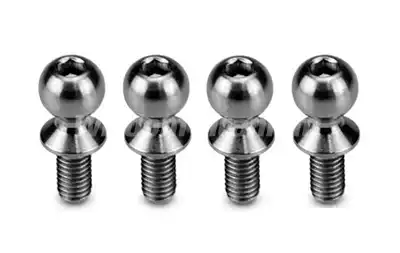
On race day, the smallest joint can decide the whole run. In an RC car, ball studs sit at that exact point of truth. They connect steering links, camber links, and suspension geometry. When they wear, the car starts to feel “soft.” You may call it slop, vague steering, or inconsistent camber. The result stays the same. You lose precision.
This page focuses on replacement parts for racing titanium ball studs in RC cars. It covers what fails, what to replace, and what to specify when you buy. If you are sourcing for a team, a shop, or a brand, you also need a supplier that can hold tolerances, keep inventory, and respond fast. Baoji Wisdom Titanium Industry and Trading Co., Ltd. is an ISO 9001-certified manufacturer (founded in 2016), focused on titanium fasteners and customized CNC parts, with stable production and inspection practices designed for consistent delivery.
Why do RC racers replace ball studs?
Racing titanium ball studs look simple. In practice, they live in a high-cycle fatigue world. Every steering correction and every landing loads that joint. Dirt works like grinding paste. Impacts add shock. Over time, the system loses crispness.
Wear patterns that mimic “setup problems”
Many racers chase handling with springs, oils, and toe settings, but the real issue sits in the linkage. When a ball stud surface and a ball cup no longer match tightly, the link moves before the suspension moves. That delay changes how the car responds at corner entry. It also changes how it exits, because the geometry does not return to the same position under load.
This is why “replace the ball studs and cups” often fixes a car that feels inconsistent. It is not magic. It is mechanical play showing up as delayed control input.
Common failure triggers in racing environments
In off-road and high-grip track conditions, abrasive dust and repeated high loads speed up wear. In wet conditions, corrosion can join the problem. Titanium is valued in many applications for its corrosion resistance. Grade 5 (Ti-6Al-4V) also brings high strength, which is why it appears in aerospace and high-performance components. Those same traits make it attractive for racing hardware where you want strength without carrying steel weight.
Titanium’s density is around 4.43 g/cm³ for Ti-6Al-4V, which helps explain why it is lighter than many steels while still delivering high tensile strength in typical datasheet ranges. Density and strength numbers vary by condition and standard, but reputable datasheets consistently place Ti-6Al-4V in a high strength-to-weight category.
What anodizing changes
Anodizing on titanium grows an oxide layer on the surface through an electrochemical process. That oxide layer can improve surface behavior and corrosion performance, and it also creates the color effect many racers like. However, if a joint rubs under abrasive conditions, the surface layer can still wear in contact zones. In other words, anodizing supports durability, but it does not make the joint “wear-proof.” This aligns with broader technical discussions of anodic oxide layers on titanium and how surface degradation can occur when exposed areas lose protection.
Replacement parts checklist for racing titanium ball studs
“Replacement parts” can mean three different purchases: the ball stud itself, the mating ball cup, and the hardware that locks the stud in place. Racing titanium ball studs cars often mix these parts across steering, camber, and suspension. That mix is where mistakes happen.
Match the interface: ball diameter and cup fit
The ball diameter controls the joint’s feel. Too tight, and the suspension binds. Too loose, and steering precision disappears. RC brands use different ball sizes depending on scale and platform. That is why many racers buy “ball stud + cup” as a system when they want a predictable fit.
Baoji Wisdom Titanium supports a customizable ball diameter. This matters for OEM or wholesale buyers who need to match an existing platform’s geometry without redesigning the link.
Match the mounting: metric thread type and thread engagement
Racing titanium ball studs hardware is commonly metric. Thread type is not a small detail. A ball stud that “almost fits” will strip plastic, crack composite mounts, or loosen under vibration. Baoji Wisdom Titanium provides metric thread type options, which aligns with the most common RC design approach.
If you are replacing multiple locations on a car, you also need consistent thread length. A stud that is too short risks pull-out. A stud that is too long may bottom out or interfere with travel. This is where custom CNC capability matters. It lets you specify thread length as precisely as the ball diameter.
Match the real-world use: steering links vs. camber links vs. suspension mounts
The “same” ball stud does not behave the same everywhere. Steering sees constant micro inputs. Camber links see long sweep movement and side load. Suspension mounts see impact spikes on landings. When you spec replacement parts, describe the use case. A supplier can then guide shoulder length, ball height, and thread engagement choices that match the load path you are actually creating.
What makes racing titanium ball studs “race-ready”?
A titanium ball stud only helps when the material and manufacturing match the job. “Titanium” as a label is not enough. Grade choice, processing, inspection, and consistency decide the outcome.
Why Grade 5 titanium (Ti-6Al-4V) is commonly selected
Baoji Wisdom Titanium uses titanium grade 5 for these parts. Grade 5 is widely recognized as Ti-6Al-4V, a high-strength alpha-beta titanium alloy. It is often cited as the most commonly used titanium alloy, and it appears across aerospace and industrial applications where strength, fatigue resistance, and corrosion resistance matter. Typical property summaries list density around 4.43 g/cm³ and tensile strength values commonly near or above 895 MPa depending on product form and condition.
Those numbers are not marketing decoration. In racing titanium ball studs, lower mass at linkages and reliable strength under repeated shock helps maintain alignment and feel. Titanium also resists corrosion well in many environments, which supports parts that may see moisture, mud, and chemical cleaners.
Anodized coatings and color options that racers actually buy
Baoji Wisdom Titanium offers anodized coating and color choices: red, black, blue, rainbow, purple, gold, burnt blue. Color is not only visual. Many teams use color to manage builds. They track which version is installed. They separate test sets. They reduce pit mistakes.
Technical sources describe anodizing as an electrochemical method that increases the oxide layer on titanium. That oxide layer relates to corrosion behavior and surface protection, although aggressive environments can still attack exposed areas. In RC use, abrasion at the cup contact zone can wear any surface over time. Smart buyers treat anodizing as a durability aid, not a lifetime guarantee.
Manufacturing credibility: ISO 9001 and Baoji Titanium Valley supply depth
Trust builds when the supply chain makes sense. Baoji Wisdom Titanium is based in China’s “Titanium Valley” ecosystem in Baoji, Shaanxi Province. Baoji is widely described as China’s largest titanium industry cluster, with a full industrial chain from sponge, ingots, and mill products through precision components and high-performance alloys. That matters for two reasons. First, it supports stable raw material sourcing. Second, it supports faster response when you need a new size, a revised drawing, or a custom ball diameter.
Baoji Wisdom Titanium Industry and Trading Co., Ltd. is ISO 9001-certified. ISO explains ISO 9001 as an international standard for quality management systems. It aims to help organizations deliver consistent products and improve processes over time. Certification involves an independent audit against ISO 9001 requirements. For buyers, that translates into a clearer system for inspection, documentation, corrective actions, and repeatability.
How to request a quote for replacement racing titanium ball studs?
Most quote delays come from missing specs. If you want speed, include the details below in your first message. You do not need a perfect drawing. A clear photo plus measurements can work.
In your inquiry, include the thread type (metric), thread diameter and pitch, thread length, ball diameter, ball height, shoulder details, target application (steering or camber), coating color, and estimated annual volume. Baoji Wisdom Titanium supports manufacturing and wholesale with competitive rates, ample inventory, and a 100 pcs minimum order. This MOQ fits small-batch race teams and parts brands that test, then scale.
Baoji Wisdom Titanium also provides customized CNC parts. That matters when your platform uses a non-standard ball diameter, or you need a special shoulder length to clear a steering knuckle.
Send your inquiry to: sales@wisdomtitanium.com.
FAQ
Q1: What should I replace along with racing titanium ball studs?
A: Replace the ball cups or rod ends whenever you replace ball studs, if you want consistent joint feel. The cup and the ball wear as a pair. When you keep an old cup, it can stay loose even with a new stud. That often brings back steering slop quickly.
Q2: Why do racers choose Grade 5 titanium for ball studs instead of steel?
A: Grade 5 titanium (Ti-6Al-4V) is widely used as a high-strength titanium alloy with a strong strength-to-weight balance, plus corrosion resistance. Datasheets commonly report density around 4.43 g/cm³ and tensile strength levels that can approach or exceed ~895 MPa depending on condition and specification. That combination can reduce weight while maintaining strength in high-stress RC joints.
Q3: Does anodizing stop wear on racing titanium ball studs?
A: No. Anodizing grows a titanium oxide layer through an electrochemical process, and it can improve corrosion behavior and surface characteristics. But RC ball cups still rub against the ball. Abrasive dust and repeated movement can wear the contact zone. Treat anodizing as a performance and durability feature, not a permanent shield.
Q4: What customization options does Baoji Wisdom Titanium offer for racing titanium ball studs?
A: Baoji Wisdom Titanium offers titanium Grade 5 material, anodized coating, metric thread type, and a customizable ball diameter. Color options include red, black, blue, rainbow, purple, gold, and burnt blue. The company manufactures and wholesales, and it supports standard and customized CNC parts with a 100 pcs minimum order.
Q5: What does ISO 9001 certification mean for buyers of RC replacement parts?
A: ISO 9001 is an international standard for a quality management system. ISO explains that it provides a framework to deliver consistent products and improve processes over time. Certification, when used, involves an independent audit against ISO 9001 requirements. For buyers, it is a practical trust signal that the supplier runs documented processes for quality control and continual improvement.
References
2. Thompson, R., & Johnson, B. L. (2019). Enhancing Durability and Precision in RC Car Suspension Systems: The Role of High-Strength Metals. International Journal of Automotive Engineering, 33(2), 211-219.
3. Li, F., & Zhang, H. (2018). Titanium Alloys in Precision Components for RC Cars: An Overview of Manufacturing Techniques and Performance Benefits. Journal of Lightweight Materials, 45(6), 1020-1030.
4. Hargrave, D., & Clark, A. M. (2017). Designing Suspension Systems for RC Cars: A Study on the Impact of Materials on Ball Stud Performance. Journal of Automotive Design and Innovation, 22(1), 65-74.
5. Harris, J. W., & Peterson, M. J. (2016). Investigating the Wear Resistance of Titanium Ball Studs in Remote-Controlled Car Applications. Journal of Mechanical Engineering Science, 21(8), 921-930.
6. Davis, R. T., & Miller, K. A. (2020). Advanced Material Selection for RC Car Components: The Role of Titanium in Racing Performance and Longevity. Materials Science and Engineering, 58(3), 237-245.