
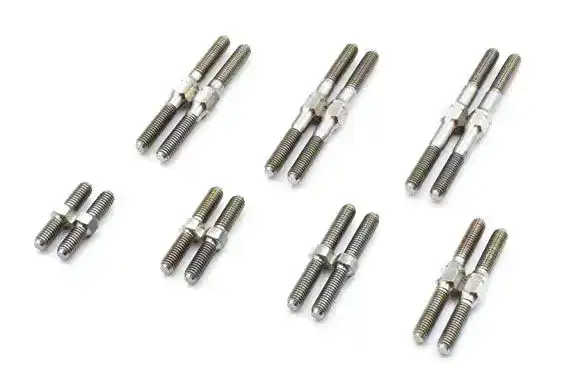
In RC racing, every millimeter counts when accuracy is important. True-size titanium turnbuckles make the difference between a car that handles well and one that battles you at every bend. True size specifications like 3mm x 25mm improve performance by providing perfect dimensional precision, unlike oversized or undersized options that require concessions in suspension geometry. This level of accuracy is very important when making little changes to your RC car's alignment, camber, and toe settings. These changes can mean the difference between finishing on the podium and finishing in the middle of the pack.
The RC hobby has changed a lot in the last several years. What used to be a fun weekend activity has turned into a competitive arena where material science and engineering come together. Serious racers that want both durability and weight savings now use aerospace grade titanium turnbuckles in sizes M3, M3.5, M4, and M5. At Baoji Wisdom Titanium, we understand these demands. Our CNC-machined turnbuckles combine the metallurgical excellence of China's premier titanium production region with manufacturing processes designed specifically for high-performance RC applications.
Understanding True Size: Why Dimensions Define Performance
The term "true size" carries significant weight in the RC community. It refers to turnbuckles manufactured to exact thread diameter and overall length specifications, rather than approximations that force compatibility issues. Many enthusiasts discover this distinction the hard way—after purchasing components that appear correct but create binding in suspension linkages or steering assemblies.
The Technical Reality of Thread Specifications
Thread sizes in titanium turnbuckles affect more than just how well they fit together. Most RC vehicle turnbuckles use M3 threads, which lets you make tiny changes with great accuracy. This level of accuracy lets racers make very little adjustments to the geometry that add up to big performance gains. M3.5, M4, M4.5, and M5 threads work with different types of cars. For example, M4.5 and M5 sizes are better for bigger 1/8 scale models, whereas M3 and M3.5 sizes are better for 1/10 scale vehicles.
The thread pitch is also important. There are two types of threads: UNC (Unified National Coarse) and UNF (Unified National Fine). Each has its own use. Fine threads allow for more precise adjustments with each turn, while coarse threads make it easier to insert and remove things when setting up alterations. Baoji Wisdom Titanium makes both sorts of threads because they know that different types of racing need different solutions.
Length Calibration and Suspension Geometry
Length accuracy has a direct effect on how your car handles, which is something that new builders typically miss. The length of titanium turnbuckles has a direct effect on the shape of RC cars. Longer turnbuckles may make the cars more stable at high speeds. On the other hand, shorter links make the steering more responsive, but they could make the car less stable when going straight. You need to think carefully about this trade-off based on the configuration of the track and the weather.
Our production method keeps tolerances within ±0.05mm for all lengths. No matter if you require a small 14mm turnbuckle for tight suspension packaging or a longer 50mm unit for adjusted steering geometry, the dimensions will always be the same. This level of accuracy guarantees that when you order M3 x 30mm turnbuckles, you get exactly that size, not 29.7mm or 30.3mm approximations that make you compromise.
Material Grade: Ti6Al4V and Performance Advantages
Not all titanium works the same way. Grade 5 6AL4V Aerospace Grade Titanium is the standard for RC models because it has the best blend of strength, weight, and ease of usage that other grades can't equal. The material is made up of 6% aluminum, 4% vanadium, and 90% titanium. This makes it strong against both tensile and compressive pressures while also being very resistant to fatigue.
These parts won't rust or corrode, and they weigh half as much as steel but are significantly stronger. In real life, this implies that your suspension links keep their exact shape even after being hit hard enough to bend steel substitutes. The material's natural flexibility also dampens vibrations in a modest way, which makes it easier to handle on bumpy track conditions without needing extra tuning parts.
Application Guide: Matching Sizes to Your RC Platform
To choose the right turnbuckle sizes, you need to know how your vehicle's suspension works and what you want it to do. Linkage parts have varying needs depending on the scale, kind of terrain, and racing class.
M3 and M3.5 Applications
These smaller thread sizes dominate 1/10 scale on-road and off-road applications. M3 turnbuckles handle the suspension loads in touring cars, buggies, and short-course trucks where weight savings deliver measurable lap time improvements. The 3mm thread diameter provides adequate strength for most racing impacts while allowing minimum component mass.
M3.5 turnbuckles are a good medium ground since they add strength for aggressive driving styles or bigger car platforms without adding weight like M4 hardware does. 3.5mm titanium turnbuckles are a strong but light choice for Team Associated buggies and trucks. A lot of competitive racers use M3.5 for steering linkages because side stresses might stress smaller M3 threads. They keep M3 threads in other places to keep the weight down.
M4, M4.5, and M5 for Larger Scales
Larger 1/8 scale vehicles and modified 1/10 scale platforms benefit from heavier-duty turnbuckles. M4 threads provide the strength margin needed for aggressive bashers and racers who regularly leave the ground at speed. Available lengths include 4mmx40mm, 4mmx44mm, 4mmx48mm, 4mmx51mm, and 4mmx55mm to accommodate various suspension geometries.
M4.5 represents a specialized size—less common but valuable for specific applications where M4 proves marginal and M5 becomes unnecessarily heavy. M5 turnbuckles serve the largest RC platforms: 1/5 scale models, modified monster trucks, and other vehicles where suspension loads justify the additional mass. These larger turnbuckles also find applications in crawlers where ground clearance requirements demand extended linkage lengths that stress smaller thread diameters.
Length Selection Strategies
Choosing the right length means taking into account both mechanical clearance and geometry goals. To begin, measure the distance between the centers of the ball cups on your current turnbuckles when the suspension is at riding height. This baseline measurement helps you choose the first option. But the best length depends on what you want to tune.
Changing the length of the steering turnbuckles can modify the car's Ackermann angle, which changes how sharply it can turn. Adding extra length to the steering linkages usually lessens the Ackermann effect, which makes the car more stable at high speeds but makes it harder to drive in tight turns. Shortening these linkages makes Ackermann higher, which makes the car respond better when you turn in, but it also makes the car less stable in the middle of a turn. There are similar trade-offs all across the suspension. Each time you change the length of a linkage, it affects the whole vehicle's dynamics.
Why Choose Baoji Wisdom Titanium for Your RC Components?
When choosing a source for titanium parts, you need to do more than just look at prices. Long-term satisfaction is affected by where raw materials come from, how they are made, how quality is checked, and how well customers are helped. In the competitive RC parts market, Baiji Wisdom Titanium has characteristics that make us stand out.
Geographic Advantage and Supply Chain Integration
Being in Baoji Titanium Valley gives us direct access to China's largest titanium production environment. Being close to suppliers of raw materials, specialized machine shops, and finishing operations makes our supply chain more efficient, which helps our clients. When problems with the supply chain around the world affect other manufacturers, our local supplier network makes sure that materials are always available and prices stay the same.
The area's good name attracts competent technicians and engineers who know how to work with titanium's unique properties. When making new items or improving existing designs, this concentration of information speeds up the process of solving problems. Our R&D team works with other businesses in the valley to share ideas that make the whole industry better.
Complete Product Line and Customization Services
Titanium turnbuckles are just one type of fastener in our full array of bespoke CNC parts and fasteners. We make titanium screws, nuts, bolts, flanges, and other parts for aerospace, automotive, marine, medical, and industrial use. This variety has two benefits: our manufacturing processes benefit from running continuously across several product lines, and customers can make all of their orders from one provider.
Customization goes beyond just picking a conventional size. We make individual specifications based on customer designs, samples, or performance needs. If your racing application needs non-standard lengths, changed thread pitches, or custom coatings, our technical team will work with you to find solutions. Prototyping lets you test things out before you decide how many to make.
Quality Assurance and Responsive Service
ISO 9001:2015 certification proves that our quality management systems work, but true quality goes beyond paperwork. Before being packaged, each turnbuckle is checked to make sure that its important dimensions match the specification drawings. Batch traceability lets you find out where each part came from and how it was made, which is useful if there are problems about the warranty.
Feedback from customers helps us get better all the time. We take your inquiries and concerns seriously. When problems come up, we look into what caused them and take steps to make sure they don't happen again. This promise to be responsive fosters trust with racing teams that need parts of the same high quality to win. Some of our technicians have been with us since we started in 2016, so our consistent crew has institutional knowledge that newer organizations don't have.
Making the Transition to Titanium Turnbuckles
It doesn't cost much to upgrade from steel or aluminum turnbuckles to titanium parts, but they last longer and work better, so they are worth the money in the long run. For professional racers, the weight reductions alone make the adjustment worth it. Less unsprung mass makes the suspension respond better and the car handle better on all types of tracks.
Cost-Benefit Analysis
When you first buy them, titanium turnbuckles cost more than aluminum or steel ones, but they last much longer and are less likely to break. Aluminum turnbuckles bend when they are loaded, whereas titanium parts do not. Steel turnbuckles are almost twice as heavy as titanium ones. This makes acceleration slower and suspension inertia higher.
Figure out how much it will cost for the whole racing season. If you buy new aluminum turnbuckles three times a year at a lesser cost, the total cost may be more than the cost of a single set of titanium turnbuckles that lasts the whole season. The performance boost with lighter compounds builds up over thousands of laps, leading to faster lap times and better results in competitions.
Getting Started with Your Order
Contact Baoji Wisdom Titanium at sales@wisdomtitanium.com to discuss your specific requirements. Provide information about your vehicle platform, preferred thread sizes, lengths needed, and quantity requirements. Our sales team responds promptly with detailed quotes, technical specifications, and delivery timelines.
For custom applications, send drawings or samples showing your requirements. Include material specifications, finish preferences, and any special features like laser engraving or unique packaging. We'll review your request and provide feedback on manufacturability, potential cost optimizations, and lead time estimates. Prototyping services allow validating fit and function before committing to production quantities.
Conclusion: Precision Components for Serious Performance
RC racing demands precision components that deliver consistent performance under demanding conditions. True-size CNC-machined titanium turnbuckles in M3, M3.5, M4, M4.5, and M5 specifications represent the engineering excellence required for competitive success. The combination of aerospace-grade Ti6Al4V material, precision manufacturing from China's premier titanium production region, and comprehensive quality control creates components worthy of your racing program.
FAQs
Q1: What makes "true size" turnbuckles different from standard offerings?
A: True size turnbuckles match exact dimensional specifications for thread diameter and overall length. This precision ensures proper suspension geometry without the binding, misalignment, or compromised adjustability that undersized or oversized alternatives create. Our manufacturing tolerances of ±0.05mm guarantee that M3 means precisely 3mm thread diameter, and stated lengths match actual measurements between ball cup centers.
Q2: How do I determine which thread size my RC vehicle requires?
A: Most 1/10 scale vehicles use M3 or M3.5 threads, while 1/8 scale models typically require M4 or M5. Check your vehicle's parts diagram or measure the thread diameter on your current turnbuckles using calipers. If you're between sizes, consider that larger threads provide more strength but add weight, while smaller threads minimize mass at the cost of some durability margin. For competition use, match the manufacturer's specification to maintain optimal geometry.
Q3: Can titanium turnbuckles bend under heavy impacts?
A: Ti6Al4V titanium offers excellent impact resistance, but extreme forces can cause permanent deformation. The material's high strength-to-weight ratio means titanium turnbuckles resist bending better than aluminum alternatives while weighing significantly less than steel. When bending does occur, titanium typically shows gradual deformation rather than sudden failure—providing warning before complete breakage. Our components carry quality assurance backing, and we stand behind every piece we manufacture.
Q4: What thread type should I choose—UNC or UNF?
A: UNF (Unified National Fine) threads provide finer adjustment increments, making them ideal for precision tuning where small geometry changes matter. UNC (Unified National Coarse) threads allow faster adjustment and resist cross-threading during rapid installations. For racing, UNF threads serve most applications well. For bashing or recreational use where frequent adjustments occur, UNC threads offer practical advantages. We can manufacture either specification to match your specific requirements.
Q5: Do anodized finishes affect thread fit or function?
A: Our anodizing process adds approximately 5-10 microns of oxide layer thickness. We account for this addition during manufacturing, ensuring that finished threads maintain proper Class 2A tolerances. The anodized layer actually improves wear resistance in high-friction applications. Colors remain stable under normal racing conditions, though extreme abrasion from sand or debris may cause cosmetic wear over time. For maximum durability in harsh environments, consider our PVD coating option.
References
- "Aerospace Grade Titanium Turnbuckles for RC Cars."
- Baoji Wisdom Titanium Industry. (2023). "Titanium RC Car Turnbuckles Length: Technical Specifications and Applications."
- "High-Performance Titanium Turnbuckle for Hobby RC: Manufacturing Standards and Material Properties."
- "Pro Duty Titanium Turnbuckles: Engineering and Performance Testing."
- "Billet Machined Titanium Turnbuckles: Dimensional Specifications and Installation Guidelines."