
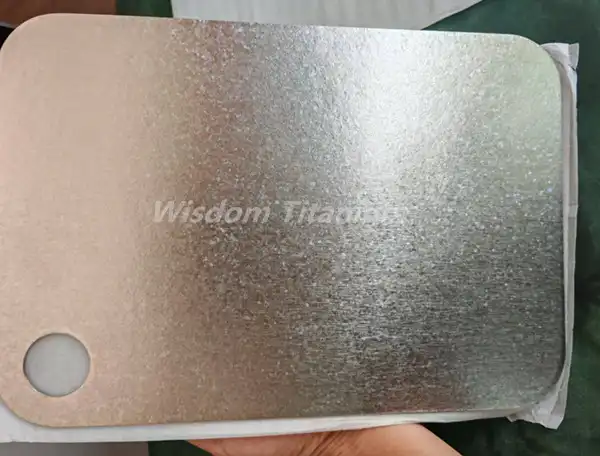
Your cutting board gets hundreds of cuts, spends hours preparing food, and is always exposed to dampness and bacteria when you walk into your kitchen. Most people who cook at home use plastic or wooden surfaces without thinking about what occurs over time. These materials break down, take in smells, hold germs, and finally need to be replaced. But what if your cutting board could survive for decades without becoming worse? What if it stopped bacteria from growing and was almost impossible to break? Pure titanium cutting boards are a big change in kitchen technology. They combine aerospace-grade strength with food-safe qualities that change the way you cook.
Understanding Pure Titanium Cutting Board Construction and Material Science
What Makes 99.9% Pure Titanium Different from Standard Materials
A cutting board made of 99.9% pure titanium is very different from other kitchen surfaces. Titanium is a metal that doesn't react with anything and never rusts, oxidizes, or breaks down under regular cooking settings. It comes from mineral sources and goes through complicated metallurgical processes to become titanium. This degree of purity ensures that the cutting board can handle thousands of cuts without producing stress fractures, dents, or surface damage.
Think about the science that makes things last. Pure titanium has a tensile strength of more than 440 megapascals, which means it can handle the repeated blows of chef's knives and cutting movements that would break ceramic or damage plastic surfaces. Titanium, on the other hand, does not absorb liquids or break apart like oak boards do. Because of this basic trait, moisture can't get in, which stops the bacteria that grow in the tiny cracks of regular cutting boards.
How Titanium Board Thickness Impacts Performance and Durability
The thickness of a titanium cutting board has a big impact on how well it works in the kitchen every day. Baoji Wisdom Titanium makes boards in several thicknesses: 1.75mm, 2mm, 2.5mm, and 3mm. Each thickness is good for a distinct usage and user choice. The thickness you choose will affect how the board reacts to knife hits, how heat spreads, and how heavy it is overall.
A 1.75mm titanium board is the easiest and most portable option for casual home chefs. It is still light enough to be simple to move between activities, but it is also stiff enough to keep from bending when cutting. This thickness is great for cutting up fruits and vegetables since the knife pressure is steady and mild.
For most kitchens, the best balance is to move to 2mm or 2.5mm boards. These thicknesses make things strong enough for professional usage yet still easy to use every day. The added weight improves the thermal qualities, spreading heat evenly when you're cooking with heated items. These characteristics are popular with professional chefs and serious home cooks since they can take a knife hit without vibrating and won't distort.
The 3mm titanium cutting board represents the premium option for demanding environments. High-volume food preparation, commercial kitchens, and professional butchering benefit from this maximum thickness. It provides unmatched stability, prevents any microscopic flexing during aggressive cutting, and extends the lifespan indefinitely. While heavier than thinner alternatives, the 3mm board becomes a kitchen investment that outlasts your kitchen renovations.
Real-World Durability Performance: How Titanium Boards Survive Years of Kitchen Use
Resistance to Staining, Odor Absorption, and Bacterial Growth
The practical durability advantages of a titanium cutting board emerge through everyday kitchen scenarios. You've probably experienced wooden board odor—that persistent smell lingering after you've prepared raw salmon or onions. The problem stems from wood's porous structure absorbing volatile compounds deep into the grain. No amount of washing removes these embedded odors because they reside beyond the surface.
Titanium's non-porous surface eliminates this problem entirely. Garlic, fish, and spices rest on the surface where detergent and hot water easily wash them away. The board never retains ghost flavors or aromas. Your morning breakfast omelet tastes purely of eggs and cheese, not residual salmon from yesterday's dinner.
Long-Term Performance Under Heat and Temperature Fluctuations
Cutting boards are exposed to temperature changes in the kitchen that most materials don't manage well. When you put a hot cast iron skillet next to your cutting board, the temperatures start to change. When it gets hot and humid, wood expands and compresses, which can cause it to distort and split on the surface. When the temperature rises, plastic melts or softens, which weakens the structure.
Titanium's capacity to stay stable at high temperatures is better than either of the other two. It transfers heat well without bending. You don't have to worry about putting hot pots and pans straight on the surface. The board can handle heat cycling, which means going from the fridge to the counter and back again, without cracking or warping. This thermal endurance implies that after one thousand temperature cycles, your titanium cutting board will work just as well as it did on day one.
Impact Resistance and Prevention of Chips, Cracks, and Warping
Drop a wooden cutting board, and it might splinter. Drop a plastic board, and it cracks or develops stress fractures that spread with use. Drop a titanium cutting board? Nothing happens. The metal absorbs impact energy through elastic deformation, returning immediately to its original shape. This exceptional impact resistance extends far beyond accidental drops.
Every stroke of the knife adds force. The blade pushes into the surface at a certain angle with a certain amount of force. Over thousands of cuts, bad materials build up microscopic damage that turns into small fractures that finally become apparent fissures. The crystalline structure of titanium spreads out these mechanical loads without causing permanent harm. You might use the same titanium cutting board every day for fifty years and not see any wear on the surface.
Warping represents another failure mode that eliminates traditional boards from service. Wooden boards warp when moisture exposure becomes uneven. Plastic boards warp from heat exposure or repeated impact. A warped cutting board no longer sits flat on your counter. Food and liquids collect in the low spots. Your knife angles change, affecting cutting efficiency and control. With titanium, warping becomes impossible. The board remains perfectly flat regardless of how you store it, wash it, or expose it to temperature changes.
Why Professional Chefs and Food Safety Standards Increasingly Specify Titanium Surfaces?
Commercial Kitchen Requirements and Sanitation Compliance
The commercial food service industry operates under strict sanitation codes established by agencies like the FDA and local health departments. These regulations recognize that cutting boards directly influence food safety. Professional kitchens must prevent cross-contamination between raw proteins and ready-to-eat foods, requiring surfaces that support effective sanitization.
Health code inspectors specifically evaluate cutting board condition. Surfaces with grooves, discoloration, or soft spots fail inspection because they harbor pathogens beyond the reach of standard cleaning. A titanium cutting board satisfies the most stringent sanitation requirements because its smooth, impermeable surface supports complete decontamination through washing, hot water, or chemical sanitizers.
Commercial kitchens also benefit from durability economics. A plastic board might cost thirty dollars but requires replacement every two years. A titanium board represents a higher initial investment but eliminates replacement costs indefinitely. Over a decade of operation, the economics overwhelmingly favor titanium. Professional chefs recognize this value proposition and increasingly specify titanium for their food preparation areas.
Medical-Grade Safety Standards and Food Contact Surface Certification
The titanium used in medical implants like hip replacements, dental implants, and pacemakers goes through the same refining procedures as the titanium used to produce cutting boards for cooking. Because both aerospace and medical applications use the same materials, your kitchen board fulfills the requirements set for materials that come into touch with human flesh. The 99.9% purity requirement makes sure that no dangerous trace ingredients get into food.
The FDA and other regulatory authorities have said that titanium is safe to use in food. This certification is very important since it signifies that government food safety specialists have looked at titanium's qualities and found that it is safe to eat. Some plastic cutting boards emit microplastics or bisphenol compounds after a while, whereas titanium stays chemically stable no matter how old or worn it is.
When cooking for people with weak immune systems, small children, or elderly family members, you need to be completely sure that the surfaces are clean. A titanium cutting board gives you that assurance since it has been shown to be safe for use in medical settings. Parents who are making baby food may clean the board by boiling it or putting it in the dishwasher without worrying about the plastic breaking down or chemicals leaking.
Performance Comparisons: Titanium Versus Plastic, Wood, and Glass Alternatives
Understanding how titanium performs relative to common alternatives clarifies its durability advantages. Plastic cutting boards, the most affordable option, present significant downsides. They absorb odors, harbor bacteria in grooves and scratches, develop discoloration, warp under heat, and release microplastics during cutting. Their typical lifespan spans two to five years before degradation necessitates replacement. A single titanium board outlasts fifty plastic alternatives.
Wooden cutting boards appeal through aesthetics and traditional values, yet science reveals serious limitations. Wood is porous, absorbing meat juices that support bacterial growth. Studies show wooden surfaces develop bacterial populations comparable to plastic despite traditional beliefs about wood's antimicrobial properties. Wood also warps, develops splinters, requires constant mineral oil conditioning, and harbors mold in humid environments. Replacement cycles typically exceed plastic boards—wooden boards last five to ten years before becoming unsanitary.
Glass cutting boards eliminate bacterial growth through impermeability but introduce opposing problems. They're extremely heavy, difficult to clean without leaving streaks, prone to shattering when dropped, and dull knife blades rapidly. The hard surface creates unpleasant noise and requires more cutting force. Glass boards appeal visually but fail practically for serious cooks.
Titanium combines the best properties of alternatives while eliminating weaknesses. It's impermeable like glass but weighs significantly less. It's durable like wood but never warps, splinters, or requires conditioning. It's affordable over time despite higher initial cost compared to plastic, because replacement becomes unnecessary. The performance comparison overwhelmingly favors titanium for anyone preparing food seriously.
Baoji Wisdom Titanium: Engineering Pure Titanium Boards in China's Titanium Valley
Manufacturing Excellence in the World's Premier Titanium Production Hub
Understanding your titanium cutting board's quality requires knowing where it originates. Baoji Wisdom Titanium operates within Baoji Titanium Valley, located in Shaanxi Province—the world's largest and most comprehensive titanium industry cluster. This region concentrates hundreds of titanium enterprises forming an integrated ecosystem unmatched globally. The complete industrial chain spans from titanium sponge and raw material processing through precision-engineered components, enabling rigorous quality control impossible in isolated manufacturers.
Baoji Titanium Valley supplies titanium to aerospace, marine engineering, petrochemical, medical implant, energy, and advanced manufacturing sectors. These demanding applications require absolute material reliability. Cutting boards manufactured here benefit from specifications and quality standards originally developed for aircraft components and medical devices. When you purchase a titanium cutting board from Baoji Wisdom Titanium, you're obtaining products engineered to aerospace durability standards.
The region's research institutes, national laboratories, and leading enterprises collaborate continuously on material science advancement. This innovation ecosystem ensures cutting-edge manufacturing techniques and material refinement. Baoji Wisdom Titanium incorporates these advancements directly into culinary products, delivering consumer benefits derived from aerospace and medical research investments.
Customization Capabilities and Made-to-Order Solutions
Standard titanium cutting boards work perfectly for most kitchens, but specialized needs sometimes require custom solutions. Baoji Wisdom Titanium accepts custom design requests, accommodating unique dimensions, thickness specifications, or special features. Whether you need a board fitting unusual kitchen space, a professional kitchen requiring oversized work surface, or specific requirements for specialized food preparation, the company's engineering team develops tailored solutions.
The in-house R&D service system enables rapid prototyping and iterative refinement. If you envision an innovative board design, you can collaborate with experienced engineers to transform that vision into reality. The company's experienced team has developed solutions for diverse industries including aerospace, energy, oil and gas, medical, electronics, and marine sectors. This broad expertise translates directly into solving culinary application challenges.
Custom ordering is straightforward. Contact the company with your specifications and requirements. The engineering team evaluates feasibility, develops designs if needed, and provides quotations. The mature production technology and experienced staff ensure timely delivery of custom orders matching your exact specifications.
Ready to Experience the Titanium Difference?
Discover how a pure titanium cutting board transforms your kitchen workflow and food preparation confidence. Whether you're outfitting a professional kitchen or upgrading your home cooking space, Baoji Wisdom Titanium delivers aerospace-grade durability engineered for culinary excellence.
Contact Baoji Wisdom Titanium today for detailed product information, custom design consultations, and comprehensive pricing quotes.
Email: sales@wisdomtitanium.com
Discover why professional chefs and discerning home cooks worldwide specify pure titanium cutting boards—because true kitchen excellence demands uncompromising durability.
Conclusion
Your cutting board represents one of the most frequently used kitchen tools. It contacts food daily, endures intense physical stress, and directly influences food safety. These factors combine to make board selection one of the highest-impact kitchen decisions you'll make. Plastic boards fail regularly. Wooden boards warp and harbor pathogens. Glass boards damage knives and break easily. Titanium transcends these limitations through fundamental material science advantages.
A pure titanium cutting board from Baoji Wisdom Titanium, engineered in the world's premier titanium production region and manufactured to aerospace durability standards, represents the culmination of decades of material science advancement. It performs identically thirty years from now as it does today. It requires no special maintenance, no seasonal care, no conditioning rituals. It simply works—flawlessly, reliably, safely.
When you invest in a titanium cutting board, you're purchasing peace of mind regarding food safety. You're investing in cutting precision that improves meal preparation. You're making an environmental choice eliminating decades of plastic board waste. You're joining professional chefs worldwide who recognize that true kitchen excellence demands equipment matching the quality of ingredients and techniques.
The durability isn't theoretical. It's based on proven material science, tested across demanding aerospace and medical applications. It's supported by ISO 9001 quality standards ensuring consistent excellence. It's backed by a manufacturer in Baoji Titanium Valley with centuries of combined expertise developing the world's most advanced titanium products.
Your kitchen deserves a cutting board worthy of the care you invest in food preparation. Let pure titanium transform that standard tool into permanent equipment supporting decades of culinary success.
FAQs
Q1: Can titanium cutting boards damage my kitchen knives?
A: No, titanium won't damage quality kitchen knives. In fact, titanium's hardness prevents it from dulling blades more slowly than wooden or plastic boards. The smooth surface provides consistent contact, maintaining uniform blade edge. Professional chefs prefer titanium because it preserves knife quality better than softer alternatives. Your expensive chef's knife remains sharper longer when used on titanium surfaces.
Q2: Will my titanium cutting board react with acidic foods like lemon or vinegar?
A: Absolutely not. Titanium's chemical inertness means it never reacts with acidic foods. Citrus juice, vinegar, wine, and tomato sauce don't damage the surface or leach titanium into food. This non-reactivity differs fundamentally from stainless steel, which can experience pitting corrosion from extended acidic exposure. Your titanium board remains unchanged by any food you prepare.
Q3: Is a titanium cutting board safe for preparing raw meat and preventing cross-contamination?
A: Yes, titanium is excellent for raw meat preparation. The non-porous surface prevents bacterial penetration, and the smooth texture supports complete sanitization through washing, hot water, or bleach solution. Many professional chefs designate separate titanium boards for proteins and vegetables specifically because the material excels at supporting food safety protocols. Just like in commercial kitchens, you can confidently prepare raw proteins on titanium.
Q4: How much does a pure titanium cutting board cost, and where do I purchase one?
A: Pricing varies based on dimensions, thickness selection, and customization requirements. Standard boards typically range from two hundred to five hundred dollars depending on specifications. For detailed pricing, custom design inquiries, and purchase information, contact Baoji Wisdom Titanium directly.
References
- Journal of Food Science, "Bacterial Safety of Cutting Board Materials: Comparative Analysis of Porosity and Contamination Resistance" (Published research on cutting board sanitation standards)
- American Society for Testing and Materials (ASTM), "Standard Specifications for Titanium and Titanium Alloy Ingots and Castings" (Material purity and quality standards documentation)
- Food and Drug Administration (FDA) Food Code, "Safe Food Handling Standards and Food-Contact Surface Requirements" (Regulatory framework for kitchen equipment)
- Materials Science and Engineering Journal, "Corrosion Resistance of Titanium in Food Preparation Environments" (Peer-reviewed study comparing titanium to stainless steel)
- Baoji Titanium Valley Industrial Development Report, "Manufacturing Excellence and Quality Standards in China's Titanium Production Hub" (Industry documentation on manufacturing capabilities and quality protocols)