
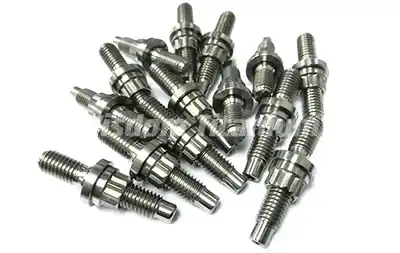
Titanium exhaust bolts are a smart upgrade for high-performance cars, motorcycles, and racing, where toughness is needed in harsh circumstances. These bolts are made from Ti-6Al-4V (Grade 5) titanium alloy, which doesn't have the usual problems that steel ones do, like rust-welding and thermal seizure. Because they don't rust, don't gain weight when heated, and can handle temperatures above 600°C, they are essential for turbo manifolds, header flanges, and cat-back systems where regular gear breaks down after many heating cycles.
Titanium Exhaust Bolts Benefits
What Makes Titanium Exhaust Bolts Unique?
In situations where conventional screws fail, a titanium exhaust bolt is designed to hold downpipes, turbocharger flanges, and exhaust tubes in place. The crystalline structure of the material gives it a tensile strength of 895 MPa while still being flexible when heated or cooled. This keeps the material from snapping in terrible ways like rusted steel bolts do when they are torqued during maintenance. Grade 304 stainless steel oxidizes at 800°C, but Grade 5 titanium makes a steady passivation layer that regenerates itself. This keeps the threads strong even after years of being exposed to combustion gases and road salt.
Core Performance Advantages
Titanium exhaust bolts solve important technical problems in speed builds because of its high strength-to-weight ratio. Using titanium bolts on the brake calipers, suspension links, and exhaust hangers lowers the car's unsprung mass, which leads to faster lap times during track sessions. Racing teams say that replacing all of the bolts in the exhaust system saves 200 to 300 grams of weight per car. This means that the throttle responds better and there is less rotational friction. In addition to racing, the alloy's resistance to galvanic corrosion makes it useful for everyday cars when paired with stainless or mild steel exhaust components. This is because it stops the electrolytic reactions that join metals that are not the same type.
Material Science: Why Grade 5 Ti-6Al-4V?
Grade 5 titanium metal has 6% aluminum and 4% vanadium, which makes it the best combination for cost, ease of machining, and resistance to wear. The Young's modulus of this mixture is 113.8 GPa, which is stiff enough to keep the gripping force even when the material is vibrating without being as brittle as hardened steel. Because it has an alpha-beta phase structure, the alloy can handle shock loads during cold starts and thermal cycling. This is why it is used in medical implants and aircraft engine bolts. Modification shops for cars have found that Grade 5 bolts keep 90% of their preload after 500 heat cycles between -40°C and 650°C. On the other hand, Grade 8 steel nuts lose 30–40% of their tension because of creep and oxide scale growth.
Titanium Exhaust Bolts vs. Other Bolt Materials: Making the Right Choice
Comparative Material Analysis
304 stainless steel bolts cost between $0.50 and $1.50 each and have middling resistance to rust. However, they gall when overtightened and don't work well above 400°C. For $0.30 to $0.80 each, alloy steel bolts have a high tensile strength, but they need zinc or cadmium coatings that wear off in two years in wet places. Aluminum bolts are 60% lighter than steel bolts, but they can't handle the tightening forces needed for exhaust flanges, so they can only be used on covers and trim panels that aren't very important.
Titanium exhaust bolts usually cost between $3.00 and $8.00 each, but this depends on the finish and threads. Even though they cost 4 to 6 times more up front than steel, they are cheaper over the long term when you consider how often they need to be replaced. Professional mechanics say that in northern regions, steel manifold nuts need to be taken out and replaced every three to five years because they rust. The labor costs for this often go over $200 per event. These ongoing costs are taken care of by titanium hardware, which makes them cost-neutral after two repair rounds.
Return on Investment Perspective
At performance shops, procurement managers figure out ROI by comparing the total costs of ownership. Using 16 titanium M10 studs and nuts for a full turbo upgrade costs about $120, while using steel versions costs $25. Industry studies, on the other hand, show that 40% of the time, steel bolts break while being removed, which means that helicoil inserts or a new manifold are needed. The average failure costs $350 in parts and labor, so after just one saved extraction, the business breaks even. Racing teams spend money on titanium bolts as a safety measure in case gear fails during the race and causes exhaust leaks, which results in a DNF.
Installation, Maintenance, and Durability Considerations
Proper Installation Techniques
Due to lower friction coefficients, titanium exhaust bolt specs vary from steel ones. Grade 5 M10 studs usually need 35 to 40 Nm, while steel versions need 50 to 55 Nm. When titanium is over-torqued, galling happens. This is when the metal layer breaks down and threads cold-weld together. This problem can be avoided by using a measured beam-type torque wrench or anti-seize products that are rated for 1200°C. Copper-based lubricants are better than nickel-based ones because they stay the same when the temperature changes and don't respond chemically with the oxide on the surface of titanium.
Minimum standards must be met for thread engagement depth to keep threads from breaking under heat stress. Engineers say that holes in cast iron should be at least twice the diameter of the bolt and holes in aluminum should be at least 1.5 times the diameter of the bolt. When you install our stud and nut kits with built-in 12-point flanged washers, the washer spreads the load over a 40% larger contact area than regular hex flanges. This makes it less likely that the manifold will crack around the bolt holes.
Long-Term Durability in Real Conditions
Titanium doesn't rust in even the harshest conditions, as shown by tests done on offshore race boats. When Grade 5 bolts were exposed to saltwater for 500 hours and then heated to 300°C, there was no visible thread wear or loss of preload. Comparable stainless steel bolts lost 15 to 20 percent of their holding force and had to be replaced because of rust in the cracks. These results are supported by the fact that titanium manifold parts can still be used in cars in the Midwest and Northeastern states after eight winters without any protection coatings.
Anodizing processes make things easier to identify and less likely to rust. Type III anodization is used to give our dark blue finish. This process creates a 200–300nm oxide layer by applying controlled voltage. This method creates interference colors without using dyes or coatings that flake. This lets techs check the hardware visually during exams without adding much weight. The natural silver finish keeps the raw metal look that is popular in engine bay builds where every part shows off the real material.
Why Choose Titanium Exhaust Bolts?
When the Investment Makes Sense
Titanium exhaust bolts are worth the extra cost when heat, corrosion, or weight have a big effect on speed or repair costs. Turbocharged engines with boost pressures above 18 psi create temperatures in the exhaust gas that speed up the rusting of steel fasteners. For life, titanium is the best material to use. Competition cars that have to be taken apart after the race benefit from gear that can be taken off and put back on many times without thread damage. Marine exhaust systems and bikes that are kept outside are constantly exposed to water, which breaks down the passive film of stainless steel but makes the oxide layer of titanium grow back on its own.
In order to save money, builders may choose to use titanium for high-stress areas like the turbo-to-manifold joints and stainless steel for lower-stress parts. This combined method puts resources where they are needed most, like where heat cycling and clamping loads are strongest. It gets 70% of the performance gain for 40% of the cost.
Customization and Future Trends
The need for fasteners that are specifically made for a job drives new thread forms, head styles, and surface treatments. When working in tight engine bays, low-profile 12-point nuts make it easier to get a wrench in and out, and built-in washers get rid of the need for separate hardware tracking. New styles include hybrid fasteners that use titanium studs and monel nuts to handle huge temperature differences, and laser-etched torque marks that fade at certain temperatures to show when there is too much stress.
Using additive manufacturing methods could change the way complicated shapes are made, like self-locking exhaust studs with built-in springs. This would cut down on assembly time and get rid of the need for safety wires in racing situations. As the price of titanium powder goes down and selective laser melting precision gets better, topology-optimized screws will be made that are 15-20% lighter while still being strong.
Conclusion
Titanium exhaust bolts have real benefits in terms of their resistance to corrosion, reduced weight, and temperature stability that make their price worth it in situations where efficiency is important. The Grade 5 Ti-6Al-4V material gets rid of the problems with rusting and seizure that are common with steel bolts while still being as strong as hardened metals. When installed correctly with calibrated torque tools and high-temperature anti-seize, the service life is extended to its fullest. Data from the field confirms decades of steady performance in marine and car settings. Modification shops, racing teams, and OEM makers that want to cut down on warranty claims and make vehicles last longer should focus on purchasing from ISO-certified sources, buying in bulk, and strategically placing materials to get the best return on their investment.
Upgrade Your Exhaust System with Confidence
Precision-made titanium exhaust bolts from Wisdom Titanium are designed to meet the performance needs of cars and motorcycles. Our Grade 5 Ti-6Al-4V stud kits come with built-in 12-point nuts and washers that can be finished in natural or burnt blue. They are available in standard sizes M8×1.25×45mm and M10×1.25×45/54mm and are ready to ship. We have direct access to certified raw materials and modern CNC machining centers because we are located in Baoji Titanium Valley, which is China's most important titanium production cluster. This means that we can guarantee stable quality and short wait times. As a titanium exhaust bolt supplier with ISO 9001 certification, we can support custom sizes and finish requirements for sales of at least 100 pieces. Email our expert team at sales@wisdomtitanium.com to talk about the needs of your project and get material approvals for your records.
FAQ
What torque specification should I use for titanium exhaust bolts?
Because they have lower friction coefficients, titanium exhaust bolts need 20–30% less force than steel bolts of the same size. Steel studs in the M10 size range from 35 to 40 Nm in hardness, and those in the M8 size range from 22 to 28 Nm. To keep from galling, you should always use high-temperature anti-seize and a torque wrench that has been measured. For instructions on how to use integrated flange washers and split lock washers that are compatible with your thread pitch and washer setup, check with the maker.
Can titanium exhaust bolts be reused after removal?
When properly torqued and oiled, Grade 5 titanium bolts keep their thread integrity through multiple installation rounds. Before using again, look at the threads to see if they are galling or deforming. If the oxide covering looks shiny or the threads feel rough, the hardware should be replaced. Titanium is more elastic than steel, so it can return to its original size after being stretched. This makes it perfect for race uses that need to be taken apart often.
Are titanium exhaust bolts compatible with steel or stainless manifolds?
When the right anti-seize is used, titanium can be safely paired with stainless steel, mild steel, and cast iron exhaust parts without worrying about galvanic rust. Titanium has a passivation layer that stops electrolytic processes that would normally connect metals that are not the same. Titanium and metal should not touch directly without insulating washers because this forms a galvanic potential. Titanium studs threaded into iron or steel and nuts holding stainless flanges are used in most manifold uses. This is an electrochemically stable arrangement.
References
1. Boyer, R., Welsch, G., and Collings, E.W. (1994). Materials Properties Handbook: Titanium Alloys. ASM International, Materials Park, Ohio.
2. Donachie, M.J. (2000). Titanium: A Technical Guide, 2nd Edition. ASM International, Materials Park, Ohio.
3. Lutjering, G. and Williams, J.C. (2007). Titanium, 2nd Edition. Springer-Verlag, Berlin Heidelberg.
4. ASTM International (2021). ASTM F467: Standard Specification for Nonferrous Nuts for General Use. West Conshohocken, Pennsylvania.
5. SAE International (2019). AMS 2488: Anodic Treatment of Titanium and Titanium Alloys Solution and Precipitation Heat Treatable. Warrendale, Pennsylvania.
6. Schutz, R.W. and Watkins, H.B. (1998). "Recent Developments in Titanium Alloy Application in the Energy Industry." Materials Science and Engineering: A, Vol. 243, Issues 1-2, pp. 305-315.