
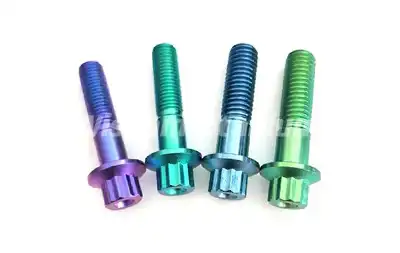
When it comes to choosing the right bolt for your project, especially in high-performance applications, the debate between titanium 12 points bolts and 6 points bolts often arises. Both types have their merits, but understanding their differences can help you make an informed decision. Let's dive into the world of these specialized fasteners and explore which might be the better choice for your needs.
Torque Transfer and Strength
The primary difference between 12 points and 6 points bolts lies in their head design, which significantly impacts torque transfer and overall strength. Titanium 12 points bolts, with their distinctive star-like pattern, offer some unique advantages in this arena.
12 points bolts provide a greater surface area for tool engagement. This increased contact allows for more efficient torque transfer, reducing the risk of slippage during installation or removal. The design distributes force more evenly across the bolt head, which can be particularly beneficial when working with the lightweight yet robust properties of titanium.
On the flip side, 6 points bolts have thicker sidewalls due to their hexagonal shape. This additional material can provide enhanced strength in certain applications, especially when extreme forces are at play. However, the 12 points design compensates for this by offering more points of contact, which can be advantageous in preventing rounded corners – a common issue with over-torqued 6 points bolts.
It's worth noting that titanium itself brings exceptional strength-to-weight ratio to the table. Grade 5 titanium (Ti-6Al-4V), commonly used in high-performance bolts, boasts a tensile strength of around 950 MPa. This impressive strength, combined with the 12 points design, creates a fastener that can withstand substantial loads while remaining incredibly lightweight.
Tool Compatibility and Practical Use
When considering the practical aspects of using titanium 12 points bolts versus their 6 points counterparts, tool compatibility and ease of use come into play. The 12 points design offers some distinct advantages in this area.
One of the most significant benefits of 12 points bolts is their increased accessibility. The additional engagement points mean that you can position your wrench or socket at more angles, which is invaluable when working in tight spaces or with limited visibility. This feature can be particularly useful in complex assemblies where every degree of maneuverability counts.
12 points bolts are also less prone to "camming out" – a phenomenon where the tool slips off the bolt head under high torque. This reduced risk of slippage not only makes the installation process smoother but also helps prevent damage to the bolt head or the surrounding components.
However, it's important to note that 6 points bolts have their own advantages in terms of tool engagement. The wider flat surfaces of a 6 points head can provide a more secure grip in some situations, especially when using open-end wrenches. This can be beneficial in applications where the bolt might be subjected to extreme torque or vibration.
When it comes to specialized titanium bolts, such as the m6 titanium 12 points bolts used in high-performance automotive applications, the choice often leans towards the 12 points design. These bolts, typically made from grade 5 titanium, offer an ideal combination of strength, weight savings, and practicality for demanding environments like racing cars and custom automotive builds.
Real-World Applications
The debate between titanium 12 points bolts and 6 points bolts takes on real significance when we consider their applications in various industries. The unique properties of titanium, combined with the specific advantages of each bolt design, make them suitable for different scenarios.
In the automotive racing world, titanium 12 points bolts have gained significant popularity. The lightweight nature of titanium helps reduce overall vehicle weight, while the 12 points design allows for quick and easy adjustments in the high-pressure environment of a pit stop. These bolts are commonly used in critical areas such as suspension components, engine mounts, and custom wheel assemblies.
For instance, in the realm of custom wheels, m6 titanium 12 points bolts are often the fastener of choice. Their ability to withstand high stress and vibration, coupled with their corrosion resistance, makes them ideal for securing 2-piece and 3-piece wheels. The 12 points head also adds a distinctive aesthetic element that many automotive enthusiasts appreciate.
In aerospace applications, both 12 points and 6 points titanium bolts find use, but for different reasons. The 12 points design is often preferred in areas where frequent maintenance might be required, as it allows for easier access and manipulation. However, 6 points bolts might be chosen for their slightly higher torque capacity in critical structural joints.
The marine industry also benefits from titanium bolts, particularly in saltwater environments. Here, the corrosion resistance of titanium is a crucial factor. While both 12 points and 6 points designs are used, the 12 points bolts often have an edge in areas where quick removal for maintenance is necessary, such as in propeller assemblies or hull fittings.
It's important to note that the choice between 12 points and 6 points bolts isn't always clear-cut. Factors such as the specific application, load requirements, maintenance needs, and even personal preference all play a role in the decision-making process. For example, while a racing team might opt for 12 points bolts for their quick-change wheels, a heavy machinery manufacturer might prefer 6 points bolts for their slightly higher torque capacity in static assemblies.
The versatility of titanium bolts, regardless of their head design, is evident in their wide-ranging applications. From high-performance vehicles to aerospace components, marine equipment to medical devices, these fasteners continue to prove their worth in situations demanding high strength, low weight, and excellent corrosion resistance.
FAQ
Q1: Are titanium 12 points bolts more expensive than 6 points bolts?
A: Generally, titanium 12 points bolts tend to be slightly more expensive than their 6 points counterparts. This is due to the more complex manufacturing process required for the 12 points head design. However, the price difference is often justified by the added benefits of improved accessibility and reduced risk of camming out. When considering the overall value, particularly in high-performance applications, many users find that the advantages of 12 points bolts outweigh the additional cost.
Q2: Can I use a 12 points socket on a 6 points bolt or vice versa?
A: While it's possible to use a 12 points socket on a 6 points bolt in some situations, it's not recommended as a standard practice. The 12 points socket will have less surface contact with a 6 points bolt head, increasing the risk of rounding off the bolt. Conversely, a 6 points socket cannot be used on a 12 points bolt as it won't fit properly. For the best results and to avoid potential damage, always use the corresponding socket type for your bolt head design.
In conclusion, while both titanium 12 points bolts and 6 points bolts have their place in various applications, the 12 points design often edges ahead in high-performance scenarios. Its improved accessibility, efficient torque transfer, and reduced risk of camming out make it a popular choice among professionals and enthusiasts alike. For those in the market for high-quality titanium fasteners, particularly for automotive applications, m6 titanium 12 points bolts offer an excellent balance of strength, weight savings, and practicality.
If you're looking to upgrade your project with top-tier titanium fasteners, consider exploring the range of titanium bolts offered by Wisdom Titanium. With options including m6 titanium 12 points bolts suitable for 2 piece and 3 piece wheels, and the ability to accommodate custom designs, Wisdom Titanium can meet your specific needs. Their Grade 5 Titanium (Ti-6Al-4V) bolts, available in sizes like M6x20, M6x25, and M6x23, combine light weight with high strength, boasting a tensile strength of 950 MPa. Whether you're working on a racing car, tuning car, or custom car wheels project, these bolts could be the perfect solution. For more information or to request a quote, don't hesitate to reach out to sales@wisdomtitanium.com. Let's collaborate and unlock the full potential of titanium in your next project!
References
- Campbell, F.C. (2021). Titanium and Its Alloys. In: Lightweight Materials. Elsevier.
- Budynas, R.G., & Nisbett, J.K. (2020). Shigley's Mechanical Engineering Design. McGraw-Hill Education.
- SAE International. (2019). Fastener Handbook - SAE J1199.
- Askeland, D.R., & Wright, W.J. (2018). The Science and Engineering of Materials. Cengage Learning.
- ASM International. (2015). Titanium: A Technical Guide. ASM International.