
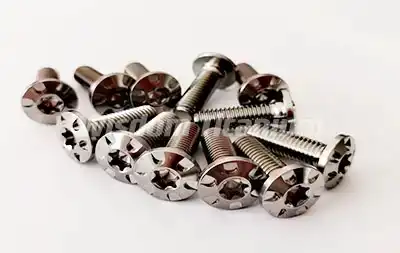
To install titanium screws on carbon fiber without crushing the laminate, I follow four rules. I pick custom titanium screws with a head style, length, and thread that match the joint. Then I spread the clamp load with a wide, flat washer or a bonded insert. I clean and deburr every hole. Finally, I tighten in steps with a calibrated torque wrench and stop at a torque value tested on the real assembly. Titanium resists corrosion and weighs about 45% less than steel, yet it can still crush a thin laminate when the load has nowhere to go.
Why Carbon Fiber Gets Crushed by Fasteners
How Clamp Load Damages a Laminate
The strength is where the threads meet, but the weakness is where a screw head pushes through the material. The clamp force under the head gets stronger as you tighten. If the head or washer is small, stress builds up in a thin ring around the hole. The resin matrix could break, the plies could come apart, and the surface could get dents. You can also stretch the hole by letting go and regaining control over and over again. Sandwich panels can have their skin squished into the foam or honeycomb core below it. Something is wrong if there is a dent or a white stress mark around the head. This is because fatigue life goes down when plies start to separate.
Why Titanium Alone Does Not Prevent Damage
A lot of useful things about titanium make it useful. Ti-6Al-4V (Grade 5) weighs about 4.43 g/cm³, while carbon steel weighs about 7.85 g/cm³. In other words, it weighs about 45% less. ASTM B348 says that Grade 5 must have a tensile strength of at least 895 MPa. That much strength is good for the screw, not the rock. A strong pin may be too much for the material to handle. The screw stuff is the only thing that goes inside. It depends on the quality of the holes, the size of the washers, the choice of inserts, and how well the torque is controlled. There are more ways to make custom titanium screws fit your joint than if you bought them from a catalog. You can change the length, width, and height of the heads.
Galvanic Contact and Titanium Screws Corrosion Resistance
You can think of carbon fiber as a fine material that moves power around. Al and carbon steel can rust quickly when they are mixed with water and carbon. Carbon is not as close to titanium as titanium is to carbon on the galvanic series. We can keep the voltage gap small this way. Titanium also forms a stable oxide film that keeps screws from rusting in water and sweat. This is why boat, bike, and motorcycle builders choose them as carbon fiber fasteners. I'm still going to finish. Leave water in a cut hole, and it can seep into the laminate. This can cause steel nuts or metal parts in the stack to rust. A thin layer of glue or a nut that doesn't conduct electricity keeps the joint dry.
Design the Joint Before You Choose Custom Titanium Screws
Define Loads, Then Pick Grade 2 or Grade 5
I start with the screw instead of the load case. Making a list of the bending, vibration, thermal, tensile, and shear loads is a good idea. You should also decide how often the joint will be fixed. After that, pick the grade. Grade 5 is good for structural parts like those in aircraft frames, motorbike mounts, and car hardware because it is stronger. Steel of grade 2 is clean enough to use for work. ASTM B348 says that it has a tensile strength of at least 345 MPa. It works well for naval tools and parts that don't have to hold a lot of weight because they need to be resistant to corrosion and easy to shape. Wisdom Titanium has both grades for sale. If you're not sure, send us the loads and the laminate's thickness, and we'll help you make a decision.
Match Head Style, Size, and Drive to the Laminate
How the load gets into the carbon depends on the shape of the head. A wide flange or button head spreads the clamp force over a bigger area than a small cap head. For countersunk heads, there is less material to hold the weight because the cone cuts away laminate. This means they need extra care. You can tell us what kind of head you want, and we make custom titanium screws from M3 to M24. The drive can have either a Torx or a hex mount. Since cam-out isn't possible with Torx drivers, a tool that slips is less likely to leave a mark on the carbon surface. Make sure that the width of the screw matches the distance between the sides and the material's thickness. A bigger screw won't make the joint stronger if the hole is too close to the edge.
Use Washers and Load-Spreading Parts
If you add a nut to a small contact ring, it gets bigger. This means that the same amount of torque puts less stress on the bearing. Check to see how big, thick, flat, and stiff the outside is. A thin, floppy screw bends when pressure is put on it, but it doesn't do much else. Titanium washers can handle high temperatures and rough conditions, while polymer or composite washers stop electricity from moving. On thin skins, sandwich panels, and joints that you open up a lot, it's best to use bonded inserts, potted holes, or fresh laminate patches. The customer needs to send me both the nut drawing and the screw drawing so that we can sell them both together. The washer won't fix a hole that is broken or wasn't drilled correctly. First, look at the hole.
Prepare and Install Carbon Fiber Fasteners Step by Step
Inspect the Holes and the Screws
Before the wrench is used, the job needs to be done right. Each hole should be checked for its size, roundness, edge distance, free fibers, delamination, and crushed core. Carefully remove the thorn, and don't try to make the hole bigger by hand. Seal the hole wall if there is a chance of water or galvanic contact. Then, use a cleaner that is safe for your glue and covering to clean the surfaces that go with it. After that, look at the screws. The thread form, head size, burrs, and surface finish should all be looked at. It is called ISO 9001, and Wisdom Titanium checks parts before they are sent out. Tell us what kinds of papers your quality team needs, and we'll let you know what we can send with the order.
Set Custom Titanium Screw Torque the Right Way
There is no such thing as a standard torque number. To connect torque and preload, use the short formula T = K × D × F. But the friction factor K is different for each insert, washer, thread finish, and lubricant. That's the reason I never copy a steel force chart. Start with the limit that is written on the carbon part. A lot of companies that make frames, stems, and panels present a top. Then, test your real stack with a measured torque wrench and, if you can, measure the charge. Set the last value below the point where the washer makes a dent in the surface. Tighten it up two or three times, and keep the washer in the middle. If you want to avoid getting hurt by rapid spikes from impact drivers, stay away from them.
Prevent Galling and Check the Finished Joint
If you rub two titanium threads against each other, the surfaces can tear and stick together. This is called galling. When you drive slowly, keep the threads clean, and use an approved anti-seize compound or thread protection, that risk goes down. Make sure that the lubricant doesn't hurt the glue and resin. Some things can hurt composites. Make sure the parts are lined up before you tighten them so the screw doesn't pull them together. Also, never cross-thread a screw. After the last pass, look at the joint. Look for gaps, cracks, dents, white stress lines, a washer that is tilted, and damage to the threads. Note the force and the tool you used. Those notes help you get the same result the next time and will also help you check the quality once more.
Order Custom Titanium Screws for Carbon Fiber Projects
What Wisdom Titanium Supplies
With its ISO 9001 certification, Wisdom Titanium has been in business since 2016 and makes and sells both standard and custom CNC parts. The biggest group of businesses that work with titanium in China is in Shaanxi Province's Baoji Titanium Valley. This is where we are. This is the chain that goes from titanium sponge and flakes to bars, plates, tubes, and forgings. You can tell us whether you want the heads and drives on our custom titanium screws to be Torx or hex. There are two grades, Grade 5 and Grade 2, and sizes run from M3 to M24. Aside from cars and bikes, they also work on projects for the military and in space. Our R&D team can make parts from a sample or an idea you give us. Before they are sent out, we check all of the bolts and nuts.
Colors, Laser Logos, and Small Batches
For many brands, the screw is an obvious part of the design. We can burn blue, black, gold, red, purple, green, and blue on them, polish them, and laser-etch or cut names on them. Because the color has to stay the same from batch to batch, I suggest that you approve a real sample before it is made and keep it for future orders. So that we can place an order, we need at least 200 pieces. This works for special launches and limited editions. You can talk about projects of different sizes and colors in the quote. Let us know if your image or color is special before you send us the files. That way, we can first sign an NDA.
What to Include in Your RFQ
When the request is done, the quote cycle goes faster. Send a 2D or 3D CAD file with the grade of titanium, the thread and head measures, the limits, the surface finish or color, your logo, and the type of washer or insert you need. Write down the working conditions, the torque you want, the laminate's thickness, the annual demand, the amounts, and the delivery date. CNC cutting works well for prototypes, heads with a lot of moving parts, and short runs of at least 200 pieces. Talk to different suppliers about technical issues and compare how they get titanium, check it, get ISO certification, help with prototypes, package it, and talk to you about it. Not only the unit price, but also the total cost. There is a chance of being turned down and having to wait. When we answer, we give you a clear price and answer any technical questions you have along the way.
Conclusion
No matter what kind of screw you use, the clamp load has to be higher than what a thin material can handle in order for it to crush. It's light, doesn't rust, and has good tensile qualities. On the galvanic series, it's close to carbon, but the joint still needs to be well thought out. Choose Grade 5 custom titanium screws for buildings that take a lot of weight, and Grade 2 for uses with less weight that focus on rust. The style, size, and drive of the head should match the plastic. After that, put in a wide, stiff nut or plug and clean and seal the holes. Instead of making a copy of a steel chart to set the pressure, test the real assembly. Watch the joint after it's done to stop galling. The results are always the same because of an easy plan and tests to make sure they are correct.
FAQ
Can I thread a titanium screw directly into carbon fiber?
Sometimes, but there's a chance it could hurt you. Direct threads can separate when they are loaded or after a lot of use. Inserts, nuts, or hard points that are reinforced work well for joints that are structural or that get a lot of use.
What torque should I use for custom titanium screws?
There isn't a single number that works for all joints. The preload is changed by the grade, girth, lubricant, washer, insert, and laminating. Do what the carbon part says, and then test the real part.
Does titanium cause galvanic corrosion with carbon fiber?
In the galvanic chain, titanium is close to carbon. This means that the risk stays low. Aluminum or steel parts of the stack can still rust, so seal the joint and keep those parts away from each other.
Can you supply small orders of custom titanium screws?
Yes. For grades M3 through M24, we need at least 200 pieces in each color and with either Torx or hex socket drives.
Request Custom Titanium Screws from Wisdom Titanium
For your carbon fiber project, Wisdom Titanium is ready to look at it. They make custom titanium screws in Baoji. Your drawing, grade, size, color, logo, and number should be sent to sales@wisdomtitanium.com. I'll send you a price and make it clear what you need to do next. We have a system in place called ISO 9001, a stock of raw materials, and enough samples and limited runs to meet your needs. Wisdomtitanium.com has more information about our titanium screws and CNC parts.
References
- ASTM International, Standard Specification for Titanium and Titanium Alloy Bars and Billets (ASTM B348), 2019.
- Composite Materials Handbook-17, Volume 3: Polymer Matrix Composites Materials Usage, Design, and Analysis (CMH-17-3G), 2012.
- Campbell, F.C., Structural Composite Materials, ASM International, 2010.
- Bickford, J.H., Introduction to the Design and Behavior of Bolted Joints, CRC Press, 2008.
- Donachie, M.J., Titanium: A Technical Guide, ASM International, 2000.
- Tavakkolizadeh, M. and Saadatmanesh, H., Galvanic Corrosion of Carbon and Steel in Aggressive Environments, Journal of Composites for Construction, 2001.