
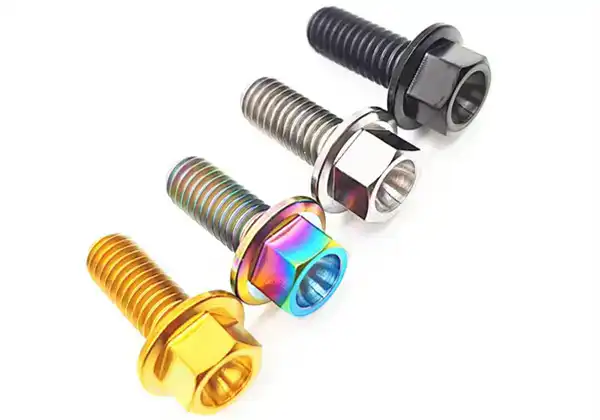
The chemical processing, oil and gas, power generating, and pharmaceutical sectors all use pressure vessels in some of the most harsh settings. Conventional steel fasteners may be compromised by the severe temperatures, corrosive environments, and cyclic loads that these vital systems' bolts must withstand. Industrial-grade titanium flange bolts provide an attractive alternative by fusing remarkable strength, low weight, and resistance to corrosion. OEM customisation offers the accuracy and quality control required to satisfy precise design standards and legal requirements for manufacturers looking for dependable, long-lasting fastening solutions. The practical advantages of titanium flange bolts for pressure vessel applications, the importance of customized production, and the exacting quality control procedures that guarantee performance and safety are all covered in this article.
Advantages of Industrial-Grade Titanium Flange Bolts for Pressure Vessels
In pressure vessel usage, titanium flange bolts provide performance characteristics that directly address the main failure mechanisms of conventional alloy steel fasteners. Titanium's inherent oxide layer, which develops instantly when exposed to oxygen and offers exceptional corrosion resistance, is its greatest benefit. Titanium is mostly unaffected by chloride-rich conditions, in contrast to stainless steels, which may experience pitting, crevice corrosion, and stress corrosion cracking. This feature is particularly useful in chemical processing facilities, desalination plants, and offshore platforms where strong chemicals and seawater would quickly erode traditional bolts. Because the oxide layer is self-healing, it will instantly re-form and retain its protective properties even if it is damaged during installation.
Pressure vessel design concerns are significantly altered by Grade 5 titanium's (Ti-6Al-4V) strength-to-weight ratio. With a density of about 4.43 g/cm³ and a tensile strength of over 950 MPa, these bolts provide almost 40% less weight than their steel equivalents without sacrificing mechanical performance. This weight reduction results in less structural stress on vessel supports and flanges, simpler installation, and cheaper shipping expenses. The combined weight reduction for large-diameter pressure vessels that need hundreds of bolts may reach several hundred kilos, making crane operations easier and lowering worker fatigue during maintenance turnarounds.
Another important benefit for pressure vessel applications is temperature performance. From cold temperatures below minus 196 degrees Celsius to high temperatures around 400 degrees Celsius, titanium flange bolts retain their mechanical qualities throughout a wide temperature range. Because titanium doesn't undergo a ductile-to-brittle transition as many stainless steels do, it's perfect for liquefied natural gas (LNG) storage and transportation vessels. Titanium's creep strength and resistance to oxidation at higher temperatures provide dependable sealing in heat exchangers and reactors subjected to continuous thermal loads.
Titanium bolts' non-magnetic properties provide crucial advantages in specialized pressure vessel systems. Completely non-ferrous fastening methods are necessary to avoid interference with delicate apparatus in research centers, magnetic resonance imaging (MRI) equipment in pharmaceutical factories, and certain naval applications. These issues are resolved by titanium's paramagnetic qualities, which also provide the structural stability required for high-pressure confinement. In ultra-pure processing settings, including semiconductor and biopharmaceutical manufacturing, this feature also guards against contamination from metallic particles.
Even though titanium bolts are more expensive initially, lifecycle cost analysis often shows that they are the most cost-effective option. Although a typical Grade 5 titanium flange bolt might last for decades without needing to be replaced, it may cost three to five times as much as a regular carbon steel bolt. In corrosive conditions, steel bolts often need to be replaced every 12 to 24 months, which means expensive shutdowns, personnel hours, and even production loss. Return on investment is achieved in two to three maintenance cycles thanks to the longer maintenance intervals and the removal of corrosion-related failures. Furthermore, titanium's ability to withstand galling minimizes thread damage from repeated assembly and disassembly, maintaining the integrity of the flange across many inspection cycles.
The argument for titanium fasteners is further strengthened by adherence to international pressure vessel norms. When constructed in accordance with specified material standards, titanium alloys are specifically permitted for use in pressure-retaining components under Section VIII of the Boiler and Pressure Vessel Code of the American Society of Mechanical Engineers (ASME). Titanium grades that satisfy established mechanical property standards are approved for use in European pressure equipment under the Pressure Equipment Directive (PED) 2014/68/EU. Because the material pedigree and performance data are well-established in regulatory frameworks, using certified titanium flange bolts streamlines the approval procedure for both new vessel building and retrofit projects.
OEM Customization: Tailored to Pressure Vessel Manufacturers' Exact Needs
Flange bolts designed for particular pressure vessel designs and operating circumstances are delivered by Original Equipment Manufacturers (OEMs), going beyond typical catalog items. In order to comprehend flange shape, gasket materials, pressure ratings, and thermal cycle profiles, fastener producers first engage in collaborative engineering with vessel designers. Engineers can accomplish consistent load distribution and stop flange rotation under pressure by examining these characteristics and optimizing bolt diameters, thread shapes, and head configurations. OEM solutions remove uncertainty and guarantee compatibility with current equipment, while standard bolts can necessitate compromise in crucial applications.
Dimensional flexibility stands at the core of OEM value for pressure vessel manufacturers.Specialized titanium fastener manufacturers may create bolts with diameters ranging from M4 to M48 and lengths ranging from 10 millimeters to 200 millimeters, covering everything from instrument connections to massive vessel flanges, while standard vendors might only provide a limited selection of sizes. Customizing the thread pitch is equally crucial since pressure vessel designs may call for coarse threads for quick field assembly or fine threads for accurate preload control. For certain actuator mounting needs, OEM manufacturers may manufacture non-standard pitches, left-hand threads, or unique thread shapes like Acme threads. As a result, there is no need for adapters or other altered parts that can cause problems.
Material grade selection within the titanium family allows fine-tuning of properties for specific pressure vessel environments. For the majority of applications, grade 5 titanium (Ti-6Al-4V) is the workhorse alloy because it provides the best combination of strength, availability, and resistance to corrosion. OEM customisation, however, may provide Grade 7 titanium with palladium addition for very reducing acid conditions or Grade 2 commercially pure titanium for applications needing highest ductility and formability. Grade 12 with nickel and molybdenum additives offers improved creep resistance for high-temperature reactors. The ability to choose and verify the precise alloy composition guarantees that the mechanical characteristics and microstructure of the bolt match the safety considerations and design margins of the vessel.
Another crucial aspect of pressure vessel bolt customisation is surface treatments and finishes. In addition to improving corrosion resistance, anodizing produces a regulated, thicker oxide coating that enables color labeling for material or size identification. Consistent preload is ensured by the anodized surface's improved lubricant retention during torque application. A thin, hard ceramic layer is applied via physical vapor deposition (PVD) coating, which significantly lowers friction coefficients and stops galling during assembly. PVD coating may reduce needed torque by up to 30% and increase thread life by a factor of three for bolts that are often disassembled for inspection. OEM vendors may adjust the coating's composition and thickness to strike a compromise between cost, friction reduction, and corrosion protection.
OEM titanium bolts may satisfy many certification criteria at once because to the flexibility of standards compliance. Pressure vessel builders often need bolts that also satisfy ASTM F468 for material qualities, ASME B18.2.1 for dimensional tolerances, and NACE MR0175 for sour gas operation, even though DIN 6921 offers a single dimensional standard for hex flange bolts. OEM manufacturers may create a single bolt that meets all of these specifications, including thorough documentation packages that expedite regulatory clearance and third-party inspection. This integrated method lowers the risk of non-compliance during vessel commissioning and does away with the requirement for independent qualification tests.
OEM suppliers are distinguished from distributors of commodity fasteners by their prototyping and validation services. Manufacturers may create prototype bolts for environmental simulation, torque-tension testing, and fit checking prior to full production. This enables pressure vessel engineers to confirm that the specially designed bolts retain preload throughout heat cycling and achieve the necessary gasket seating stress. In order to pinpoint stress concentrations and optimize head-to-shank fillet radii, sophisticated vendors provide finite element analysis of the bolted connection. This technical assistance guarantees that the finished product operates as planned in service while cutting down on development time.
Strict Quality Control: Ensuring Reliability for Pressure Vessel Safety
Industrial-grade titanium flange bolt quality control encompasses a thorough verification procedure that covers every phase from raw material to final shipping, going well beyond simple dimensional inspections. Each manufacturing lot is connected to verified mill test reports that provide the precise chemical composition, melt source, and heat treatment conditions, forming the basis of material traceability. For Grade 5 titanium, this entails confirming that the alloy maintains the required mechanical qualities by keeping the aluminum percentage between 5.5 and 6.75 percent and the vanadium content between 3.5 and 4.5 percent. Through all machining, heat treatment, and finishing processes, the traceability system keeps this connection intact, enabling full genealogy for each bolt that is sent.
Each batch of bolts is verified to fulfill the minimum tensile strength of 950 MPa and other property criteria by mechanical testing. Tensile tests on sample bolts verify the material's ductility by measuring ultimate strength, yield strength at 0.2 percent offset, and elongation at fracture. Fatigue testing may be carried out to determine the endurance limit and confirm the design in accordance with ASME Boiler and Pressure Vessel Code standards for pressure vessel applications where bolts undergo cyclic loads. Rockwell or Vickers hardness testing offers a non-destructive way to confirm that heat treatment is consistent across the manufacturing batch. All test data becomes part of the quality documentation package supplied to the pressure vessel manufacturer.
Internal and external flaws that can jeopardize the integrity of a bolt under pressure are found via non-destructive inspection. Internal voids, inclusions, or unconsolidated material that may not be visible are scanned for in the bolt volume using ultrasonic testing. Surface-breaking flaws such as laps or fractures in threads and beneath the head fillet, crucial regions where stress accumulates, are revealed by liquid penetrant examination. To confirm the interior soundness of big diameter bolts used in high-pressure vessels, radiographic testing may be used. These NDE techniques provide uniform application and interpretation of data by adhering to ASTM E2375 for ultrasonic testing and ASTM E1444 for penetrant testing.
Pressure vessel specific quality requirements demand additional controls beyond standard fastener specifications.A Declaration of Conformance and quality assurance records that can be tracked back to a registered organization are required under the European Pressure Equipment Directive. Compliance with Section II Part D's material standards and Section VIII's design guidelines are prerequisites for ASME certification. According to NACE MR0175, bolts used for sour gas service must pass certain environmental testing in order to show that they are resistant to sulfide stress cracking. To avoid cross-contamination with regular manufacturing, OEM providers maintain distinct production streams with specialized tools and handling techniques for these vital applications.
Documentation and certification packages provide the evidence pressure vessel manufacturers need for regulatory approval and their own quality systems. Each shipment includes material test certificates (MTC) per EN 10204 Type 3.1, detailed inspection reports, NDE results, and compliance statements referencing applicable standards. Heat treatment charts showing time-temperature profiles validate that bolts received the proper solution treatment and aging cycle for Grade 5 titanium. For bolts used in ASME-stamped vessels, the supplier provides Form U-2 or U-3 partial data reports as required by the code. This comprehensive documentation eliminates delays during vessel inspection and commissioning.
Third-party verification by recognized classification societies adds another layer of confidence for pressure vessel manufacturers. Lloyds Register, TÜV, Bureau Veritas, and other notified bodies can witness production and testing, providing independent certification of compliance. This service is particularly valuable for international projects where end users require validation from a trusted third party. The involvement of these organizations early in the OEM customization process ensures that the quality plan addresses all project-specific requirements, avoiding costly rework or rejection during final inspection. Many OEM suppliers maintain pre-qualified status with major classification societies, streamlining the approval process for each new order.
Titanium Flange Bolt For Sale
For pressure vessel manufacturers ready to implement titanium flange bolt solutions, partnering with an experienced specialized supplier ensures access to engineering expertise and consistent quality. Wisdom Titanium has established itself as a dedicated producer of industrial-grade titanium fasteners, focusing exclusively on titanium alloys and understanding the unique demands of pressure vessel applications. Their manufacturing facility maintains AS9100 quality management system certification while producing bolts that meet the full spectrum of aerospace, chemical, and pressure equipment standards. By specializing in titanium, they have developed deep expertise in machining, heat treatment, and surface finishing of these challenging materials, resulting in products that consistently exceed minimum specifications.
Engineering support begins the moment you contact their technical sales team at sales@wisdomtitanium.com. Their application engineers review flange designs, gasket requirements, and operating conditions to recommend optimal bolt configurations. Whether you need standard hex flange bolts for a new vessel or specialized prototypes for a research reactor, they provide rapid response with detailed quotations including material certifications, test plans, and delivery schedules. The direct communication channel eliminates the confusion often encountered when working through distributors who lack technical depth in titanium metallurgy.
Conclusion
References
1. American Society of Mechanical Engineers. (2023). ASME Boiler and Pressure Vessel Code Section VIII - Rules for Construction of Pressure Vessels Division 1. ASME.
2. ASTM International. (2022). ASTM B348 - Standard Specification for Titanium and Titanium Alloy Bars and Billets. ASTM.
3. ASTM International. (2021). ASTM F468 - Standard Specification for Nonferrous Bolts, Hex Cap Screws, and Studs for General Use. ASTM.
4. Donachie, M. J. (2000). Titanium: A Technical Guide (2nd ed.). ASM International.
5. European Committee for Standardization. (2017). DIN 6921 - Hexagon Flange Bolts. DIN.
6. Lütjering, G., & Williams, J. C. (2007). Titanium (2nd ed.). Springer.