
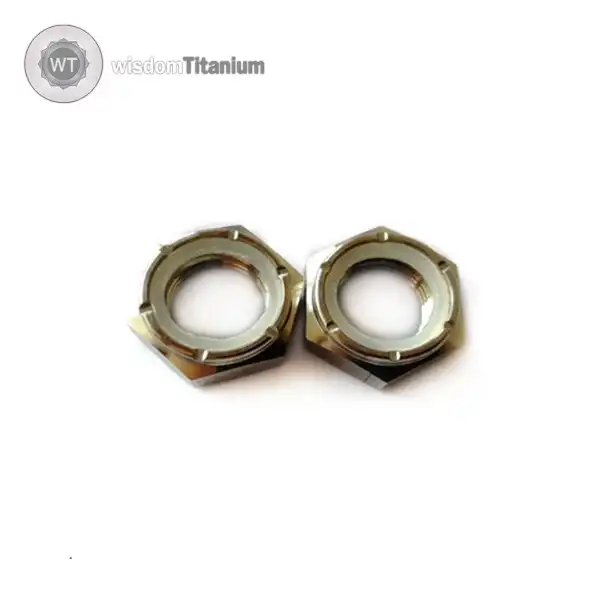
If you use a nylon lock nut correctly, it can turn simple parts into strong links that won't break even in the roughest work conditions. Titanium nylon lock nuts are strong and light, like Grade 5 titanium. They also have a nylon plug that tightly grips threads and keeps them from coming loose, even when the temperature changes quickly and there are dynamic loads. This book talks in great detail about nylon lock nuts, mostly the titanium kinds that are becoming more important in engineering and business.
Nylon Lock Nuts and Their Role in Modern Assembly
Find out about nylon lock nuts and how they are used in modern building.
Nylon lock nuts are a unique type of fastening. They have a metal core and a nylon filler that keeps them from coming loose when there are movements or dynamic loads. It's a simple but smart idea: the bolt threads get stuck when they go through a nylon polymer ring inside the nut's top part. This interference makes friction, which fights against forces that are spinning. This makes sure that the tightening pressure stays the same even when there are shocks, changes in temperature, and constant mechanical stress.
What Makes Titanium Variants Superior
Titanium nylon lock nuts are well-known for being strong for their weight and not rusting easily. Because of this, they work great in tough industry settings. Our hot-forged hex titanium nylock nuts are made of Grade 5 titanium (Ti-6Al-4V), which is stronger than steel at over 900 MPa and weighs about 40% less. For cars, this weight advantage directly means better gas mileage. For aerospace parts, it means more payload capacity. For special motorbikes and race bikes, it means better handling dynamics.
Lack of rust is another important trait. Oxides of titanium are stable and protect against saltwater, chlorides, hypochlorites, and industrial poisons. When these things happen, stainless steel often breaks by pitting or stress rust breaking. This makes them last longer, which is good for marine equipment, offshore oil platforms, and chemical processing plants because it lowers the cost of their life and the number of times they need to be changed.
How the Nylon Insert Creates Locking Action
The nylon plug keeps the unit together by using friction and mechanical resistance to hold the parts together. When the bolt goes into the nut, the nylon slightly shrinks, making a tight grip on the threads. This main torque, which is the pressure you feel when you're installing something, means the bolts are tight enough. When you need to do maintenance, you can carefully take out nylon inserts instead of threadlockers that stick and make it harder to take parts apart. They lock right away.
It is very important that temperatures stay stable. From -40°C to 120°C, which is most of the temperature ranges used in business, good cotton plugs work well. These limits must be passed for all-metal closing systems or high-temperature nylon models to work.
Specification Guide for Procurement
It is easier to buy and use these things because readers can use full specification charts to find the right sizes, thread types, and grades for their technical needs. Our titanium nylon lock nuts come in sizes from M3 to M24, and they can be used with threads that are either metric or inch. It is made of Grade 5 titanium and has a natural titanium finish, which can be seen in the specs. This keeps the resistance to rust high without adding extra coats that could flake off or break.
For important jobs like brake systems, suspension parts, engine mounts, and structure pieces, it's important to check the pressure values and make sure the threads touch perfectly. When you know these specs ahead of time, you can avoid connection issues and make sure you're following standards like DIN 985, ISO 10511, and ASTM F467.
Step-by-Step Guide on How to Properly Use Nylon Lock Nuts
Installing titanium nylon lock nuts the right way is important if you want to get the most out of them. By making sure there is enough pressing force and that the locking works well for the whole service life, the right fitting protects both the fastener and the assembly. It does this by keeping the threads from getting hurt.
Preparation and Inspection
Before putting it together, make sure to carefully check the threads and parts that fit together to avoid damage or threads that cross over. To get rid of dirt, oil, and rust from bolt and nut threads, use the right solutions or wire brushes. Cross-threading happens when screws are not lined up right the first time they are tightened. This hurts the threads and makes it less strong to hold. Titanium is hard, so it is not as flexible as steel. When you line it, you need to be very careful.
To keep the bolt from breaking, make sure that it's long enough to allow enough thread contact. This is usually at least six full threads past the nylon insert. Stress builds up on a smaller number of threads when there isn't enough touch. This makes it more likely that the structure will break under load.
Torque Values and Installation Techniques
The suggested force levels make sure that the locking works properly and doesn't damage the material. Titanium needs to be tightened to a certain force level because of the way it works mechanically. If you torque the fastener too much, you could damage the threads or break it. If you torque it too little, the binding force isn't strong enough, and movements could free the fastener.
Sometimes, Grade 5 titanium nylon lock nuts need as little as 2 Nm for M3 sizes and as much as 90 Nm for M24 sizes. However, this depends on the situation and the length of the thread contact. Always check the part's technical specs before you work on it. To be sure of your accuracy, use torque wrenches that have already been set up. Digital models let you get exact numbers and keep records for quality control.
Use force slowly and evenly. When forces come on quickly, they can damage the nylon fill or bend the threads. When you put together a pattern of bolts, like wheel hubs or flange joints, make sure the pressure is spread out evenly by going from left to right across the pattern. The parts will not bend and the seals will stay tight.
Environmental Considerations
Extreme temperatures and chemical contact are two examples of outdoor factors that can change where and what to put. If the metal is acidic, titanium nylon lock nuts work great. But the nylon core can only handle a certain temperature. If nylon is exposed to temperatures above 120°C for a long time, it breaks down, which makes closing less effective. In places where temperatures stay high for a long time, like exhaust systems, turbine units, or industrial ovens, you need closing nuts made of metal or high-temperature nylon.
Contact with chemicals is also important. Most acids, bases, and solvents don't hurt titanium, but some strong chemicals can damage nylon. Before you buy screws for chemical processing equipment or other specialized industrial gear, you should look at material selection charts and think about where the gear will be used.
Comparing Titanium Nylon Lock Nuts with Other Lock Nut Options
It is clear that titanium nylon lock nuts are better than other commonly used types in this comparison. If you know about these differences, you can make smart purchases that combine your need to be efficient with your income.
Titanium vs. Stainless Steel Nylon Lock Nuts
Titanium is better than stainless steel because it is lighter and doesn't rust. This is especially true in the high-performance, naval, and airplane industries. Even though 316 stainless steel doesn't rust very often, it can still crack in saltwater due to chloride stress corrosion. Titanium, on the other hand, almost never fails in this way. Up to 40% of the weight is saved, which makes bikes and bicycles easier to handle and helps cars and trains use less gas.
Titanium is clearly stronger than steel when it comes to weight-to-strength comparison. Grade 5 titanium is much lighter than grade 5 stainless steel but has the same tensile strength. This lets engineers make things lighter without changing how well they hold together. It is very important to have this benefit in places where every gram counts, like Formula 1 racing, high-end bicycle parts, and airplane electronics.
Titanium vs. Aluminum and Brass Lock Nuts
Titanium is compared to brass and aluminum metal lock nuts in terms of how long they last, how strong they are for how light they are, and how stable they are over time. Aluminum costs less and is lighter than titanium, but it's not strong enough for settings with a lot of stress. Using it with steel nuts can cause galling, and it's more likely to rust in mixed-metal systems, so it's not the best choice for secure fastening.
Due to its ability to fight galling and corrosion, brass is a good metal for nautical gear and home art. But it can't be used for structural or heavy-load parts because it's not as strong as titanium. Lock nuts made of brass work well in places where looks or electrical links are more important than power.
Cost-Effectiveness and Procurement Value
It is helpful for procurement experts to know the prices of things in addition to the technical overview. This is especially true for big orders with complicated supply lines. Lock nuts made of titanium nylon usually cost three to five times more per unit than those made of stainless steel or aluminum. However, the extra cost is worth it because they last longer, need less maintenance, and are lighter.
When working out the total cost of ownership, you should think about how many repairs you'll need, how much downtime costs, and how much fuel you'll save by reducing the weight. This is very clear when you look at marine uses: titanium screws last decades in saltwater, but stainless steel screws need to be changed every two years. When maintenance is done less often and things work better, the money spent on them pays for themselves.
Unit costs go down a lot when you buy a lot of something. When you order at least 100 pieces from our plant, the prices are fair, and you can save money when you order more. When you use OEM services, you can get custom shapes and specs, which makes it easy to add to your production processes.
Conclusion
Nylon lock nuts, especially titanium ones, are useful in many places, like cars, motorcycles, spacecraft, ships, and factories, as long as they are used correctly. Putting together the strength and resistance to corrosion of Grade 5 titanium with the locking action of nylon inserts makes screws that can handle shaking, changing temperatures, and bad weather. They are also lighter and don't need to be kept as often. If you use the right fitting methods, like checking the threads carefully, adding the right amount of pressure, and thinking about the environment, you can be sure that the job will last as long as possible. Titanium definitely works better than other materials in harsh environments and when weight is an issue. The higher price is worth it because it lasts longer and costs less to own overall. When you buy from providers that are trustworthy and have ISO 9001 certification and vertical integration, you can be sure of the quality of the materials, the accuracy of the measurements, and the dependability of the supply chain. These are all important for industrial uses that need to work well.
Partner with Wisdom Titanium for Superior Fastening Solutions
If you want strong, high-performance titanium nylon lock nuts, you should work with a manufacturer that has been in business for a long time and knows a lot about both material science and industrial needs. Wisdom Titanium is in Baoji Titanium Valley, which is the world's main place for making titanium. The fact that they use vertical integration and ISO 9001-certified manufacturing methods means they can offer factory-direct rates without lowering the standard of their goods. Our Grade 5 titanium hot-forged hex nylock nuts come in sizes from M3 to M24. You can ask for them to have metric or inch threads. You can bank on our ready-to-ship quality to make your projects better. Our prices are low, we have a lot of stock, and you only need to order 100 pieces to start.
You can trust us to give you titanium nylon lock nuts, and we can make them to any size or specification you need. This is supported by our skilled research and development team and cutting edge production technology. Prices stay the same and wait times stay the same when there are enough standard parts and raw materials in stock. Quality checks are done at every step of the way to make sure that every clip meets the greatest standards. You can email our experienced staff at sales@wisdomtitanium.com to get personalized help or to request a sample kit to check out the quality before committing fully. You can also go to wisdomtitanium.com to see our full collection of products and find out how our fastening solutions can help your motorbike, car, spacecraft, or industrial assemblies.
FAQs
Can titanium nylon lock nuts withstand extreme temperatures?
Lock nuts made of titanium nylon work well in temperatures from -40°C to 120°C, which is enough for most business uses. While the metal part can handle much higher temps, the nylon filler breaks down above 120°C, which makes the seal less strong. When it's very hot for a long time, you need locking methods made of metal or high-temperature nylon. Titanium nylon lock nuts are great for aircraft and racing applications that work in normal temperature ranges because of their benefits in weight and vibration.
Are these fasteners suitable for aerospace and high-stress environments?
There are a lot of titanium nylon lock nuts used in airplanes because they are reliable and light. Grade 5 titanium is light enough to be used for structural and flight-critical parts but strong enough to not go over weight limits. Not being magnetic means it doesn't mess up sensors or gadgets that help you find your way. There is no room for failure in Formula 1, MotoGP, and professional racing, so these screws are used on suspension parts, wheel kits, and engine cases. Less weight means better performance.
How does chemical resistance compare to standard steel nuts?
Titanium can handle poisons better than normal steel and stainless steel. It is the steady metal layer that keeps chlorides, saltwater, hypochlorites, and most industrial chemicals out of steel bolts that would damage them by pitting and stress corrosion cracking. This long life is very useful in marine areas, chemical plants, and tools used offshore. The nylon core can handle most chemicals, but it can break down in tough situations with strong acids or organic solvents, so it's important to check that the materials will work together.
References
- American Society for Testing and Materials. "ASTM F467: Standard Specification for Nonferrous Nuts for General Use." ASTM International, 2019.
- Bickford, John H. "An Introduction to the Design and Behavior of Bolted Joints, Fourth Edition." CRC Press, 2008.
- Boyer, Rodney, Gerhard Welsch, and E.W. Collings. "Materials Properties Handbook: Titanium Alloys." ASM International, 1994.
- International Organization for Standardization. "ISO 10511: Prevailing Torque Type Hexagon Nuts with Non-Metallic Insert." ISO Standards, 2012.
- Kulak, Geoffrey L., John W. Fisher, and John H.A. Struik. "Guide to Design Criteria for Bolted and Riveted Joints, Second Edition." American Institute of Steel Construction, 2001.
- Schutz, R.W. and D.E. Thomas. "Corrosion of Titanium and Titanium Alloys." ASM Handbook Volume 13B: Corrosion—Materials, ASM International, 2005.