
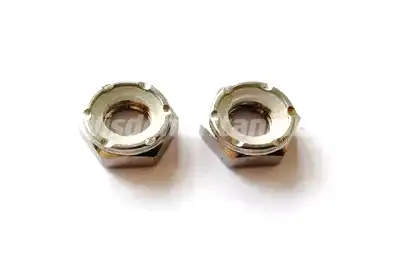
Tightening a nylon lock nut correctly requires threading the fastener onto the bolt until moderate resistance is felt from the nylon insert, then applying calibrated torque until the specified value is reached without over-compression. When working with titanium nylon lock nuts, precision matters even more—the Grade 5 titanium construction demands torque values approximately 15-20% lower than steel equivalents to prevent thread galling while maintaining secure, vibration-resistant connections. Proper installation ensures the nylon insert engages fully without distortion, preserving the locking mechanism's integrity throughout demanding service cycles in automotive, aerospace, and marine applications.
Step-by-Step Guide: How to Properly Tighten Nylon Lock Nuts
Preparation and Thread Inspection
Before you start installing, make sure that the threads on the bolt and nut are compatible. Titanium fasteners come in fractional inch and M3–M24 metric sizes. They must exactly match the bolt thread pitch; if they don't, the threads will bind before the nylon insert enters, giving incorrect pressure readings. Check the threads in good lighting for burrs, cross-threading damage, or contamination that could stop them from sitting properly. If there is oil, anti-seize compound, or debris on the threads, clean them with isopropyl alcohol. Lubricants change friction coefficients greatly and make normal torque specs useless.
When using nylon insert nuts, the thread contact length is very important. The fastener needs enough bolt extension to go all the way through the nylon collar—usually at least 1.5 thread diameters—so that it can fully lock in place. Because there isn't enough contact, the nut can hit the shoulder of the bolt before the nylon insert can do its job, which removes all vibration resistance.
Applying Calibrated Torque
Start the nut by hand and turn it clockwise with your fingers alone for at least three full turns. This first threading checks for cross-threading and makes sure the threads are lined up before any damage happens. As the threads go deeper into the nylon insert, usually between 70 and 80% of the total contact depth, resistance will rise significantly. This input from the touch shows that the locking device is working correctly.
Change to a torque wrench that has been measured and set to the manufacturer's specs for the bolt's diameter and material. Titanium has a lower friction coefficient than steel, which means that the same binding force needs about 15% less power to be applied. For Grade 5 titanium nylon lock nuts, a general rule of thumb says:
- M6: 6-8 Nm (53-71 lb-in)
- M8: 14-16 Nm (124-142 lb-in)
- M10: 28-32 Nm (248-283 lb-in)
- M12: 48-54 Nm (425-478 lb-in)
Instead of "clicking" forwards and backwards, apply force in a single, continuous action. Stop right away when the wrench shows that the goal number has been reached. When you over-torque, you squeeze the nylon insert too much, which makes it less effective at locking and could cause thread stripping in lighter base materials.
Multi-Fastener Assembly Sequences
If you need to tighten a pattern of lock nuts, like on wheel hub systems or brake caliper mounting, do it in a star or cross design instead of a circle. This method evenly spreads the binding load, which keeps the part from warping and makes sure that the seal is compressed evenly when needed. Tighten all the screws to half of their final torque on the first pass. Then, follow the same process for the final torque.
The fitting process is affected by temperature. When titanium screws are placed at room temperature, the preload will slightly rise as the parts heat up during operation. This is because different materials expand at different rates. When installing hot parts, on the other hand, the torque values should be lowered by 5 to 10 percent to account for material softness and thermal expansion that will reverse when the parts cool down.
Buying Titanium Nylon Lock Nuts for Industrial Use
Supplier Qualification and Certification Verification
Finding important screws requires careful evaluation of suppliers that goes beyond price comparison. While ISO 9001 approval is a good starting point for quality management systems, AS9100 or ISO 13485 compliance is usually needed for aircraft or medical uses. Ask for material certifications (mill test results) that show the composition of the alloy, its mechanical qualities, and how it can be traced back to the heat lots of the raw materials. This is important for uses that need to be able to analyze failures and show compliance with regulations.
OEM production skills show how sophisticated a seller is. Manufacturers who offer custom geometries, thread forms, and non-standard measures show engineering know-how and production freedom that standard wholesalers can't match. This combined capability is shown by Baoji Wisdom Titanium Industry and Trading Co., Ltd., which is situated in Baoji Titanium Valley, Shaanxi Province and is home to China's biggest titanium industry center. The company was founded in 2016 and is certified by ISO 9001. They keep a full inventory of raw materials and have set up production processes that make sure the quality of each batch is the same.
Navigating Pricing Models and Order Quantities
Titanium nylon lock nuts are priced based on the cost of the raw materials, how hard they are to make, and how many are ordered. The amount of Grade 5 titanium rod stock changes based on demand in the aerospace industry around the world. For hex shapes, hot forging methods make production more expensive than simple molded designs. For common sizes, the minimum order quantity is usually 100 pieces. This is done to balance the cost of production runs with the buyer's investment in inventory.
People who buy a lot of things can save money by signing bulk purchasing deals. Every year, automakers, race organizations, and equipment original equipment manufacturers (OEMs) discuss supply contracts that spell out delivery times, quality standards, and terms for stable prices. Smaller buyers can get competitive prices because distributors keep popular sizes (M6, M8, M10, and M12) in stock and ready to ship. For measurements that aren't in stock, buyers must wait longer.
Value-Added Services and Supply Chain Reliability
Aside from providing parts, smart buyers also look at how well providers can help with technical issues, the quality of their paperwork, and how open the supply chain is. Help from engineers during the blueprint development process keeps expensive design mistakes from happening, and faster processing meets the needs of prototype deadlines and production situations. When suppliers keep a lot of popular sizes in stock, they avoid the schedule risks that come with longer manufacturing lead times.
When an industry is controlled, traceability is very important. For every batch of fasteners, there should be paperwork that connects the finished parts to the approvals of the raw materials, the process settings, and the inspection results. This paper trail lets you figure out what went wrong if something goes wrong in the field, and it meets the auditing standards for aircraft, medical devices, and nuclear uses.
Practical Applications and Longevity of Titanium Nylon Lock Nuts
High-Performance Automotive and Motorsports
When it comes to the drivetrain and suspension systems, where vibration resistance and weight reduction are directly linked to success, racing teams and speed vehicle builders use titanium lock nuts. Titanium hardware is used in three-piece wheel systems to reduce the spinning mass. This improves acceleration response and lowers brake rotor temperatures by lowering kinetic energy. Brake caliper mounting nuts made of titanium are thermally stable, so they keep their holding force even when the temperature changes from room temperature to 400°F or more.
Electric vehicle manufacturers increasingly adopt titanium nylon lock nuts to balance out the weight of the batteries while keeping structure gaps. Because the material isn't magnetic, it doesn't mess up electric motor sensors or battery management electronics, which is a benefit over screws made of ferromagnetic steel. Luxury automakers market titanium gear as a high-end way to set their cars apart, appealing to buyers who value real speed and reducing weight.
Aerospace and Unmanned Aerial Systems
Fasteners used in aircraft systems need to be able to handle big changes in temperature, vibration, and stress cycles over many years of use. Titanium lock nuts keep engine cowlings, flight control surfaces, and landing gear parts in place when the costs of failure are high enough to support the use of expensive materials. Titanium fasteners have been used in the aircraft business since the 1960s. This has led to a lot of performance data and standard specifications (NAS, MS, and AN series) that make sure they can be used interchangeably and are reliable.
Drone and UAV makers have to deal with special problems when they try to balance durability, carrying capacity, and structural integrity while sticking to very strict weight limits. Titanium hardware makes the airframe lighter without lowering its ability to resist vibration. This is important for keeping sensitive sensors and camera gimbals safe from motor-induced motion. Radiotransparency and non-magnetic properties of the material keep navigation and transmission technology from being affected.
Marine and Offshore Applications
Exposure to saltwater is the worst thing that can happen to screws because it causes rust. Traditionally, yacht gear, outboard motor mounts, and deck hardware were made of stainless steel that had to be replaced often and coated with an anti-seize substance. Titanium doesn't need any of these maintenance processes because it stays passive in saltwater forever and doesn't rust when combined with carbon fiber composites or aluminum structures.
Titanium fasteners are being used more and more in offshore wind farms, subsea sensor arrays, and coastal structures to lower the costs over their entire life. Access is hard to get to and repair costs are high in these situations, so the materials used should be more expensive. However, environmental laws encourage upkeep plans that use and throw away hazardous materials as little as possible.
Maintenance Protocols and Reuse Guidelines
To figure out the state of a lock nut after taking it apart, you have to look at both the metal threads and the stability of the nylon insert. Look at the threads closely to see if they have any galling, stretching, or distortion that would stop them from joining properly. The nylon filler should have even tension marks that don't show any cracks, melting, or big changes in the material. If the color changes beyond a light tan, it means the item was exposed to too much heat and needs to be replaced.
Conservative recommendations for reuse say that titanium nylon lock nuts should only be installed three to five times in non-critical situations. After each use, the suggested pressure should be lowered by ten percent. Safety-critical systems, like brake parts, suspension mounts, and flight control surfaces, need single-use rules no matter how good they look. Write down the times of installation and the number of cycles to make upkeep easier to track.
Temperature cycling and chemical exposure speed up the breakdown of nylon. If fasteners are constantly exposed to temperatures above 200°F or to fuels, solvents, or hydraulic fluids, they should be viewed more often and replaced at intervals based on how they look instead of how many cycles they've been used.
Conclusion
When installing a nylon lock nut the right way, you need to think about both mechanical concepts and the material itself. This is especially important when working with advanced metals like Grade 5 titanium. The steps described—using measured torque, making sure the threads are engaged, and tightening in the right order—ensure stable resistance to vibration and keep the fastener's integrity over its service life. Titanium nylon lock nuts offer clear benefits in harsh conditions, uses that need to be light, and high-stress mechanical systems where the higher starting cost is justified by the lower lifetime costs.
For procurement to go well, suppliers must be qualified, pricing models must be understood, and the right qualifications must be specified for the planned uses. Hot-forged titanium lock nuts are better for engineering than just switching out materials. They allow for better design optimization and performance that regular screws can't. Titanium nylon lock nuts will continue to be important in demanding situations where dependability is a must as long as industries continue to prioritize weight reduction, corrosion resistance, and longer maintenance intervals.
Reliable Titanium Nylon Lock Nut Supplier for Your Industrial Needs
Hot-forged hex titanium nylon lock nuts made to strict standards in Baoji Titanium Valley—the world's most complete titanium production cluster—are sold at factory-direct prices by Wisdom Titanium. Our ISO 9001-certified facility keeps ready-to-ship stock of Grade 5 titanium fasteners in sizes M3 to M24 (metric and inch threads) with premium nylon inserts. These fasteners are made for vital reliability in automobile, aerospace, marine, and industrial uses.
You can place an order as little as 100 pieces, and we offer reasonable bulk rates and full material certifications and traceability paperwork to back them up. Our skilled engineering team offers custom CNC machining services for non-standard shapes, thread requirements, and unique tasks that need precise making. We promise consistent quality and delivery times that procurement professionals can count on because we have a steady supply of raw materials and well-honed production processes.
Get in touch with our expert staff at sales@wisdomtitanium.com to talk about your titanium nylon lock nut needs. Visit wisdomtitanium.com to see our full selection of fasteners and learn why top makers choose Wisdom Titanium as their first choice for mission-critical titanium parts.
FAQ
Can titanium nylon lock nuts be reused safely?
Titanium lock nuts can be used again and again in non-critical situations for three to five cycles, as long as the threads stay unbroken and the nylon core doesn't crack or deform too much. Every time you replace something, lower the power requirements by 10 to 15 percent. Safety-important parts like brake gear, suspension mounts, and airplane structures need to be handled only once, no matter what the outward state is. Always look at threads under a microscope for galling, which happens a lot with titanium, and make sure the nylon plug is still intact before using it again.
How do torque specifications differ between titanium and steel lock nuts?
Because titanium has a lower friction coefficient than steel, fasteners of the same size need about 15 to 20 percent less power to apply the same gripping force. When you over-torque titanium, you could break the nylon filler or cause thread galling. For exact numbers, always check the manufacturer's instructions. As a general rule, M10 titanium nylon lock nuts need 28–32 Nm, while steel versions need 40–45 Nm. The end preload is affected by the temperature during installation. For hot installations, torque numbers should be lowered to account for thermal expansion.
What temperature range can titanium nylon lock nuts withstand?
Grade 5 titanium keeps its mechanical qualities from -40°F to 600°F, but regular nylon plugs break down after being exposed to temperatures above 250°F for a long time. High-temperature nylon versions make the operating range go up to 400°F while keeping the closing ability. Titanium's low thermal expansion rate keeps the pressure from changing too much when the temperature changes, which is better than stainless steel. This stability works well in harsh environments, which is good for marine and aircraft uses.
References
- Bickford, J.H. (2008). Introduction to the Design and Behavior of Bolted Joints: Non-Gasketed Joints (4th ed.). CRC Press.
- Boyer, R., Welsch, G., & Collings, E.W. (1994). Materials Properties Handbook: Titanium Alloys. ASM International.
- Budinski, K.G. & Budinski, M.K. (2010). Engineering Materials: Properties and Selection (9th ed.). Prentice Hall.
- Eccles, W. (2009). Design Guidelines for the Selection and Use of Stainless Steel. Nickel Institute Technical Series No. 10 058.
- Kulak, G.L., Fisher, J.W., & Struik, J.H.A. (2001). Guide to Design Criteria for Bolted and Riveted Joints (2nd ed.). American Institute of Steel Construction.
- Schutz, R.W. & Watkins, H.B. (1998). Recent developments in titanium alloy application in the energy industry. Materials Science and Engineering: A, 243(1-2), 305-315.