
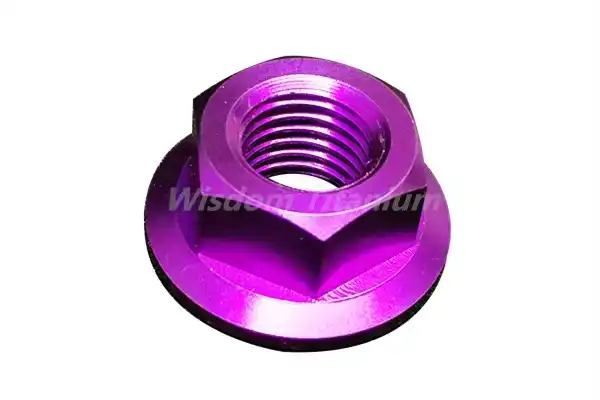
To remove hex flange nuts quickly and safely, you need to know how the fastener is designed and what materials it is made of. The process is more complicated when working with titanium hardware because of the way the metal is made. Hex flange nuts have a flange built in that spreads the load over a bigger surface area. This keeps the nuts from coming loose when they are vibrated. When rust, overtorquing, or thread galling happen, it makes removal even harder. Titanium hardware, especially Grade 5 (Ti-6Al-4V) parts that are often used in racing and cars, needs to be handled carefully to keep the threads in good shape and avoid damage when taking the hardware apart. Knowing the right way to remove something will protect your investment and keep the component's purity.
Hex Flange Nuts and Their Challenges
What Makes Hex Flange Nuts Different?
Hex flange nuts are different from regular hex nuts because they have a washer-like lip built right in. This part of the design does more than one thing: it spreads the clamping force over a larger area, gets rid of the need for different washers, and makes it harder for vibrations to free things. These screws hold important parts like brake pads, wheel hubs, and suspension systems in place in high-performance settings like racing and making changes to cars.
The flange makes more touch with the mating surface, which increases friction and stops the movement. This trait makes it safer to use, but it makes it harder to take off when repair or replacement is needed. Because there is more touch area, more surfaces can rust or get thread damage over time.
Material Considerations in Removal Difficulty
The choice of material has a big effect on how hard it is to remove. Hex flange nuts made of stainless steel don't rust very easily, but they can stop up in saltwater or chemical conditions. Even though aluminum screws are lighter, they may dissolve galvanically when they are used with metals that are not the same. Maintenance workers need to know about the unique properties of titanium alloy screws.
The tensile strength of titanium gear made from Grade 5 alloy (Ti-6Al-4V) is between 900 and 1050 MPa, which is very high for its weight. This material doesn't rust in tough settings and doesn't rust as well as stainless steel. But titanium's surface hardness can make galling more likely. Galling is a type of wear in which material moves between threads when they are pressed together and rubbed against each other. This happens more often with titanium-to-titanium links, and if you don't know the right way to do it, it can be very hard to remove.
Environmental Factors That Complicate Removal
The operating setting has a big effect on how hard it is to remove a hex flange nut. Corrosion, which bonds bolts to their contact surfaces, happens on parts that are exposed to road salt, salt water, or industrial chemicals. Cycling temperatures, which happens a lot in brake systems and engine bays, makes things expand and contract, which can free or tighten threaded connections without warning.
There are more difficulties in racing settings. Extreme temperatures, high vibrations, and repeated thermal cycles can cause screws to wear out. When these things happen together with overtorquing during installation, they can twist the thread in a way that makes it impossible to remove. Knowing the external factors that affect your application can help you plan for removal issues before they become major issues during time-sensitive maintenance times.
Proven Methods to Remove Hex Flange Nuts Safely and Efficiently
Traditional Tool Approaches
For most hex flange nut uses, manual removal is still the best way to start. Six-point sockets grip better than twelve-point sockets, which lowers the chance of rounding the sides of fasteners. When working with titanium hardware, the quality of the socket is very important. Premium chrome-vanadium or impact-rated sockets keep their shape even when they're loaded, so the hex profile doesn't slip and get damaged.
Correct method improves the success of removal. Before adding pressure, make sure the socket is fully on the nut. Don't jerk your body, as this can damage threads or break bolts. Instead, use steady, controlled force. When nuts won't budge, breaker bars can help mechanically, and torque wrenches keep you from using too much removal force, which could damage nearby parts. When working on speed cars at shops that modify cars, techs often mark fasteners with torque specs while they are being installed to help with removal later on.
Advanced Removal Techniques for Seized Fasteners
Progressive increase keeps parts from getting damaged when standard ways fail. Specially made penetrating oils for titanium help break down rust links without hurting the base metal. These special oils, unlike general-purpose ones, take titanium's reaction into account and won't change the way the material works. When applying something, you need to be patient. Give it 15 to 30 minutes to soak in before you try to take it off.
Using heat is another good method, but you need to be careful when doing it with titanium hardware. When heated slowly to 150–200°F, the nut slightly grows in relation to the bolt, which breaks the rust seals. Induction heaters heat precisely where they're needed without putting people or fuel systems at risk of a fire. Stay away from temperatures that are too high; they could change the metallurgical features of titanium or hurt surrounding parts like seals and rubber parts.
If there is room, impact tools are another choice. Impact wrenches send out short bursts of fast spinning that can free threads that have become rusted. But because titanium tends to galle, impact tools should only be used carefully and with the right anti-seize chemicals on them first, if possible.
Specialized Tools for Titanium Hardware
When you work with high-performance titanium hardware, you need to buy special tools. When installing or removing something, torque-limiting tools keep you from twisting too much, which lowers the risk of galling. Beam-style torque wrenches and other precise measuring tools can give accurate readings for titanium's lower suggested torque values compared to steel peers.
Thread chasers and tap sets made for titanium metals can fix broken threads without taking out too much material. Bolt extractors with reverse-thread designs can grip and turn broken fasteners, even if the sides of the hex flange nuts are rounded from previous attempts to remove them. Racing teams keep complete toolkits just for maintaining titanium parts because they know that having the right tools will keep expensive fails from happening during competitions.
Maintaining and Handling Titanium Hex Flange Nuts Post-Removal
Inspection Protocols for Reuse Determination
Not all hex flange nuts that have been taken off can be put back on. Systematic inspection tells you which screws can be used again and which ones need to be replaced. The first thing that you should do is look at it visually. Look for rounded hex corners, cracks, rust pits, or flanges that are distorted. If any of these things happen, the fastener can't be used again in important situations.
The state of the thread needs to be carefully looked at. You can hand-run a thread gauge or a bolt that fits through the nut. Smooth, constant resistance means that the threads are not damaged, while binding or roughness means that the threads are damaged by galling or cross-threading. Titanium hardware that has galling should be thrown away and changed instead of being used again because the broken threads will get worse when it is put back together.
For accurate uses, checking the sizes becomes important. Micrometers can be used to find damage caused by overtorquing by measuring the thickness and height of the joint. Racing groups often keep "go/no-go" lists for important fasteners, which set objective standards for reuse that get rid of biased opinion. When the safety of a part depends on the integrity of a bolt, like in brake pads, wheel hubs, or suspension mounting points, it's better to replace the part than to risk failure from weak hardware.
Storage Best Practices
Titanium hardware can become slightly oxidized on the surface if it is not stored dry in a climate-controlled setting. This oxidation doesn't weaken the structure, but it can change how it looks, which is especially important for show cars that use color-anodized titanium hardware as decorative elements. Titanium naturally makes an oxide layer that protects it from breaking down, while steel gear rusts when it comes in contact with water. But this doesn't mean that you don't need to store things properly.
Clean fasteners with water and a light soap before putting them away to get rid of dirt and dust that could affect future installs, such as brake dust, oil residues, or road grime. Separated storage systems for screws based on size and type keep them from mixing and cut down on the time needed for future installs.
Putting on anti-seize substance should happen during installation, not while the item is being stored. Applying anti-seize right before use makes sure that the substance is the right consistency and keeps it from getting dirty from being handled in storage. Keeping small packages of titanium-compatible anti-seize with the fastener supplies, on the other hand, makes sure that materials are always on hand when they are needed.
Lifecycle Management for Fleet and Racing Applications
Lifecycle tracking for titanium hardware is helpful for businesses that take care of multiple cars. Simple inventory management systems can keep track of when important screws were installed, how much force they need, and when they were removed. This information lets us know when to replace things before they break and shows us where titanium hardware is most useful and where it's too much for less demanding tasks.
Racing teams often throw away brake caliper and wheel hub parts after a certain number of heat cycles or races, no matter how good they look. This cautious method recognizes that fatigue damage may be present at amounts that can't be seen. Used racing equipment is often put to use again in less important settings where its remaining service life offers enough safety gaps.
For titanium hardware in harsh settings, maintenance plans should include regular inspection times. Fasteners should be checked and re-torqued on a regular basis in marine applications, winter-driven speed vehicles that are exposed to road salt, and off-road bikes that operate in mud and water. These proactive steps stop technology from breaking down without warning, which could lead to downtime and safety risks.
Conclusion
To successfully remove hex flange nuts, you need to know about the qualities of the material, the surroundings, and the right way to use the right method. Titanium gear has great performance qualities that make it worth the higher price. It is more resistant to rust, stronger, and more reliable over time. Titanium's tendency to galle makes it hard to remove, but the right tools, specialized oils, and controlled pressure application can solve the problem. Total lifecycle costs, not just the original purchase price, should be taken into account when making a choice to buy something. This is because quality titanium fasteners from certified sources make upkeep easier and extend the time between service visits. After removing hardware, it should be inspected and stored properly so that it can be used again while still meeting safety standards. Following these best practices for removing and handling titanium hex flange nuts will protect your investment and make sure your business runs smoothly, whether you're in charge of a race team's supplies, an auto modification shop, or a fleet of high-performance vehicles.
Partner with Wisdom Titanium for Premium Titanium Hardware Solutions
To keep high-performance cars in good shape, you need to be able to rely on sellers of high-quality titanium hardware who know your exact needs. Since 2016, Wisdom Titanium has been making parts for the car, motorbike, and racing industries. Our ISO 9001-certified production processes make sure that the quality of every order is the same. We are in the Baoji Titanium Valley in Shaanxi Province, which is China's biggest and best-connected titanium industry center. This means that our supply chain is fully integrated, from raw materials to finished screws.
Our titanium engine bay bolts and hex flange nuts are made from Grade 5 (Ti-6Al-4V) metal, which has a tensile strength of 900–1050 MPa. They are CNC machined and have rolled threads for the best resistance to wear. You can get our screws in polished, black, gold, rainbow, blue, and purple styles. They look good and work well. We keep a full stockpile of raw materials, which lets us quickly meet standard requirements and offer custom manufacturing for special application needs.
Working with a titanium hardware maker with a lot of knowledge gives you expert help in addition to the products themselves. Our research and development team helps with choosing fasteners, coming up with force specifications, and fixing problems in applications. You can reach our team at sales@wisdomtitanium.com or visit wisdomtitanium.com to talk about your specific needs, whether you're looking for parts for production cars, making custom bikes, or keeping racing groups in good shape. We offer material certifications, low number discounts, and the quality guarantee that your applications need.
FAQ
How can I prevent titanium hex flange nuts from seizing during installation?
Stopping stalling starts with installation, not removal. Before putting the parts together, use an anti-seize substance that is compatible with titanium on the threads. Stay away from goods that contain aluminum or zinc, as these can react with titanium. Tighten screws to the manufacturer's specs using calibrated torque tools; too much tightening greatly increases the risk of galling. When putting titanium-to-titanium links, the chance of galling goes up, so anti-seize must be used. Thoroughly clean the threads before putting them together to get rid of any dirt that could cause high spots that encourage galling. Don't use the "tighter is better" mentality, which can damage threads. Instead, use the recommended torque values.
When should I replace rather than reuse removed hex flange nuts?
If you can see damage on the rivets, like rounded hex corners, thread damage, cracks, or distorted flanges, you should replace them. Important safety areas like brake pads, wheel hubs, and suspension mounting points need new screws even if they look fine at first glance. Replacement schedules for racing apps are usually based on heat cycles or race events instead of health rating. When removing a fastener with too much force, heat, or impact tools, replacing it makes sure that the threads haven't been damaged in ways that an eye check might miss. When it comes to high-performance applications, material prices are a small investment compared to what happens when something fails.
References
- Boyer, R., Welsch, G., & Collings, E.W. (2007). Materials Properties Handbook: Titanium Alloys. ASM International, Materials Park, Ohio.
- Lutjering, G., & Williams, J.C. (2003). Titanium: Engineering Materials and Processes. Springer-Verlag, Berlin.
- Society of Automotive Engineers. (2019). SAE J429: Mechanical and Material Requirements for Externally Threaded Fasteners. SAE International Standards.
- American Society for Testing and Materials. (2021). ASTM F467: Standard Specification for Nonferrous Nuts for General Use. ASTM International.
- Donachie, M.J. (2000). Titanium: A Technical Guide, 2nd Edition. ASM International, Materials Park, Ohio.
- National Aerospace Standards Committee. (2018). NAS3350: Fastener Test Methods, Sections on Titanium Alloy Fastener Performance. Aerospace Industries Association.




