
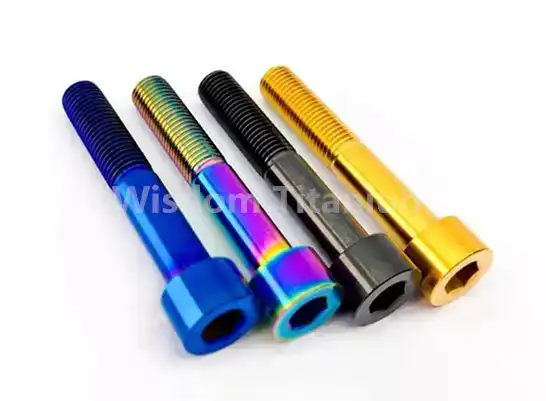
Before you can measure titanium allen head bolts properly, you need to know their standard diameter, thread pitch, head size across flats, head height, and overall length. You will need digital tools and thread sizes to make sure these maths are right. First, find out how wide the shank is just below the head. Next, check the thread pitch with a pitch scale. Finally, find out how deep the hexagonal hole is and how long the bolt is from the head to the tip. Because titanium allen head bolts are so light, they need to be very precise. Because of this, they are perfect for things like making changes to motorcycles, race cars, and space structures where every gram counts and measuring wrong can damage the structure.
People who work in precision engineering, on race teams, or in shops that build fast cars know that the first step in finding the right screw is to measure properly. If you use the wrong Grade 5 allen head bolt when updating the brake calipers on a supercar or putting together lightweight parts for a competition motorbike, it could mean the difference between getting third place and failure.
Allen Head Bolts and Their Key Dimensions
Because they are a special kind of fastener, titanium allen head bolts are made to fix performance issues that happen with steel hardware. Most of these bolts are made from Grade 5 Ti-6Al-4V or Grade 2 pure titanium. They can pull apart more than 950 MPa and are 45% lighter than bolts made of stainless steel that do the same job. It's often just called a "Allen socket," but the hexagonal internal drive lets more torque be sent to tight spots where external hex heads won't fit. This is why they are necessary for engine covers on motorcycles and small brake systems for cars.
Material Composition and Performance Characteristics
This Grade 5 titanium alloy, which is mostly aluminum (6%), and vanadium (4%), is very strong for its weight. This is important for racing. When it comes to rust resistance in sea and chemicals, this titanium allen head bolt alloy is much better than AISI 316 stainless steel. Steel made from AISI 316 can split and crack. Grade 2 titanium is very flexible and has a slightly lower tensile strength. This makes it good for things that need to be able to bend or curve. Because it has a density of 4.51 g/cm³, rotating parts like wheel hubs and brake blades can be made lighter. This makes the car faster and easier to handle.
Critical Dimensions for Procurement Specifications
When you know about measurement standards, you can be sure that all the parts of a foreign supply line can work together. Among the most important values are:
Nominal Diameter: Number of Millimeters (M1.6) to M18 (#0 to 3/4" in standard systems): This is the bolt head's width. It tells you how strong the thread contact is and how much weight the bolt can hold.
Thread Pitch: Finding the right thread pitch is important because cross-threading and assembly problems can happen if the pitch is wrong. For metric bolts, the pitch is given in millimeters (1.25 mm for M8 bolts), and for imperial numbers, it is given in threads per inch.
Head Dimensions: The socket size, which is found by measuring across the hexagonal hole, tells you what tools will work with it. The most common socket sizes for Allen keys are 3mm, 4mm, 5mm, 6mm, 8mm, and 10mm. Head Height: Headroom in recessed mounting uses is affected by head height.
Overall Length: This is the length of the bolt from the bottom of the head to the tip of the bolt. It needs to include both the width of the material and the depth of the thread contact so that the bolt doesn't bottom out or not have enough gripping force.
For external threads to fit properly with tapped holes, the thread specs must be within a Class 6g range according to ISO 4762 or DIN 912. The procurement teams must make sure that these specs match the engineering plans to avoid mishaps during assembly that cost a lot of money.
Step-by-Step Guide to Measuring Titanium Allen Head Bolts
As a professional sourcing expert or quality control engineer, you need calibrated tools and an organized approach to measure titanium allen head bolts correctly. They use precision tools to check allen head bolt specs before taking a batch.
Essential Measurement Tools
For quality control and keeping track of things, it's important to keep the calibration certificates for these tools. Digital calipers with a resolution of 0.01 mm can measure diameter and length accurately. Thread pitch gauges, which come in both metric and imperial sets, can quickly find thread specifications without damaging the titanium allen head bolt. Micrometers are more accurate for critical applications, and go/no-go thread gauges make sure that tolerances are met.
Measuring Nominal Diameter
If you hold the allen head bolt straight up and close the caliper jaws around the shank just below the head, where the threads haven't started yet, the reading on the digital display should be 8.00mm ±0.15mm for an M8 bolt, depending on the tolerance class. Measuring at the thread crest gives you wrong information because of how the thread profile is shaped.
Determining Thread Pitch
If you choose the wrong thread pitch gauge (in either metric or imperial), make sure the teeth of the gauge line up with the titanium allen head bolt threads. The right gauge will fit perfectly, with no gaps. For example, an M8×1.25 bolt can only use a 1.25mm pitch gauge, while an M8×1.0 bolt needs a 1.0mm gauge. Writing this down will help you avoid making mistakes when you order from suppliers.
Measuring Head Dimensions
To find out what size Allen key to use, put the short leg of the caliper into the hexagonal socket and measure across the flats on opposite sides. A standard M8 DIN 912 titanium allen head bolt has a 6mm hex socket. Measure the head height from the bottom to the top. A standard M8 cap head height is about 8mm, while low-profile versions may be 5–6mm. This is important information for figuring out brake caliper clearances.
Calculating Overall Length
Lay the allen head bolt flat on a surface and extend the depth probe of the caliper from the bottom of the head to the end of the bolt. Standard lengths range from 10mm to 40mm and up in 10mm, 12mm, 16mm, 20mm, 25mm, 30mm, 35mm, and so on. If you need custom lengths that aren't standard, it's important to be clear with brands like Wisdom Titanium that offer CNC customization services.
Metric vs. Imperial Distinction
The thread pitch for metric titanium allen head bolts is given in decimal degrees, while the thread pitch for imperial bolts is given in fractional inches and is written as threads-per-inch. For example, a 5/16"-24 imperial bolt looks like an M8×1.0 metric bolt, but they can't be used together because their thread forms and pitches are different. Before you place your order, make sure you know which standard you need.
Procurement Insights: Buying and Sourcing Titanium Allen Head Bolts
Strategic sourcing balances quality, cost, and the security of the supply line by buying titanium allen head bolts in a smart way. Buyers in the business world should know how the market works and what providers can do before they choose allen head bolts.
Supplier Evaluation Criteria
You can tell if a titanium allen head bolt maker is reliable by looking at their production skills, quality certifications, and customer reviews. Suppliers that have been around for a while have bought CNC tools, places to roll threads, and places to heat treat things. Wisdom Titanium is in Baoji Titanium Valley, which is the biggest hub for the titanium industry in China. In its fully integrated environment, it can make titanium spheres, cast ingots, extrude bars, and machine parts very precisely. This makes sure that the quality of the materials is managed all the way from getting the raw materials to checking the allen head bolt end product. One lot of this helps make sure that the quality of the next batch is the same.
Customization and Engineering Support
Items from catalogs can be used for many things, but they often need to be made to specific titanium allen head bolt sizes or given special finishes in order to change how well they work. Manufacturers who offer CNC shaping can work with different head styles, thread types, and lengths that aren't standard. Surface treatments like anodizing and PVD finishing make allen head bolts last longer and make them easier to find in an assembly by adding color. You should send detailed technical plans with tolerances, material grades, and inspection standards when you want to make a special titanium allen head bolt. When you work with an experienced company like Wisdom Titanium, their R&D service teams can make prototypes from samples or rough plans. This speeds up the process of making a new product.
Volume Pricing and Lead Time Negotiation
When you buy a lot of allen head bolts, economies of scale work best. When you place a special order, it takes 4 to 6 weeks to set up the tools and start making the goods. Standard sizes that are in stock are shipped within days. With planned releases and blanket purchase orders, you can balance the costs of having stock with the saves you get from buying titanium allen head bolts in bulk. If you have been working with the same providers for a long time, you can get more production space when demand for your product or service goes up.
Geographic and Logistics Considerations
It is easy to move titanium allen head bolt items to North American and European markets from Baoji Titanium Valley because it has a lot of infrastructure. Delivery won't be held up if you know about import taxes, uniform tariff numbers, and the paperwork you need for customs. Suppliers with a good name will give you all the information you need to export allen head bolts, like packing lists, business bills, and certificates of origin. If you compare prices from different sellers, don't just look at the unit price. Also look at the total landing cost, which includes handling, freight, and taxes.
Conclusion
It is important to accurately measure allen head bolts before buying and putting them together for tough uses in cars, motorcycles, and airplanes. To avoid making mistakes that cost a lot of money, it's important to know how to measure things like standard diameter, thread pitch, head size, and total length, and to use the right measuring tools and methods. Titanium allen head bolts are stronger than steel, do not rust, and stay stable at high temperatures. This makes these bolts the best choice for conditions where steel gear would fail. Working with approved makers who offer tracking of materials, customization options, and expert help makes it easier to buy titanium allen head bolts and makes sure that the products are of good quality. As performance standards get tighter across all industries, allen head bolt technology keeps getting better to meet new engineering challenges.
Partner with Wisdom Titanium for Precision Fastener Solutions
Wisdom Titanium delivers ISO 9001-certified allen head bolts engineered for demanding automotive, motorcycle, and aerospace applications. As a trusted titanium allen head bolt manufacturer based in Baoji Titanium Valley—the world's most comprehensive titanium production cluster—we combine vertical integration with precision CNC capabilities to ensure dimensional accuracy and material consistency. Our Grade 5 Ti-6Al-4V titanium allen head bolts provide the strength, corrosion resistance, and weight savings your high-performance projects demand, available in sizes from M1.6 to M18 with custom configurations developed through our experienced R&D team. Complete inventory of raw materials and standard parts ensures competitive pricing and rapid delivery to North American markets. Contact our engineering team at sales@wisdomtitanium.com to discuss your specific requirements, request material test reports, or explore bulk pricing options that optimize your supply chain efficiency.
FAQs
How do I measure the length of an Allen head bolt correctly?
From the bottom of the head to the tip of the titanium allen head bolt, use digital calipers to get the length. Put the bolt on a flat surface and stretch the depth probe all the way to the end. This will give you the right number. A 25mm bolt's length only describes its body, not its head height.
Does titanium resist corrosion better than stainless steel?
The titanium allen head bolt is better than stainless steel in places where it is dangerous to use it. The inactive oxide layer on titanium fixes itself right away after being broken. This layer protects the titanium allen head bolt from acids, alkalis, salt water, and salt. When there is salt in the air, stainless steel gets corrosion and crevice rust, which stops threaded joints from working.
Can I use regular calipers to measure titanium bolts?
Standard digital tools that can read as little as 0.01 mm are good enough to measure most titanium allen head bolts. Before you take important measures, check to see how the calibration is going. You can use thread pitch tools for either metric or imperial threads to make sure you get the pitch right without damaging the titanium allen head bolt threads.
What is the difference between Grade 2 and Grade 5 titanium bolts?
When it comes to strength, Grade 2 titanium allen head bolt material is good for non-structural uses because it doesn't rust and has a tensile strength of 340 MPa. Grade 5 (Ti-6Al-4V) is much stronger (above 950 MPa) and is used in high-stress areas of cars, planes, and races where strength-to-weight performance is very important.
References
- American Fastener Journal. (2021). "Titanium Fastener Specifications and Material Properties in High-Performance Applications." Technical Standards Review, Vol. 34, No. 2, pp. 45-62.
- Society of Automotive Engineers. (2020). "SAE AMS 4967: Titanium Alloy Bolts, Screws, and Studs Ti-6Al-4V, Annealed." Aerospace Material Specification Standards Manual.
- International Organization for Standardization. (2019). "ISO 4762: Hexagon Socket Head Cap Screws—Dimensions and Technical Requirements." Geneva: ISO Standards Publication.
- Materials Performance Magazine. (2022). "Comparative Corrosion Resistance of Titanium and Stainless Steel Fasteners in Marine Environments." NACE International, Vol. 61, No. 8, pp. 32-39.
- Racing Technology Quarterly. (2023). "Weight Reduction Strategies in Motorsport: Titanium Fastener Applications and Performance Gains." Automotive Engineering Institute, Spring Edition, pp. 78-91.
- Fastener Technology International. (2020). "Measurement Standards and Quality Control Protocols for Precision Titanium Socket Head Cap Screws." European Fastener Association Technical Bulletin, Issue 127, pp. 12-28.