
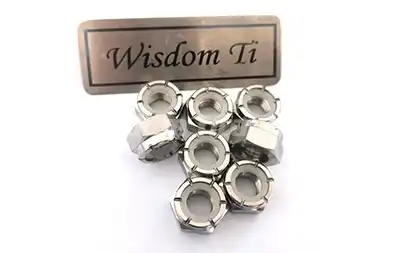
Installing titanium nylon lock nuts properly is easy and necessary to make sure links last a long time and don't shake. First, look for any damage or dirt on the bolt threads and nut. By hand, thread the nut onto the bolt until the nylon part touches. There will be more pushback at this point. Tighten the bolt to the manufacturer's recommended torque value, which changes based on the bolt width and the purpose. Use a calibrated torque wrench to do this. Do not tighten too much because too much force can damage the nylon plug and make the locking less effective. In difficult situations, Grade 5 titanium nylon lock nuts must be reliable. This is because they are very strong and don't rust. This makes them perfect for brake calipers, wheel hubs, and suspension parts.
Step-by-Step Guide on How to Install Nylon Lock Nuts
Essential Tools and Preparation
Getting the right tools is the first step to a proper operation. For important fastening jobs, you must use a measured torque wrench—guesswork leads to either not enough holding force or broken parts. Digital torque wrenches give accurate readings and sound alerts when goal values are met, which cuts down on mistakes made by hand when doing the same thing over and over again. Socket sets with thin walls are easier to get to in tight places, like brake caliper bolts, because the sides of the sockets won't round over.
Problems with activation can be avoided by checking the threads. Use a thread measure or a matched nut to check the length of the bolt threads for damage, debris, or rust. If there is dirt on the threads, clean them with a wire brush and solvent. Make sure that the grade of the bolt meets or exceeds the grade of the nut. For example, if you put a Grade 5 titanium nut with a lower-grade steel bolt, the link will be uneven, and the bolt will break.
Anti-seize chemicals need to be thought about carefully. Copper-based anti-seize stops steel bolts from galling, but it's not needed and could cause problems with titanium. Titanium threads naturally lubricate, and the nylon insert's friction properties make it work well enough without any extra lubrication. If working in places that are very corrosive, putting a small layer of titanium-compatible anti-seize on the bolt threads (but not on the nylon insert) can make removal easier in the future without affecting the locking function.
Installation Sequence for Maximum Performance
Aligning the threads is the first and most important step. To put the nut on the bolt by hand, make sure that the first few turns go easily and without any resistance. When the nut is pushed onto threads that aren't lined up properly, this is called cross-threading. It hurts both parts and makes weak spots that cause them to fail early. If you run into pushback before the nylon insert engages, don't force the link. Instead, back off and realign it.
Rotational resistance goes up a lot when the nut gets to the nylon core. Tighten by hand through this area until the nut touches the mounting surface. During this hand-tightening phase, you can find any unusual resistance that could mean that the thread is damaged or contaminated. As the nut moves forward, the nylon filler should slowly get tighter, not all at once.
When using a measured wrench to apply torque, move it in a smooth, steady way instead of hitting something or moving it. Refer to the manufacturer's instructions for torque values based on bolt width. For M6 fasteners, these values are usually between 5 and 10 ft-lbs, while for M12 uses, they are between 50 and 80 ft-lbs. When you under-torque, the nylon insert isn't fully connected, which makes closing less effective. When you over-torque, you either bend the nylon, strip the threads, or go beyond the bolt's yield strength. This makes a link that looks strong but isn't actually.
Once the required pressure is applied, check visually to make sure the nylon insert is fully engaged. Usually, two or three threads should be visible past the nut face. Use paint or a pen to mark where the nut is in relation to the bolt or the next part so that it can be checked for movement later. Some standards call for a witness mark that shows any loosening during repair intervals in important places like brake calipers or suspension links.
Troubleshooting Common Installation Issues
For cross-threading avoidance to work at first, you need to be patient. If a nut won't thread easily, take it off fully and look at both parts in good lighting. Some threads are damaged by partial cross-threading, leaving weak spots that can't be fixed even after the threads are realigned. In production settings, thread check tools find broken bolts before they are installed.
Things in the environment can change the mounting force. The nylon insert can become stiffer in cold weather, which can temporarily make fitting harder. On the other hand, torque characteristics may be different for parts that are warm during operation compared to cold sections. Take these differences into account by following torque standards that are right for the assembly conditions and knowing that you may need to do retorque steps after the first thermal cycling.
Reuse issues depend on how serious the application is. Titanium nylon lock nuts can usually handle three to five installation cycles before the nylon part wears out and makes the sealing less effective. Before using it again, check the insert for cracks, deformation, or damage to the threads that can be seen. When safety is important, like when it comes to brake systems, wheel retention, or mounting structures, replacing old screws with new ones takes away any doubt and makes it possible to track the quality of the work.
Titanium Nylon Lock Nuts vs Other Lock Nuts: Choosing the Best Fit
Performance Comparison Across Material Options
Because stainless steel lock nuts don't rust and are cheaper to make, they can be used in non-critical situations where weight isn't a big deal. But stainless steel's lower density becomes a big problem when you try to figure out its unsprung mass. For example, a titanium nylon lock nuts wheel hub bolt system can be 50% lighter than a stainless steel version while still being as strong or stronger. Stainless can also cause galling when it is being installed or taken off, especially in high-torque situations.
Aluminum lock nuts are almost as light as titanium ones, but they are not as strong or last as long. Because aluminum doesn't have a high tensile strength, it can only be used for links that aren't heavily loaded. Aluminum threads wear out faster, especially when they are installed over and over or are exposed to pressure. Because of this, titanium is always better than aluminum in racing uses that need to be both light and very reliable.
All-metal lock nuts that don't have nylon cores rely on thread shapes that are deformed or spring elements to keep them from coming loose. These designs can handle higher temperatures than nylon-insert versions, but they usually don't provide as much steady locking force and may damage bolt threads while being installed. The choice between all-metal and nylon insert designs relies on the temperature at which they will be used, how often they will be used, and how complicated the fitting needs to be.
Cost-Effectiveness and Longevity Analysis
When compared to steel or aluminum options, titanium nylon lock nuts cost more at first—usually three to five times as much as steel lock nuts of the same type. But lifetime cost research shows a different picture of the economy. Titanium doesn't rust, so you don't have to pay to repair rusty steel bolts, and its high fatigue strength cuts down on failure-related downtime and safety risks.
Different applications make money in different ways from weight saves. Racing teams figure out how much a weight loss is worth in terms of faster lap times and a competitive edge. Manufacturers of electric vehicles use the money they save to make the batteries last longer and work better, which affects consumers' choices to buy. Weight reduction across hundreds of fasteners can help improve fuel economy and meet emissions standards even in traditional car uses.
How long a nylon patch lasts depends on how it is used. When used within the temperature range of nylon and kept away from chemicals that break down materials, fasteners keep locking effectively through multiple installation rounds. Nylon breaks down faster when it is exposed to high temperatures, certain solvents, or ultraviolet light. However, Grade 5 titanium bodies keep their structural integrity forever under normal working conditions. This means that in some designs, the nuts can be replaced with new nylon inserts.
Selecting Appropriate Grades and Sizes for Your Application
The thread pitch you choose affects both how strong it is and how well it resists shaking. Fine-thread screws have a larger tension area and are less likely to come loose, but they are more likely to cross-thread and get damaged during installation. Coarse threads make assembly go faster, can handle thread fouling better, and work better with lighter materials like aluminum or composite parts. Match the thread pitch to the needs of the product and the where the assembly will be done.
Hex size is important for more than just wrench access. Larger hex sizes better spread torque loads, making it less likely that a nut will bend or a wrench will slip during high-torque installation. But nuts that are too big add weight and can make it hard to get things together in small spaces. For most uses, standard DIN or ISO hex sizes are the best mix, but custom OEM specs can be made to meet particular engineering needs.
Manufacturers usually have minimum order amounts that start at 100 pieces, which works with small production runs and modification shop project sizes. When OEM assembly lines or big race teams buy in bulk, they can negotiate better prices and keep stock for a variety of vehicle types. Standard sizes have lead times that range from being available right away for common setups to taking 4 to 6 weeks for special specifications that need dedicated production runs.
Bulk Procurement and Supplier Selection for Titanium Nylon Lock Nuts
Understanding Global Supply Chain Dynamics
Titanium raw materials are mostly found in places where aircraft and defense businesses are well-established. The Baoji Titanium Valley in Shaanxi Province, China, is one of the largest production hubs for titanium in the world. It includes the whole supply chain, from making sponges to finished parts. This vertical unity makes it easier to control costs and make sure quality, which is hard to do with supply networks that are spread out.
ISO 9001 approval is a basic way to make sure that quality management systems work, but it's only the beginning of evaluating a seller. More aerospace certifications (AS9100) or car standards (IATF 16949) show that a seller can meet strict requirements for testing, paperwork, and tracking. For important uses, packages should come with material test results, lot traceability, and dimensional inspection papers.
Minimum order amounts strike a balance between how quickly and easily customers can change their minds. Standard shapes and sizes usually need at least 100 pieces to be produced. For unique requirements or non-standard sizes, 500 to 1,000 pieces may be needed to cover the costs of the tools and setup. Small-quantity delivery is available from suppliers who keep common sizes in stock for prototyping or emergency substitute needs.
Evaluating Supplier Capabilities and Reliability
How consistent and scalable a product is depends on how well it can be made. When compared to machined screws, hot forging creates better grain structure and mechanical qualities, especially for high-stress situations. CNC finishing makes sure that the dimensions are correct and that the product looks good. Automated inspection equipment gives statistical process control data that can't be gotten from human inspection.
OEM service skills set manufacturing partners who help with product development apart from providers who only stock standard parts. For engineers to work together on titanium nylon lock nuts thread specs, coatings, head setups, or combined assembly solutions, production systems need to be able to adapt. Suppliers with their own research and development (R&D) teams can make changes to prototypes quickly, which helps iterative design processes that are popular in racing development and limited-production cars.
Reliability in lead times affects planning production and keeping track of supplies. Established providers keep enough raw materials and production capacity to fill standard orders within one to two weeks. However, special specs usually take four to six weeks, which includes engineering review and scheduling production. International shipping can take an extra one to three weeks, based on where it's going and what form of transportation is chosen. For urgent needs, air freight is available at an extra cost.
Pricing Structures and Payment Terms
Titanium material costs change depending on how much demand there is in flight around the world, how easy it is to get raw materials, and the value of the dollar. Price structures usually include the cost of the base material, things that affect how hard it is to make, finishing requirements, and savings for large orders. Due to the alloying elements and heat treatment needs, Grade 5 titanium costs more than industrial pure grades. However, the performance benefits make up for the price difference in challenging applications.
When you buy more than 500 to 1,000 pieces, you can get a volume price. There are also breaks at 5,000 and 10,000 pieces. Long-term supply deals that lock in yearly amounts allow for the best prices and make sure that production operations always have supplies. Blanket orders with planned releases work with methods for keeping inventory low without giving up the benefits of big prices.
Payment terms depend on the supplier and how long the customer has been a customer. For new customers, lenders usually ask for prepayment or a letter of credit until their creditworthiness is proven through past transactions. Established accounts may be able to get net-30 or net-60 terms, and contract inventory deals are good for OEM customers who buy a lot and know exactly when they will need to use their inventory. When you price something in USD, EUR, or RMB, you may be exposed to different levels of risk, based on how the exchange rate changes and how you hedge your bets.
Conclusion
When titanium nylon lock nuts are installed and maintained correctly, they make connections that are reliable and don't shake in difficult automobile, motorcycle, and industrial settings. When you mix Grade 5 titanium's high strength-to-weight ratio and resistance to corrosion with tried-and-true nylon insert locking technology, you get performance benefits that support the higher price by extending service life and lowering the risk of failure. To get the best performance and safety from fasteners, make sure you follow the manufacturer's torque recommendations, do regular checks, and buy from approved suppliers with well-documented quality systems.
Partner with Wisdom Titanium for Your Critical Fastening Solutions
Wisdom Titanium Industry and Trading Co., Ltd. was founded in 2016 and is ISO 9001 approved. They make titanium nylon lock nuts and custom CNC parts for use in automobile, motorbike, aircraft, and industrial settings. We are fully integrated from obtaining raw materials to delivering produced parts. We are located in Baoji Titanium Valley, which is China's largest titanium production hub. Our hot-forged hex titanium nylock nuts come in sizes M3–M24 and have threads that are both metric and inch. You can get them at factory-direct prices, and you only need to order 100 pieces to get them right away. As a provider of titanium nylon lock nuts with a lot of experience, we can meet your exact needs by offering OEM services, custom engineering support, and full material tracking documents. You can talk to our expert team at sales@wisdomtitanium.com about your fastener needs, ask for material certifications, or place an order for high-quality locking fasteners that give you measurable performance advantages in important situations.
FAQs
Can titanium nylon lock nuts be reused in critical applications?
Titanium nylon lock nuts can usually handle three to five installation cycles before the nylon part wears out enough to make the sealing less effective. But when putting things back together, new bolts should be used for safety-critical parts like brake pads, wheel hubs, and suspension links to get rid of any doubt. Before using the nylon insert again in a non-critical situation, check it for cracks, warping, or thread damage. For quality management reasons, write down choices about reuse and keep records of tracking.
What temperature range is suitable for nylon insert lock nuts?
Nylon inserts work well in temperatures ranging from -40°F (-40°C) to about 250°F (121°C). The Grade 5 titanium body can handle much higher temperatures—more than 600°F (316°C)—but the breakdown of nylon makes it impossible to use the assembly in places with very high temps. When used near exhaust pipes or brake rotors, nylon may reach temperatures higher than its service temperature. To protect bolts, all-metal locking solutions or thermal management strategies are needed.
How do I determine correct torque specifications for installation?
Check the manufacturer's specs for the bolt's width, thread pitch, and material grade. For M6 fasteners, the normal torque range is 5 to 10 ft-lbs. For M12 uses, it's 50 to 80 ft-lbs. For other sizes, the numbers are proportionally scaled. Instead of guessing, use measured torque tools. Over-torquing can damage nylon inserts and may be stronger than the bolt's yield strength. Under-torquing, on the other hand, leaves connections not properly held against vibration.
References
- American Fastener Journal. "Nylon Insert Lock Nuts: Design, Performance, and Application Guidelines." Industrial Fastener Technology Review, Vol. 47, 2021.
- Boyer, R., Welsch, G., and Collings, E.W. "Materials Properties Handbook: Titanium Alloys." ASM International, Materials Park, Ohio, 1994.
- Bickford, John H. "Introduction to the Design and Behavior of Bolted Joints: Non-Gasketed Joints." CRC Press, 5th Edition, 2008.
- Society of Automotive Engineers. "SAE J1199: Mechanical and Material Requirements for Metric Externally Threaded Steel Fasteners." SAE International Standards, 2019.
- Titanium Information Group. "Titanium Fastener Selection and Application Guide for Corrosive Environments." Technical Publication Series, 2020.
- Marsh, Kevin J. "Prevailing Torque Lock Nuts: Comparative Analysis of Locking Mechanisms and Reusability Performance." Fastener Technology International, March 2022.