
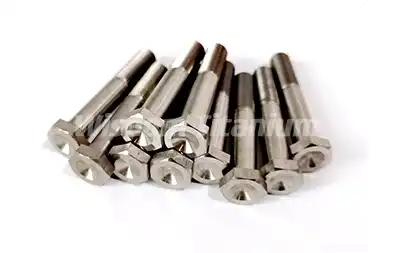
To determine hex bolt size, measure four things: the thread diameter, the thread pitch, the length under the head, and the width across the head flats. Then confirm the standard, such as DIN 933, DIN 931, ISO 4017, ISO 4014, or ASME B18.2.1, and the material grade. A caliper gives you diameter and length, and a thread gauge gives you pitch. Metric bolts read like M10 × 1.5 × 60, and inch bolts read like 1/2-13 × 2 in. Below, I walk through each step and show how it applies to titanium hex bolts.
"Size" means more than diameter. It also covers length, pitch, threaded length, head dimensions, material, strength grade, finish, and standard. A wrong specification can cause poor thread engagement, tool mismatch, early corrosion, or joint failure. I wrote this guide for maintenance teams, OEMs, distributors, and purchasing departments.
Measure the Core Hex Bolt Dimensions
Step 1: Identify the Key Hex Bolt Dimensions
Start with a clean bolt. First, get rid of the rust and other junk. Then, use a ruler to find out how wide the threads are across. Next, find out how long the head is from the base to the tip. No matter how high the head is, hex head bolts are always the same length. Note the width of the flats, the height of the head, the length of the threads, and the presence or absence of a plain shank below the head. This number lets you know if the hex bolt fits your wrench, nut, washer, and joint. Check your numbers against a public record or the norm. If a caliper reads 9.9 mm on the threads, the bolt is most likely a standard M10 because the thread limits are just a little less than the size given.
Step 2: Determine the Thread Type and Pitch
The size of a nut doesn't tell you if it will fit or not. An M10 × 1.5 × 60 bolt is 10 mm wide, has a 1.5 mm pitch, and is 60 mm long. For M10, the big pitch is 1.5 mm and the little pitch is 1.25 mm. A 1/2-13, which is also written as UNC, is a half-inch diameter with 13 threads per inch. For an inch-wide UNF screw, there are twenty threads. Thread pitch gauge leaves need to be lined up with threads until they don't let any light through. After that, use a well-known nut to make sure you got it right. If you put the wrong nut on the bolt, be careful not to damage it.
Step 3: Use a Hex Bolt Size Chart Correctly
A hex bolt size guide is faster, but it only shows how to put things together. Metric maps show the diameter, pitch, width across flats, head height, and standard lengths of something. There is a chart that shows the height, width, and number of threads per inch. Watch out for standards that aren't the same. Based on DIN 933 and DIN 931, the sides of an M10 head are 17 mm wide. However, ISO 4017 and ISO 4014 say they are 16 mm wide. By that one millimeter, you can tell which wrench will work. Plus, a chart doesn't show whether a bolt can handle a certain load in tension, shear, or long-term use. Make sure you know what the standard is and how many mistakes it lets you make before you place your order.
Match Grade, Thread Length, and Fastener Type
Step 4: Identify Hex Bolt Grade, Material, and Surface Finish
A steel hex bolt's head has lines that show how strong it is. ISO 898-1 says that metric steel bolts are in groups 8.8, 10.9, and 12.9. Inch bolts have marks that say either SAE Grade 5 or Grade 8, but the numbers don't match up. Steel and titanium are not the same. Titanium grade 2 is very pure and doesn't rust easily, so it can be used in business. ASTM B348 says that Grade 5 bar stock needs to have a tensile strength of at least 895 MPa. Grade 5 is made of Ti-6Al-4V. That range is about the same as class 8.8 to 10.9 steel, but I wouldn't use a 12.9 bolt instead unless an expert told me it was okay. You need to get material certificates because the color, finish, or shape of the head doesn't tell you anything about the grade.
Step 5: Select Full-Thread or Partial-Thread Hex Bolts
What makes a joint work is the length of the thread. Use DIN 933 to find a hex head screw with full threads. Use DIN 931 to find a hex head bolt with only partial threads. Since ISO 4017 and ISO 4014 have taken the place of these two DIN standards, I still list both on a specification because many customers still order by DIN number. Full-thread bolts work well with short grips and thin plates. When partial-thread bolts are used, the shaft stays smooth. This holds the shank in place and helps it line up when it's in the shear plane. Before you clamp the grip on a stack, make sure it's the right length. Also, leave a few threads of extra space for the nut. It's not good for the joint to have too much or too little extension. Adding too much length can hurt parts close.
Step 6: Distinguish Hex Bolts from Similar Fasteners
Parts don't always have the same names, so use their sizes to find them. This is how ASME B18.2.1 in the US talks about hex bolts and hex cap screws. The sizes are different for each. Because it has a round head and a square neck, a carriage bolt can't be turned. Lag bolts are made for wood and have rough threads. There is no need for extra space around socket head cap screws with a hex drive. They don't stick out on the sides. Flange bolts have a screw face built right in. Before you switch them, make sure you know what length, thread, grade, head size, tool access, and joint needs each type has. Put the standard on every purchase description so that things don't get lost.
Verify Installation and Apply Sizing to B2B Orders
Step 7: Verify Installation, Torque, and Joint Performance
Still, it's important to put the right size in the right way. The bolt, washer, and nut should all be the same size, grade, and surface. Clean the joint and turn the nut by hand if there are more than one bolt in it. Don't do all at once; do it in steps. Torque is different for each bolt and relies on its thickness, pitch, lubrication, surface state, and goal preload. There isn't a single steel chart that works for all bolts. Titanium threads can get stuck when they rub against each other. Molybdenum disulfide is a chemical that stops seizing. For some jobs, you can use a DLC coating. Your tech should also give you a torque number. If you see stripped threads, fasteners that won't move, or heads that are round, it's likely because of a mismatch or bad torque control.
Step 8: Apply the Sizing Method to Common B2B Applications
Sometimes it's the little things that matter the most. When working on building projects, it's important to keep track of inspection records, strength grades, and rust protection. When machine parts are put together, they are put together with shaking, access, and thread length in mind. The weight, heat, and wear and tear of parts for cars and racing are taken into account when they are made. Titanium is about 40% lighter than steel, and salt water won't make it rust. Because of this, it can be used in the chemical, aerospace, marine, and bicycle industries. Distributors need to take care of something else. Since people order by DIN number, the order has to be sent back if the shelf is the wrong size. Tell the company that makes hex bolts how many are needed each year, what the standards are, how they need to be tested, and what the drawings are. This will make sure the quote you get is correct.
Step 9: Build a Complete Hex Bolt Procurement Specification
A full specification stops you from messing up with quote marks and the wrong words. Write down the name of the item, its minimum diameter, length, pitch, full or partial thread, material, grade, finish, and the most important head measurements. Make a list of the things you need for packing, labels, certificates, and inspections. I think each item should have its own line that is ready for ERP and shows the style, grade, size, quantity, and price per unit. They need to be clear and show the grade and size. Also, you need to be able to keep track of each group. When you shop, it's not enough to just look at the unit prices. Other things you should look at are the quality systems, the sizes, the experience with shipping, the wait time, and the total cost of delivery.
Avoid Common Sizing Mistakes and Choose Titanium Hex Bolts
Common Mistakes When Determining Hex Bolt Size
A lot of the time, people get the hex bolt size wrong. If you measure the bolt over the head, it will be too long. You can cross-thread two bolts that look the same if you match their width but don't check their pitch. It's not smart to choose a grade based on head shape, color, or coating. Use documents and notes instead. If you use a steel torque chart on a titanium bolt, the joint might be too tight or too loose. Putting in a new bolt that hasn't been used before will make the failure happen again. This is because the cause doesn't change, like galvanic rusting. Before you accept a replacement, make sure everyone knows about the size, weight, certificates, and materials that work with each other.
Hex Bolt Sizing Checklist
Use this short checklist before every order. Clean it up first and check to see if it's in inches or metric. Second, make a note of the outside diameter, the length under the head, the pitch or threads per inch, the head height, the width across the flats, and any markings. Third, make sure the washer and nut are the same size, grade, material, finish, thread engagement, and torque. You should ask for examples, inspection data, and material documents when you buy something big or important. Use go/no-go gauges to check the threads and test pieces for hardness when your quality plan says to. When engineers, sellers, and wholesalers all have a written list, everyone is on the same page.
Titanium Hex Bolts from Wisdom Titanium
Baoji Wisdom Titanium Industry and Trading Co., Ltd has been in business since 2016 and is ISO 9001 certified. They make and sell both standard and special CNC parts. We are in the Baoji Titanium Valley in the province of Shaanxi. It is where most of China's titanium industry is done. Based on DIN 933 and DIN 931, our titanium hex bolts come in two grades. They're cheap because they ship straight from the plant. You can send us pictures or models to help us make something just for you. 200 pieces is the least amount you can buy. We make sure that our bolts and nuts are good before we send them out. They are made from great titanium pieces. We also keep standard tools and raw materials on hand at set prices.
Conclusion
To get it right, you need to see more than just how wide the hex bolt is. You measure how wide the flats are, how long the thread is under the head, how high the head is, and the thread pitch. After that, you use a ruler to find the pitch and make sure it's right. The rule could be ISO 4017, ASME B18.2.1, or DIN 933. Shapes are shown on size guides, but so are grade, material, finish, and thread length. Each of these should be checked on its own. Grades 2 and 5 of titanium are not the same when it comes to how strong they are or how they stop corrosion. Partial-thread and full-thread bolts are used in different places. When you install and place your order, you can avoid making most mistakes if you have the right torque, anti-seize on titanium threads, and a written specification. Do not make the mistake of measuring over the head or picking a grade based on how it looks. This will help you get quotes from several companies and keep extra parts safe.
FAQ
How do I measure hex bolt length?
Don't count how tall the head is when you measure. Measure from the base of the head to the tip. Most sizes can be found with a caliper or tape measure. If you want to know how to do something like countersunk heads, look at the model or standard first.
What separates DIN 933 from DIN 931?
A DIN 933 screw has a full thread and a hex head. In DIN 931 there is a hex bolt with threads on the bottom of a straight base. They have been replaced by ISO 4017 and ISO 4014. For each size, a different wrench width is needed, so make sure you know what number the customer wants.
Can titanium replace a steel hex bolt?
Yes. Titanium hex bolts can replace steel bolts in some applications, depending on mechanical requirements and operating circumstances. Grade 5 titanium (Ti-6Al-4V) has a high strength-to-weight ratio and superior corrosion resistance. Its tensile strength can be similar to some Class 8.8 and Class 10.9 steel fasteners, depending on the material specification, but it is not a direct substitute for Class 12.9 steel.
What is your minimum order?
To handle a sale, we need at least 200 pieces. Titanium hex bolts in Grades 2 and 5 are in line with DIN 933 and DIN 931. We can also make custom designs from a sketch or plan.
Request Your Titanium Hex Bolt Quote from Wisdom Titanium
Looking for a hex bolt manufacturer that supplies Grade 2 and Grade 5 titanium to DIN 933 and DIN 931? Wisdom Titanium offers factory-direct pricing, stocked raw materials at stable prices, ISO 9001 quality, a 200 pcs MOQ, and custom designs. Send your sizes, drawings, or samples to sales@wisdomtitanium.com, and we will prepare a quotation. See product details at wisdomtitanium.com.
References
- ISO 4014, Hexagon Head Bolts: Product Grades A and B, 2011
- ISO 898-1, Mechanical Properties of Fasteners Made of Carbon Steel and Alloy Steel: Bolts, Screws and Studs, 2013
- ASME B18.2.1, Square, Hex, Heavy Hex, and Askew Head Bolts and Hex, Heavy Hex, Hex Flange, Lobed Head, and Lag Screws (Inch Series), 2012
- ASTM B348, Standard Specification for Titanium and Titanium Alloy Bars and Billets, 2019
- An Introduction to the Design and Behavior of Bolted Joints, 2007
- Titanium: A Technical Guide, 2000