
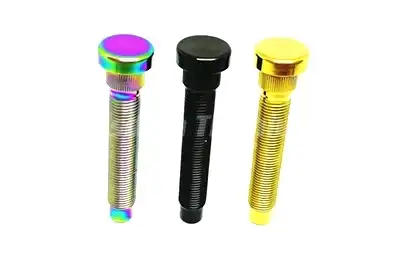
To choose titanium wheel stud length, measure the full mounting stack: wheel mounting-pad thickness, any spacer or adapter, and the lug nut depth. Add the engagement your nut needs plus a small safety allowance. Then confirm the stud does not bottom out in the hub or touch the brake parts. Aim for the shortest length that gives full thread engagement and enough clearance. Check thread size and pitch first, such as M12 x 1.5 or M14 x 1.5. I wrote this guide for distributors, buyers, and race teams who want fitment they can defend and a drawing they can send to a supplier.
How to Measure and Calculate Titanium Wheel Stud Length?
Know Which Length Your Supplier Means
Before you compare quotes, make sure you understand what "length" means on each drawing. They are overall length, thread length on the hub side, shoulder-to-end length, exposed wheel-side length, and thread engagement that can be used. Most studs have a shoulder or collar, a thread on the wheel side, and a thread on the hub side. Some styles also come with a way to place them. Two different businesses can sell different parts of the same "60 mm" pin. I always ask for a technical drawing with arrows showing where things should go. There is a page with samples, specs, and quotes. This is helpful when you need to buy a lot of titanium wheel studs.
Add Up the Mounting Stack
Next, I guess the needed exposed length by adding four things: the thickness of the wheel mounting pad, the thickness of the spacer or adapter, the engagement of the lug nuts you need, and a small safety margin. As per a shop rule, at least one stud's width of touch must be met. This is 12 mm for an M12 stud. For me, that's the very least. I also read the instructions that came with the wheel and vehicle. If you want to measure real parts instead of catalog numbers, you should use calipers since the differences in size add up. You can't get free space. It might hit the brake caliper, stop the wheel from sitting down, or rule out nuts that have a closed end. Most of the time, the smallest stud that fits and gives enough space is the best choice.
Check Hub-Side Engagement and Clearance
You need to take care of both the wheel side and the hub side. They must be able to hold their weight on the hub side of the stud and not fall out of the shoulder before they seat. Check the space between the brakes and calipers, the depth of the wheel pocket, and the thread depth of the nut with the wheel on. Before you order a lot of them, I think you should see how they fit on a real hub. If the tip of the stud is at least flush with the face of the nut, an open-end nut should work fine. You should also measure the room inside closed-end nuts, since they need to be bigger on the inside. These checks are quick and don't return any money.
Match Stud Length to Your Application
Street, Track, and Spacer Setups
Every job has different length needs. Studs on street cars with stock or aftermarket wheels are often close to the length that came with the car. You might need longer wheel studs for spacers, racing wheels with stronger pads, quick wheel changes, or track cars. When you add a spacer to the stack, you should think about its full thickness. You should also check hub engagement and hub-centric seating again. The nut can't reach as much of the screw when the wheel is moved outward with a spacer. There should be a simple chart that shows how thick the wheels are, how big the spacers should be, and how long the studs should be. Techs and people who work at the counter can then both answer questions about fitting in the same way.
Drag Racing and Drift Use
When you drift or drag race, you put different amounts of stress on the car's parts. Drag cars put a lot of weight on the studs at the beginning. Their wheels are also usually very light, so spinning mass is important. Drift cars often switch wheels, their brakes get hot, and they hit walls or curbs. Titanium can be used for both because it is not as thick. Ti-6Al-4V is only 4.43 g/cm³ dense, which is about 44% less dense than steel (7.85 g/cm³). It's also more likely to gall when you change wheels a lot, so a length that makes nut starts easy and straight is good. It is still important for technicians to check the threads after tough events and follow the torque recommendations made by the vehicle builder.
Motorcycles and Special Applications
An engineer needs to look over both auto and specialty projects separately. It's not possible for a car chart to be used on a truck because the thread standards, load lines, seat designs, and fitting steps may be different from those in a car. When I do these jobs, I don't use the model name. Instead, I use a picture or part that is unique to the car. Wheel and hub shapes can change from one model year to the next, so if you only look at the model, you might not get the right fit. We can figure out a length for you based on the sample you send us and measure it to make sure the thread pitch is right. Before going into production, the last check is a test fit on a real wheel and hub.
Compare Materials, Grade, and Finish
Titanium Versus Steel, Chromoly, and Aluminum
You can only put weight in. Titanium Grade 5 is not as thick as steel and doesn't rust like steel does. On the other hand, steel might be stronger overall, but it costs less. Aluminum is stronger, doesn't wear down as quickly, and doesn't have as long of a thread life, so it's not as good for heavy-duty wheels. Chromoly steel is still a good choice for budget-friendly or big loads. At the same time, think about the total cost, upkeep, service life, temperature, corrosion, galling, and how things wear out. You should sell titanium wheel studs to people who want their road or race cars to have less rotating mass and be less likely to rust. I would tell you that steel might be a better choice for the price.
Why Grade 5 (Ti-6Al-4V) Suits Wheel Hardware?
Grade 5 titanium, which is also called Ti-6Al-4V, is the most common type of titanium alloy. It is often used for performance fasteners because it is strong for its weight. ASTM B348 says that Grade 5 bar needs to have a tensile strength of at least 895 MPa and a yield strength of at least 825 MPa. Still, a grade doesn't really show how well you did. Other things that can change the outcome are the heat treatment, the thread geometry, the quality of the cutting, the surface treatment, and the checking. You can get material certificates and test reports, as well as tensile, yield, proof-load, and fatigue data, from anyone. So, you can compare lots in a fair way.
Finish Options and Anti-Galling Installation
Our titanium wheel studs are made from Steel Grade 5 (Ti-6Al-4V). Threads come in three sizes: M12 x 1.5, M14 x 1.25, and M14 x 1.5. You can change the length, and the finish can be satin, anodized, or something else. At work, we follow ISO 9001:2015. Make sure you like the color and feel of a sample before you order a lot of it. Finish changes how something looks and feels. Titanium threads can get clogged, so clean them before putting them on. Then, use the right anti-seize, tighten the nuts slowly, and make sure you use the right amount of force for the lube. Find out more about those numbers from the wheel and car maker. Threads that are oiled change the clamp load at a given torque.
Verify Dimensions and Avoid Common Errors
Build a Purchasing Checklist
A detailed question keeps you from having to send a lot of emails. You should describe the car, the hub thread width and pitch, the lengths of the threads on the hub side and the wheel side, the total length, the shoulder measurements, the wheel and spacer thickness, the type of lug nut, the grade of the material, and the finish. Also, buyers at the OEM and wholesale levels should request certificates, inspection reports, drawings, and records that show where the goods came from. These papers help the people on your quality team and in charge of insurance or safety. Their job is to help you with product risk. You can get a good quote from a supplier if they have a list and a drawing on hand. You don't have to guess when you can compare offers line by line.
Seat Type, Nut Design, and Torque
Length isn't the only thing that helps things work together. Wheels can use different kinds of nuts with various thread lengths. Nuts can have ends that are open or closed. Shoulder room and the size of the wheel pocket are also important. Due to titanium studs, lubricant, nut material, and clamping targets being different from steel hardware, make sure the right force is used for the whole. Make sure you check a steel force number before you copy it. Sources that talk about bolted joints, like Bickford's text, say that friction at the threads and under the nut changes the clamp load that a certain force has. This is the reason I see torque as a part of the specs and not as an extra.
Common Length Mistakes to Avoid
Most issues with length happen more than once. They pick a stud based only on the model of the car, measure from the wrong point of reference, don't check the spacer's thickness, compare prices without seeing the drawings, or believe that the longest stud is the safest. Each habit can cause the wheel to bottom, connect briefly, or nuts that don't work with the wheel. Bad installation raises the risk: cross-threading, over-tightening, threads that are dry or dirty, and bad assembly that happens over and over again can all damage titanium parts. While the machine is running, check the threads, nuts, shoulders, and any other parts that can be seen for damage, galling, or contamination. As directed by the maker, fix any studs or nuts that are broken that hold them together. People who come after you will be safe if you catch these mistakes early. They will keep the return rate low.
Choose a Supplier and Follow a Decision Process
What to Ask a Titanium Wheel Studs Manufacturer?
A qualified provider takes care of all the steps needed to find titanium, machine it using CNC, make threads, heat treat it, finish the surface, measure it, and finally release it. Need to know more about the materials? Ask for conformity certificates, mechanical test reports, drawings, inspection records, and details about the packaging. You should look at more than just the unit price. You should also consider how hard the machine is to use, how long it takes to ship, how much it costs to engineer, the small order quantity, and the lead time. If you want to get repeat business, make sure you can design for M12, M14, extended, shortened, and specific applications. Also, make sure you can do samples, get approval for the first article, have enough space, and back up your guaranty. The writing answers you gave to these questions can help you answer the rest of the questions.
About Wisdom Titanium and Baoji Titanium Valley
With its ISO 9001 certification, Baoji Wisdom Titanium Industry and Trading Co., Ltd has been in business since 2016 and makes and sells both standard and custom CNC parts. We are in Shaanxi Province's Baoji Titanium Valley. It is the biggest group of titanium businesses in China and one of the most important places in the world to make titanium. Ingots, bars, plates, tubes, forgings, and high-performance alloys made of titanium are all part of the local chain. Bolts and nuts that we sell are made from titanium rods, and we make sure they are good before we send them out. Our in-house R&D team uses samples or ideas you give us to make custom parts just for you. We also keep stable-priced standard parts and raw materials on hand.
A Step-by-Step Decision Process
I always do things in the same order. First, explain the car, wheel, brake package, how it is used, how spacers are used, and how many times the wheel has been changed. To do this, measure the hub thread depth first, then the pad thickness, then the spacer thickness, then the nut depth, and finally the distance between the wheels. Third, check to see how engaged the hub and wheel are. Next, select the type of thread, shoulder design, grade, finish, and tightening system. Fourth, test-fit a sample or the first item before letting the factory start making them. And finally, make a controlled buying specification that includes drawings, standards, inspection, packing, and the ability to keep track of lots for orders from other countries that will be placed over and over. Your fitment answers will be the same in every store you work with if you do these steps over and over again every season.
Conclusion
You need to measure the whole mounting stack and make sure the titanium wheel studs give the nut enough contact, enough hub-side hold, and enough space around the brake parts to choose the right length. If those things are true, the shortest stud is most likely the best choice. It's not always better to have a longer stud. It makes a difference whether it's for street, track, spacer, drag, drift, or motorbike. As a whole, steel is cheaper and harder than Grade 5 titanium, but it is less dense and less immune to rust. This means that every standard needs to be backed up by sketches, tolerances, and papers. These should show the grade, finish, thread condition, torque, and anti-galling steps. Missed fits are less likely to happen when there is a step-by-step process that includes a test fit.
FAQ
How long should a titanium wheel stud be?
Too long and the nut won't be able to fully engage through the wheel and any gap. Too short and the brake parts will get in the way, and the threads will wear out. Make sure you look at your real stack.
Is a longer stud safer?
Not at all. Too much length can cause problems like nuts that don't fit together right and wheels that don't seat properly. Choose the short length that lets you clear and make touch.
Are titanium wheel studs good for racing?
Titanium wheel studs can be used in races where it's important to have a low spinning weight and protection to corrosion. If the job is tough or the budget is small, steel might still be able to handle it.
What should I send with an inquiry?
Send the nut type, finish, number, drawings or samples, the need for inspection, the thread size and pitch, and the measurements of the hub side and wheel side. Also include the wheel and spacer width.
How do I prevent galling?
Tighten the nuts slowly and make sure the torque is right for the lube. Make sure the threads are clean and that the right anti-seize is added.
Send Wisdom Titanium Your Titanium Wheel Studs Sizing Inquiry
To get in touch with Wisdom Titanium, send an email to sales@wisdomtitanium.com with your drawing, thread size, number, and plan. We are a Baoji company that makes titanium wheel studs. The sizes of our Grade 5 (Ti-6Al-4V) studs are M12 x 1.5, M14 x 1.25, and M14 x 1.5. You can change the length, and you can polish, anodize, or make your own finish. The ISO 9001:2015 standard has also been met. Go to wisdomtitanium.com to find out more, and let us know if you need to remain anonymous.
References
- ASTM International, Standard Specification for Titanium and Titanium Alloy Bars and Billets (ASTM B348), 2019
- ASM International, Titanium: A Technical Guide, 2000
- Budynas and Nisbett, Shigley's Mechanical Engineering Design, 2020
- Industrial Press, Machinery's Handbook, 2020
- Bickford, An Introduction to the Design and Behavior of Bolted Joints, 2007
- International Organization for Standardization, ISO 9001: Quality Management Systems – Requirements, 2015