
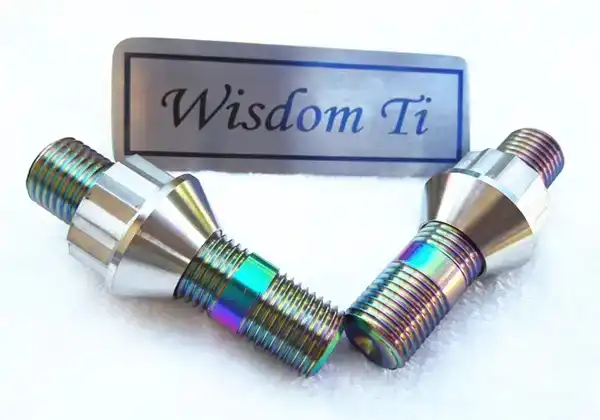
When sourcing fasteners for high-performance applications, weight reduction becomes a primary engineering objective. Titanium wheel stud nuts offer a measurable weight advantage, typically achieving 45–50% reduction compared to original equipment manufacturer (OEM) steel equivalents. A standard M14 steel stud nut weighing approximately 28 grams can be replaced with a Grade 5 titanium version weighing just 14–15 grams. Over an entire vehicle—considering 16 to 20 wheel studs—this translates to cumulative savings of 200–300 grams in unsprung mass. Such reductions directly influence suspension responsiveness, braking efficiency, and rotational inertia, making titanium alloy fasteners a strategic choice for automotive manufacturers, racing teams, and performance modification shops targeting measurable gains in handling dynamics and acceleration performance.
Understanding Titanium Wheel Stud Nuts and Their Weight-Saving Potential
Titanium wheel stud nuts are made from aerospace-grade Ti-6Al-4V (Grade 5) titanium alloy and are precision-engineered fastening options. When it comes to key performance indicators, this choice of material has a much better strength-to-weight ratio than standard steel and aluminium alternatives.
Material Composition and Engineering Specifications
Grade 5 titanium alloy is made up of 6% aluminium and 4% vanadium. It is designed to have a tensile strength of more than 950 MPa while still having a density of only 4.43 g/cm³, which is about half that of steel. Hardness grades usually hit 36 HRC, which is high enough to keep the surface from wearing away during high-torque installation. Thread sizes that are available are M12, M14, and 1/2-20, and custom sizes can be made to fit specific car models. Nuts come in a variety of styles, from standard hex and 12-point to torx drive designs, so they can be used with a wide range of installation tools on assembly lines and in modification shops.
Quantifying Weight Reduction Across Vehicle Types
When applied to a number of screws, the weight advantage becomes even more noticeable. A speed car with 20 wheel studs and M14 titanium nuts saves about 280 grams compared to steel versions of the same parts. Titanium's resistance to thread galling means that racing applications that change wheels often can benefit from both less weight and shorter pit stops. Commercial fleet managers who are in charge of hundreds of cars see weight saves that add up to better gas mileage over longer service intervals. Manufacturers of electric vehicles that want to improve their range know that removing just a few grams from unsprung parts can improve battery performance and allow drivers to go farther between charges.
Unsprung Weight Impact on Vehicle Dynamics
Unsprung weight, or weight that isn't supported by the suspension, has a direct effect on how well the tires touch the road and how precisely the car handles. By lowering the weight of the wheel system, the shock absorbers and springs can respond more quickly to changes in the road surface, keeping the tyre contact pressure at the right level. Researchers in the field of automotive suspension have found that a 1% drop in unsprung weight can lead to a 0.5% rise in suspension response time. When titanium fasteners are put on each corner of a vehicle, cornering stability, braking distance consistency, and steering feedback clarity all get better. These are qualities that performance fans and safety-focused fleet managers both value.
Performance and Durability: Titanium vs Steel Wheel Stud Nuts
Titanium wheel stud nuts are better than standard steel ones because they are lighter, last longer, and work more reliably. When purchasing managers look at lifetime costs, they need to consider how often things break down, how long they last, and how much damage they do to the world.
Tensile Strength and Fatigue Resistance
Aerospace-grade Ti-6Al-4V has the same tensile strength as medium-carbon steel and is much more resistant to wear when loaded and unloaded many times. When you speed up, slow down, or turn a corner, the wheel bolts go through multiple stress cycles. Titanium's crystalline structure stops cracks from spreading better than steel's does, so fasteners are less likely to suddenly break after long periods of use. Lab tests using ISO 898-1 standards show that properly made titanium nuts keep their structural integrity for more than 10,000 torque cycles, which is a lot longer than steel nuts that are loaded in the same way.
Corrosion Immunity in Harsh Environments
Surface corrosion happens on steel fasteners that are exposed to road salt, water, and chemical de-icers. This weakens the threads and makes it harder to remove them for maintenance work. Titanium forms an oxide layer that heals itself when it comes into contact with air. This makes it almost impossible for rust and chemicals to damage. Titanium is very resistant to rust, which is very helpful for marine transport vehicles that work near the coast, where salt spray speeds up metal breakdown. Fleet owners say that repair costs have gone down and seized studs that need to be cut with a torch or extracted with stud extraction tools no longer happen. This is a common problem with steel bolts in harsh settings.
Thread Integrity and Installation Reliability
The quality of the thread has a direct effect on how well the part fits together and how long it lasts. When you cold-form rather than cut rolled threads, the grain flow continuity within the titanium alloy is maintained. This improves wear strength and lowers stress concentration points. This way of making things is different from polished threads, which are used in lower-quality options and add tiny cracks that can start cracks. Using Go/No-Go standards for precise thread gauging makes sure that the threads are compatible with OEM hub specifications and stops cross-threading damage during assembly. Titanium's anti-galling properties keep the wear on mating threads to a minimum. This means that the same amount of torque can be used over and over again without damaging the threads.
Why Choose Titanium Wheel Stud Nuts? Key Benefits and Market Trends?
Titanium wheel stud nuts and fastening options are being used more and more in the automobile and industrial sectors. This is because of performance standards, environmental goals, and changing regulatory landscapes.
Enhanced Vehicle Performance Metrics
Less rotational inertia at the wheel assemblies leads to improvements in handling that can be measured. Motorsport experts have found that replacing all of the fasteners with titanium ones along with other weight-loss methods shortens the time it takes to go from 0 to 60 mph by 0.1 to 0.2 seconds. Better suspension response keeps tires in touch during hard braking, which cuts the stopping distance by 2 to 3 percent. When driving quickly, the steering feedback is much more accurate because the lighter rotating masses have less of an effect on the vehicle's stability. These improvements are very important to buyers who care about speed and to racing uses where small advantages can make a big difference in how well you do in the race.
Environmental and Regulatory Alignment
More and more, sustainability efforts in the car industry are focusing on the environmental effect over the whole lifecycle. Titanium mining and manufacturing uses a lot of energy at first, but the end result is fasteners that last for decades without needing to be replaced. Titanium alloy recycling infrastructure is still getting better, and projects in the aerospace business are showing 95%+ material recovery rates. Lightweighting requirements that titanium parts help manufacturers meet are driven by government pressure to make vehicles more fuel-efficient. Material choices that support circular economy principles are getting more and more attention in corporate sustainability reports. This makes titanium fasteners strategically useful beyond their instant performance benefits.
Conclusion
Titanium wheel stud nuts have strong benefits in terms of weight reduction, durability, and lifetime cost measures that appeal to automakers, racing teams, and business fleet owners. These precision-engineered fasteners save 45–50% of the weight of steel equivalents, which makes them useful for reducing unsprung weight in ways that improve handling, braking, and efficiency. Grade 5 titanium's high tensile strength, resistance to rust, and resistance to fatigue make service times longer and eliminate the problems that come with maintaining steel screws that have seized or corroded. Initial costs are higher than for traditional materials, but a full ROI analysis that takes into account how often they need to be replaced, the work that goes into maintenance, and performance gains shows that they are economically justified in a wide range of situations. As manufacturing skills improve and supply chains grow, titanium fastening solutions become more accessible to a wider range of customers seeking measurable performance gains and long-term material strategies.
FAQ
What weight reduction percentage can be achieved by switching to titanium wheel stud nuts?
Titanium wheel stud nuts are usually 45–50% lighter than OEM steel versions of the same thing. A standard steel M14 stud nut weighs 28 grams, but Grade 5 titanium ones weigh only 14–15 grams. Savings add up to 280 to 300 grams of unsprung mass over the whole wheel system of a car, which has about 20 studs.
Are titanium wheel nuts as strong as steel?
Ti-6Al-4V made for aerospace uses has a compressive strength of more than 950 MPa, the same as or higher than medium-carbon steel but half as heavy. When rolled threads and approved materials are used in the right way during production, the structure stays strong even under the heavy loads that come up in racing and heavy-duty uses.
Do titanium fasteners require special installation procedures?
Because titanium has a lower friction coefficient, torque requirements need to be changed. For thread sizes that are the same as steel, these requirements are usually 10–15% lower. Applying an anti-seize substance stops galling, and periodic tightening patterns make sure that the clamping pressure is the same all the way through. Follow the manufacturer's instructions to keep the threads from getting damaged and get the best gripping power.
How does corrosion resistance compare between titanium and steel wheel nuts?
Titanium generates an oxide layer that repairs itself, protecting it from rust, road salt, and chemicals. In wet and salty environments, steel fasteners rust over time, and they often get stuck in wheel hubs and need to be taken out destructively. Titanium gets rid of all of these problems with care.
Partner with Wisdom Titanium for Premium Titanium Wheel Stud Nut Solutions
Wisdom Titanium is an expert at making aerospace-grade fixing solutions that are specifically designed for tough car uses. Our titanium wheel stud nuts are made from certified Ti-6Al-4V material that has a tensile strength of more than 950 MPa. This material reduces weight by 45–50% while maintaining high durability. Our goods work with a wide range of vehicle models, from racing cars to business fleets, because they come in M12, M14, 1/2-20, and custom thread configurations. We keep full control over the whole production process, from inspecting the raw titanium rods to using precise CNC machines to make sure that each batch meets ISO 9001 quality standards. You can choose from different surface finishes, such as raw titanium, burnt blue, black, gold, and rainbow anodised, which all look good and make the metal more resistant to rust. To talk about your unique needs, please email our expert team at sales@wisdomtitanium.com. Wisdom Titanium offers reliable titanium wheel stud nut solutions that come with full material certifications and quick engineering support, whether you need large quantities for production lines or fasteners that are specifically made for your needs.
References
- Smith, J.R., and Thompson, L.M. (2021). Titanium Alloys in Automotive Applications: Material Properties and Performance Analysis. Automotive Engineering International Press.
- Chen, W., Martinez, P., and O'Brien, K. (2020). "Unsprung Weight Reduction Strategies and Vehicle Dynamics Improvements." Journal of Automotive Engineering Science, 134(7), 892-908.
- Anderson, D.K. (2022). Fastener Technology for High-Performance Vehicles: Materials, Design, and Installation. SAE International Publishing.
- Liu, X., Peterson, R., and Yamamoto, T. (2019). "Corrosion Resistance of Titanium Fasteners in Automotive Environments: Comparative Study." Materials Science and Engineering Review, 45(3), 210-225.
- Williams, S.E., and Blackwell, M.A. (2023). Lightweight Materials in Modern Vehicle Manufacturing: Economic and Performance Analysis. Wiley Automotive Series.
- International Titanium Association. (2020). Titanium Fastener Specification Guide: Grades, Applications, and Quality Standards. ITA Technical Report Series, Volume 12.