
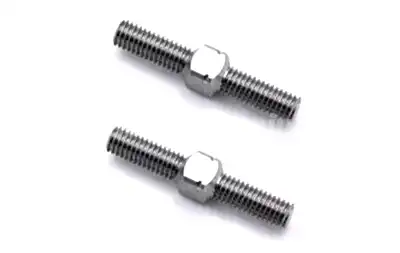
In RC racing, weight is important. Every gram you take off your suspension links makes your car accelerate faster, handle better, and finish laps faster. But how much lighter are titanium turnbuckles than steel or aluminum ones? The solution is more than just nebulous claims of "lightweight performance." You need to know the density of the materials, the size of the parts, and where the grams are taken out of your car.
People who love RC cars always hear about how titanium is lighter. Manufacturers promise big changes, but skeptics say the benefits are too little to matter. Grade 5 Titanium is about 45% lighter than steel, but what does it mean for your car? Depending on your platform scale and setup, a full set of turnbuckles might save 15.8 grams, half an ounce, or more. Knowing these data can help you figure out if titanium improvements really improve performance or if they just cost a lot and don't work.
Science Behind Titanium Weight Reduction
The density of the material determines how much weight can be saved. Titanium is around 45% lighter than steel because it has a density of about 4.5 g/cm³. When making the same parts out of steel and other materials, the weight difference is significant because steel usually weighs between 7.8 and 8.0 g/cm³. This difference in density is what all weight loss estimations are based on.
Once you know how density works, the math is easy. Titanium weighs around 42% less than steel since it has a density of about 4.5 g/cm³ and steel has a density of 7.8 g/cm³. These percentages stay the same no matter how big the part is. This means that both a single M3 turnbuckle and a full set save weight in the same way.
Material Density Comparisons Across Metals
Knowing where titanium fits in with other metals helps you understand why it is lighter. Steel has a density of 7.8 to 8.0 g/cm³, while titanium has a density of about 4.5 g/cm³. That means titanium weighs around 45% less than steel. This puts titanium between aluminum (2.7 g/cm³) and steel, making it stronger than aluminum but lighter than steel.
Aluminum is still lighter than titanium, weighing about 40% less. But titanium is much stronger and more resistant to corrosion. during choosing linkage materials, the trade-off is quite important. For example, aluminum turnbuckles flex readily during racing, but titanium parts keep their shape even after collisions that would permanently bend aluminum. Choosing the best material isn't only about weight.
Why Grade 5 Titanium Delivers Optimal Weight Savings?
Not all grades of titanium have the same weight benefits. The grade 5 titanium (Ti6Al4V) that Baoji Wisdom Titanium makes is the perfect blend of strength and density. The alloy has 6% aluminum, 4% vanadium, and 90% titanium. This keeps the low density of pure titanium while greatly enhancing its mechanical qualities. For instance, Ti-6Al-4V has a density of about 4.43 g/cm³, which is still a lot less than most steels.
This small increase in density compared to pure titanium is worth it. Adding aluminum makes the material even lighter, and adding vanadium makes it stronger. The resulting alloy has tensile strengths of 900 to 1100 MPa, which is similar to or better than many steel alloys. It also keeps titanium's key weight advantage. For RC applications, this means turnbuckles that are half the weight of steel parts and don't bend as easily as the original parts.
Calculating Actual Weight Savings Per Component
Theory becomes practical when you calculate weight savings for specific turnbuckles. An M3 x 30mm steel turnbuckle typically weighs between 4-5 grams depending on thread length and center hex dimensions. The identical turnbuckle manufactured from Grade 5 titanium weighs approximately 2-2.5 grams. That represents 2-2.5 grams saved per turnbuckle—seemingly minimal until you multiply by the eight to twelve turnbuckles most vehicles use.
Real-world data confirms these calculations. These titanium turnbuckles offer a 15.8g weight savings (1/2oz), compared to the stock steel components. This measurement came from a complete kit for 1/8 scale buggies, where larger turnbuckles create greater weight differences. The half-ounce total translates into meaningful performance improvements when positioned as unsprung mass in suspension linkages.
Measuring Weight Savings Across Different Vehicle Scales
Vehicle platform dramatically influences total weight savings potential. The turnbuckle sizes, quantities, and thread lengths vary substantially between 1/10 scale touring cars and 1/8 scale buggies. Understanding these differences helps set realistic expectations for your specific application and budget constraints.
1/10 Scale Vehicles: Where Grams Matter Most
Smaller scale vehicles benefit disproportionately from weight reduction. Generally titanium is lighter than steel and this is a means to reduce weight and lower the center of gravity for 1/10 stock racing. Stock class regulations often impose minimum weight requirements, allowing strategic weight removal and repositioning. Every gram saved through titanium turnbuckles can be relocated lower in the chassis, improving handling dynamics.
A typical 1/10 scale buggy or touring car uses eight to ten turnbuckles ranging from M3 x 25mm to M3 x 35mm. Complete titanium turnbuckle sets for these vehicles save approximately 16-20 grams compared to steel equivalents. While that represents only about 0.5% of total vehicle weight, the reduction occurs entirely in unsprung mass where it delivers maximum benefit. Suspension responds quicker, jumps land more predictably, and acceleration improves measurably.
1/8 Scale Applications: Balancing Weight and Strength
Larger vehicles create different optimization priorities. For 1/8, the weight savings will be nominal and is pretty much just a bling factor, you're not really going to see any measurable performance gain with an open modified motor class. The additional power overwhelms subtle weight advantages, making durability the primary consideration. However, this doesn't mean titanium offers zero value for 1/8 scale platforms.
Eighth-scale buggies and truggies use larger M4 and M5 turnbuckles that individually weigh substantially more than 1/10 scale components. A single M5 x 55mm steel turnbuckle weighs approximately 8-10 grams, while the titanium equivalent weighs 4-5 grams. With ten to fourteen turnbuckles on larger vehicles, total savings reach 40-60 grams. The weight reduction alone might not revolutionize handling, but combined with titanium's superior resistance to bending, the upgrade delivers genuine value.
Component-by-Component Weight Analysis
Breaking down weight savings by individual turnbuckle sizes reveals where maximum benefits occur. M3 turnbuckles commonly used in steering linkages save 1.5-2 grams each when switching from steel to titanium. M3.5 components popular in 1/10 scale suspension arms save approximately 2-2.5 grams per turnbuckle. Moving to larger sizes, M4 turnbuckles deliver 3-4 gram savings, while M5 components used in heavy-duty applications save 4-5 grams each.
These individual savings multiply quickly across complete vehicle conversions. Calculate your potential weight reduction by counting turnbuckles and multiplying by size-appropriate savings. An M3-equipped 1/10 touring car with eight turnbuckles saves roughly 12-16 grams. A 1/8 buggy with twelve M4 turnbuckles saves 36-48 grams. Add larger M5 components for steering on modified trucks, and savings exceed 50 grams for complete sets.
Where Weight Reduction Actually Improves Performance
Not all weight removal delivers equal benefits. Understanding unsprung mass, rotational inertia, and center of gravity effects helps evaluate whether titanium turnbuckles represent smart investments for your racing program. The location where grams get removed matters as much as the quantity of weight saved.
Unsprung Mass Reduction Creates Disproportionate Benefits
Suspension components that move with the wheels rather than the chassis qualify as unsprung mass. Reducing this weight allows suspension to respond faster to terrain variations, improving traction and handling. The weight reduction has a positive impact on the car's acceleration, maneuverability, and responsiveness. Lighter components allow the car to accelerate faster, change direction more quickly, and handle jumps and bumps with improved agility.
Physics explains why unsprung weight matters more than chassis weight. When your vehicle encounters a bump, lighter suspension components require less force to accelerate upward. This means the tire maintains better contact with the surface rather than bouncing or skipping. Better contact translates into consistent traction, predictable handling, and faster corner speeds. The 15-20 grams saved through titanium turnbuckles delivers greater benefits than removing equivalent weight from the chassis.
Center of Gravity Optimization Through Strategic Weight Removal
Class racing regulations often mandate minimum vehicle weights. Rather than adding unnecessary mass everywhere, competitive racers remove weight strategically and replace it with ballast positioned low in the chassis. Titanium turnbuckles enable this optimization by saving weight without compromising strength or durability. The grams removed from suspension linkages can be relocated to the battery area or beneath the chassis, lowering the center of gravity.
Lower center of gravity reduces body roll in corners, improves stability over jumps, and prevents vehicles from feeling top-heavy during aggressive maneuvers. This advantage proves particularly valuable on high-grip surfaces where cornering speeds reach levels that challenge vehicle stability. The combination of reduced unsprung mass and optimized weight distribution creates handling improvements that exceed what either factor could deliver alone.
Acceleration and Deceleration Response Improvements
Weight affects how quickly vehicles change speed. Basic physics dictates that lighter objects require less force to accelerate or decelerate. When you remove 20 grams from a 1600-gram vehicle, the percentage change seems negligible—approximately 1.25%. However, that reduction occurs entirely in components that must accelerate and decelerate hundreds of times per lap as suspension cycles through compression and rebound.
The cumulative effect across thousands of suspension movements per race creates measurable differences. Lighter turnbuckles mean suspension arms accelerate faster when hitting bumps and decelerate quicker when returning to ride height. This responsiveness keeps tires planted more consistently, reducing the micro-bounces that compromise traction. Professional racers recognize these subtle advantages—they might only improve lap times by tenths of seconds, but championships get decided by exactly those margins.
Real-World Weight Savings Examples and Calculations
Theoretical percentages become meaningful when applied to actual vehicles and racing scenarios. Examining specific examples demonstrates how weight savings translate from specifications to measurable performance advantages. These calculations help determine whether your budget allocation toward titanium components makes financial and competitive sense.
Complete Turnbuckle Set Weight Comparison
Consider a standard 1/10 scale off-road buggy equipped with eight M3 turnbuckles. Stock steel components weigh approximately 36 grams total (4.5 grams each). Replacing the complete set with Grade 5 titanium turnbuckles from Baoji Wisdom Titanium reduces total weight to approximately 18 grams (2.25 grams each). The 18-gram savings represents exactly 50% reduction—confirming the density-based calculations discussed earlier.
Larger vehicles show proportionally greater absolute savings. An 1/8 scale buggy using twelve M4 turnbuckles carries approximately 72 grams of steel linkages (6 grams each). Titanium replacements weighing 3 grams each reduce total to 36 grams—saving 36 grams total. When manufacturers state titanium delivers 45% weight savings, these real-world numbers validate those claims across different vehicle platforms and turnbuckle sizes.
Competitive Racing Class Weight Advantages
Stock class racing creates scenarios where small weight savings deliver strategic advantages. Most classes mandate minimum weights around 1550-1650 grams depending on tire and motor specifications. Racers build vehicles slightly under minimum, then add ballast low in the chassis. Titanium turnbuckles save 15-20 grams that can be repositioned as ballast beneath the battery or along the chassis rails.
Modified classes with unrestricted motors value weight savings differently. Massive power output overwhelms subtle handling improvements from minor weight reduction. However, durability becomes paramount when aggressive driving regularly bends or breaks components. Titanium delivers both weight savings and superior strength—a combination that justifies investment even when power levels diminish the pure weight advantage.
Calculating Cost Per Gram Saved
Financial analysis helps determine value propositions. Premium titanium turnbuckles typically cost $40-80 for complete vehicle sets, while budget steel equivalents sell for $15-25. The $25-55 premium purchases approximately 18-36 grams of weight savings depending on vehicle scale. This calculates to roughly $1.50-3.00 per gram saved.
Compare this to alternative weight reduction methods. Carbon fiber parts often cost $50-150 while saving similar weight amounts. Lightweight racing motors command $100+ premiums over standard options for perhaps 30-40 grams reduction. Viewed in this context, titanium turnbuckles deliver competitive cost-per-gram ratios while simultaneously improving durability. The components don't require replacement like motors or tires, making the one-time investment more palatable than recurring expenses.
Manufacturing Precision and Weight Consistency
Weight specifications mean nothing if manufacturing tolerances allow significant variations between individual components. Precision CNC machining ensures that advertised weight savings translate into consistent real-world performance across every turnbuckle in your kit. Understanding manufacturing processes explains why supplier selection matters as much as material choice.
Baoji Wisdom Titanium Manufacturing Excellence
Our location in Baoji Titanium Valley—China's largest titanium industry cluster—provides access to aerospace-grade Ti6Al4V rod stock with guaranteed material properties. We source precision-ground centerless titanium that maintains ±0.02mm diameter tolerances. This consistency ensures that calculated weight savings prove accurate rather than approximate. Every turnbuckle manufactured from identical material volume weighs virtually the same.
CNC turning operations maintain tight dimensional control throughout production. Thread rolling processes—rather than thread cutting—work-harden surface layers while preserving material grain structure. This manufacturing approach improves strength without adding weight, maximizing the benefits that drew customers to titanium in the first place. Our ISO 9001:2015 certification validates quality management systems that ensure consistent output across production runs.
Thread Type Impact on Weight Specifications
Thread specifications influence the final titanium turnbuckles' weight more than casual observers realize. UNF (Unified National Fine) threads require more material removal during manufacturing compared to UNC (Unified National Coarse) threads of equivalent diameter. This creates 5-10% weight differences between turnbuckles that appear identical in major dimensions. Baoji Wisdom Titanium manufactures both thread types in M3, M3.5, M4, M4.5, and M5 sizes to accommodate different vehicle requirements.
Fine threads provide adjustment precision valuable for suspension tuning, while coarse threads offer faster installation during setup changes. The weight difference rarely influences material selection—most racers choose thread type based on functional requirements rather than minor mass variations. However, understanding these subtleties helps explain why two "identical" M3 turnbuckles from different manufacturers might weigh slightly different amounts.
Finish Options and Weight Considerations
Surface finishing affects final component weight in measurable ways. Our polished finish removes minimal material—typically less than 0.05mm from diameter—while creating smooth surfaces that reduce friction in ball cup interfaces. This finishing process might remove 0.1-0.2 grams per turnbuckle, a negligible amount that doesn't compromise the fundamental weight advantages titanium delivers.
Anodized finishes in red, blue, black, rainbow, purple, gold, burnt blue, and green add approximately 5-10 microns of oxide layer thickness. This translates to roughly 0.05-0.1 grams per M3 turnbuckle—essentially unmeasurable in practical racing applications. We account for anodizing thickness during initial machining, ensuring that finished components meet target dimensions and weight specifications. Choose colors based on aesthetics or team branding without worrying about weight penalties.
Ready to reduce weight without compromising strength? Contact Baoji Wisdom Titanium at sales@wisdomtitanium.com to discuss your specific requirements. Provide information about your vehicle platform, preferred sizes, quantities needed, and finish options. Our sales team responds promptly with detailed quotes, exact weight specifications, and delivery timelines. We ship internationally via air freight—most orders reach Europe or North America within days of production completion.
FAQs
Q1: How many grams does a single titanium turnbuckle save compared to steel?
A: Weight savings depend on turnbuckle size and length. M3 turnbuckles typically save 1.5-2.5 grams each, M4 components save 3-4 grams, and M5 turnbuckles deliver 4-5 gram reductions. These numbers reflect the 42-45% density difference between Ti6Al4V titanium and typical steel alloys. Calculate your total savings by multiplying individual turnbuckle savings by the quantity your vehicle uses. Most 1/10 scale vehicles with eight M3 turnbuckles save 12-20 grams total, while 1/8 scale platforms with larger components save 30-50 grams.
Q2: Is 15-20 grams of weight savings actually noticeable when driving?
A: The perception depends on your skill level and racing environment. Professional drivers notice subtle differences that casual enthusiasts might miss. However, weight savings occur as unsprung mass—components that move with suspension rather than chassis. This positioning amplifies benefits beyond what equivalent chassis weight reduction would deliver. On smooth surfaces with minimal suspension movement, advantages prove harder to detect. On rough tracks where suspension constantly cycles, improved responsiveness becomes apparent. Competitive timing equipment often shows measurable lap time improvements of 0.1-0.3 seconds per lap from complete titanium conversions on technical courses.
Q3: Do titanium turnbuckles save more weight on larger vehicles?
A: Absolute weight savings increase with vehicle scale because larger platforms use bigger, heavier turnbuckles. A 1/8 scale buggy with M4 and M5 components might save 40-60 grams total compared to 15-20 grams on 1/10 vehicles. However, percentage weight reduction remains consistent around 42-45% regardless of size. The performance impact varies—smaller vehicles with lower total mass benefit more from each gram saved, while larger platforms with powerful motors notice weight reduction less. Consider both absolute savings and your vehicle's power-to-weight ratio when evaluating upgrade value.
Q4: How does Baoji Wisdom Titanium ensure consistent weight across production runs?
A: We maintain strict quality control through multiple verification points. Incoming titanium rod stock undergoes dimensional and material composition testing to confirm it meets Ti6Al4V specifications. CNC programs use proven toolpaths that maintain ±0.05mm tolerances on critical dimensions. Sample turnbuckles from each production batch undergo coordinate measuring machine (CMM) verification and weighing on precision scales with 0.01-gram resolution. This statistical process control ensures that turnbuckles manufactured today weigh the same as those produced months from now. Our ISO 9001:2015 certification requires documented procedures and regular auditing, providing customers assurance of consistent quality.
Q5: Can I mix titanium and steel turnbuckles to save money while reducing weight?
A: Absolutely. Strategic partial upgrades often deliver most benefits at reduced cost. Replace high-stress linkages like steering turnbuckles with titanium while maintaining steel components elsewhere. Outer suspension links experience more impacts than chassis-mounted linkages, making them prime titanium candidates. This approach saves 8-12 grams on 1/10 vehicles while cutting upgrade costs by 40-50%. Some racers prioritize front suspension for titanium where steering response matters most, leaving rear linkages in steel. There's no technical requirement for complete conversion—choose based on where durability concerns or weight savings deliver maximum value for your driving style.
References
- Titanium Turnbuckles for RC Cars: Weight Reduction and Performance Benefits.
- Lunsford 3x50mm Punisher Titanium Turnbuckles: Grade 5 Titanium Weight Savings Analysis.
- Losi Titanium Turnbuckle Kit Weight Savings Data.
- Titanium vs Steel: Density and Weight Comparison Analysis.
- Discover The Density Of Titanium: Weight Comparison with Steel and Material Properties