
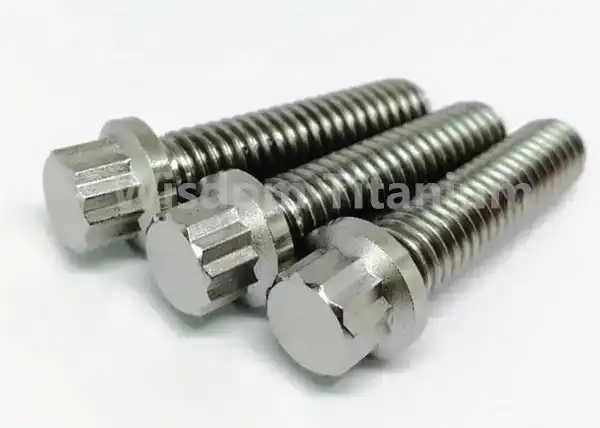
Titanium beadlock bolts usually save about 40 to 45 percent of fastener weight compared with steel bolts of the same shape. Grade 5 titanium has a density near 4.43 g/cm³, while steel sits near 7.85 g/cm³. In our size estimates, a 5/16-18 titanium bolt saves about 4 grams per inch of shank, so a wheel with 24 bolts could shed roughly 100 grams. Real results change with bolt length, head style, and washers. In this guide, we explain the math, compare materials, review strength, and show what to check before you order from Wisdom Titanium.
How Much Weight Can Titanium Beadlock Bolts Save?
The Density Math Behind the Savings
Titanium beadlock bolts typically weigh 40 to 45 percent less than steel bolts of the same size and shape. Grade 5 titanium is only 4.43 g/cm³ dense, while steel is about 7.85 g/cm³ dense. We think that a 5/16-18 titanium bolt can save you about 4 grams per inch of shank. This means a wheel with 24 bolts might be able to save about 100 grams. What really happens is based on the bolts' length, style, and number of nuts. In this guide, we'll talk about math, compare materials, talk about strength, and show you what to look for before you order from Wisdom Titanium.
Which tells you how much something weighs. The manual says that Grade 5 titanium (Ti-6Al-4V) is 4.43 g/cm³. Aluminum is about 2.7 g/cm³, steel is about 7.85 g/cm³, and stainless steel is between 7.9 and 8 g/cm³. If the titanium bolt stays the same shape as the steel bolt, it will save you 1 − (4.43 ÷ 7.85), which is about 44%.
Any kit with two recipes will do. The initial weight less the titanium's weight is the weight that was saved. To get the percentage drop, divide the weight that was lost by the weight that was started by 100. For the same shape, set the top at 44%. It's best to weigh whole sets because the final number can change based on the lengths, heads, and screws that are used.
Example Savings for 1/4-20 and 5/16-18 Bolts
I'll make an educated guess. A stable cylinder that is an inch long and 5/16 of an inch thick will weigh about 5.6 grams of titanium and 9.9 grams of steel. That's about 4.3 grams less than before. They weigh about 3.6 grams and 6.3 grams at a width of 1/4 inch, which is about 2.7 grams less.
Real bolts will be different from these numbers because they don't include the washers, the head, or the thread root. The size will still work. There are 24 5/16-18 bolts on this wheel, and each one has a one-inch shank. About 100 grams would be saved. Having four wheels would cut down on weight by 400 grams. A titanium washer costs a little less than a steel washer. Send us the item's exact length and weight.
Why Rotating and Unsprung Mass Matter?
There are beadlock nuts close to the outside of the wheel. The mass makes the circle spin more slowly as it moves farther away from the center. This is because the moment of inertia goes up as the radius squared. For the suspension to work, the wheel mass has to be kept in check. If there is less of it, it can help the tire stick to the ground.
But we need to be clear about the size. Titanium won't make a heavy wheel lighter because the wheel's bolts aren't what make it heavy. It helps you lose weight better when you use it with a plan. It also gives your clients an improvement they can see, touch, and think about at home.
Titanium Beadlock Bolts vs. Steel, Stainless Steel, and Aluminum
Steel: Low Cost, Highest Weight
A lot of wheels are still made of steel. Some titanium beadlock bolts kits have 25 Grade 8 screws and nuts in them. SAE J429 says that Grade 8 bolts must have a tensile strength of at least 150 ksi, which is around 1,034 MPa. That is strong and doesn't cost a lot.
It wears out faster and costs more. Grade 5 titanium is about 77% denser than steel. Steel that has been plated or coated can rust if the finish comes off on trails or roads with a lot of salt. It works well for cheap builds or wheels that can only be made from steel. Titanium is a better choice when both weight and rust resistance are important.
Stainless Steel: Corrosion Resistance Without Weight Savings
Stainless steel doesn't rust, so it's better than regular steel when it gets wet or dirty. Since its mass is about the same as carbon steel, it doesn't really make things lighter. It is known that some popular kinds of steel fasteners, such as A2-70 under ISO 3506, can pull apart at least 700 MPa. It's not as good as Grade 8 steel.
Steel threads can also gall when they get dry. Even though it costs more per unit, Grade 5 titanium can protect against rust and make things lighter. Stainless steel might be enough for someone who only needs to protect against rust. Not the name of the material, but the grade that fits the load is more important.
Aluminum: Lightest, but Limited
Aluminum is about 2.7 g/cm³ lighter than titanium. What's wrong is strength. The tensile strength of most 6061-T6 metals is only about 310 MPa, which is not nearly as strong as Grade 5 titanium. Also, aluminum threads break more easily and can change shape after being tightened a lot of times.
If you want to use aluminum for beadlock bolts, you should know that they are subject to a lot of vibration and clamp load. Titanium is the choice in the middle. Steel weighs a lot more than this and isn't nearly as strong. Before you change the materials, you should always look at the list of acceptable parts that came with the wheel.
Titanium Beadlock Bolt Strength: Grade 5 vs. Grade 9
Grade 5 (Ti-6Al-4V)
Grade 5 titanium beadlock bolts metal is used most of the time. Vanadium makes up 4% of it and aluminum makes up 6%. ASTM B348 says that Grade 5 bar needs to have a tensile strength of at least 895 MPa and a yield strength of at least 825 MPa. To make sure that the values given are correct, we recommend that you get mechanical test data on your lot.
To keep things together in spacecraft and race cars, this alloy is used because it is strong, doesn't rust, and has a low density. All of our 1/4-20 and 5/16-18 nuts are made from grade 5 titanium. They are made from titanium rod and are checked before they are sent out.
Grade 9 (Ti-3Al-2.5V)
A little over 3% of Grade 9 is aluminum, and 2.5% is vanadium. The least strong grade on ASTM B348 is 620 MPa, which is not even close to Grade 5. Because it's easy to shape, it's often used to make tubes for bike frames and airplane hydraulic lines. Also, it doesn't rust quickly.
Because it is stronger, Grade 5 is generally the best choice for a bolt that holds a beadlock ring in place under clamp load. For less heavy-duty gear, Grade 9 might work. Our beadlock bolts are all Grade 5, so you only have to test and keep track of one clear specification.
Strength Is More Than the Grade Number
A bolt can only be put in a joint. The preload, the length of the grip, the shape of the head, and the shape of the washer set the level of how well the joint holds. Besides that, titanium is not as stretchy as steel. The stretchiness of Ti-6Al-4V is only 114 GPa, while steel's is 200 GPa. Being able to stretch more when the load stays the same changes how torque turns into clamp force.
So, we recommend that you use a sample set on the real wheel. Check the fit, torque, and thread fit before giving the go-ahead for a run. If you look at Bickford's work on bolted joints, you can learn a lot about how preload and joint stiffness work.
Titanium Beadlock Bolt Sizes, Styles, and Order Details
Available Sizes: 1/4-20 and 5/16-18
We have sizes 1/4-20 and 5/16-18. The smaller bolt has 18 threads per inch, while the larger one has 20. The uni-thread coarse is used by both. We do a lot of custom CNC work, so the length can be made to match your example or plan.
An M8 bolt is about the same size as a 5/16-inch bolt, and an M6 bolt is about the same size as a 1/4-inch bolt. But these titanium beadlock bolts flange bolts can't be used with metric threads. Don't change the size of a wheel until the company that made it says it's okay. You can send us a picture or a 3D model, and we'll talk about thread fit and head height.
Head Styles: Hex Flange, 12-Point Flange, Inner 12-Point, and Torx
We have four kinds of heads. You might not need a separate washer for hex flange heads because they already have a washer face that spreads the load. The wrench has more chances to connect with the 12-point base, which is helpful when it's close to the ring. With inner 12-point heads that use an internal drive, the profile is not as high. The tool is less likely to slip and go around the drive because Torx heads don't let the cam out.
Pick the style based on how your customers take care of their wheels and how simple it is for them to get to the tools. A flange head can make the whole kit lighter when it's used instead of a screw.
MOQ and Sampling: 200 Pieces Each
To fill an order, we need at least 200 of each size and style. That way, a new company can test out a style on a single head size before deciding to make a whole line. It's simple to do things this way: check the drawing first, then approve a sample, and finally make 200 pieces as a test run.
We keep standard parts and raw materials in stock at set prices. Our own research and development team can also make parts based on what you suggest or show us. Everybody uses ISO 9001. That helps when your launch window changes because racing season is over.
Installation, Cost, and Choosing a Supplier
Installation, Torque, and Corrosion
Use a torque wrench with a gage to tighten the nuts in steps, making a cross pattern. Clean the wheel and ring and make sure the threads fit. Titanium beadlock bolts can break if the threads dry out or if parts are put together too many times. Use a lube or anti-seize that the company that made the wheel says is okay. When lubricant is used, the relationship between torque and preload changes, so use the given torque number in that case.
Titanium is less likely to rust than aluminum, but it is more likely to conduct electricity. If salt and water get stuck around an aluminum wheel, they can damage the aluminum near the bolt. Check the seats and wash the wheel after salty rides.
Is the Higher Price Worth It?
Don't look at the unit price when you compare prices. Instead, look at the whole amount. It matters how much customers are willing to pay, how much weight they want to lose, and how often they need to replace things because of corrosion. People who make UTVs, race teams, and high-end wheel brands often make the most money because people pay attention to the weight and finish.
Steel or stainless steel wheels are still the best choice when money is tight, they need to be used a lot, or they can only be made of steel. You need to guess how much each gram saved will cost. Divide the extra cost of a titanium set by the number of grams it takes away. Then, check that number against what your clients expect.
Supplier Checklist
Any company that sells titanium wheel nuts should be judged by this list. Each point is about a different risk that comes with buying.
- Material proof: Ask for a mill certificate that has the lot's Grade 5 chemistry and technical data on it, along with a heat number that links each batch to its copper rod. Since our bolts are made from titanium rod and are carefully checked before being sent out, we're glad to hear these requests during the quote stage.
- Dimensional control: How do they check the head height, flange width, and drive depth? It's important to know what thread standard the provider checks against. To make sure it works with your wheel and ring, ask for a sample set and test it first. It costs a lot less to fix fit problems in a sample set than in a whole lot.
- Quality system and lead time: Look for ISO 9001 certification and a written way for review. Find out if the raw materials are easy to get and if the prices are stable. During busy times, having supplies on hand cuts down on wait time. Order a few weeks before the months you think you will sell the most. Write down how long it takes to get samples and make the whole thing.
If you do these checks, there is less chance of problems with fit, materials being mixed up, and shipments being late.
About Wisdom Titanium and Baoji Titanium Valley
With its ISO 9001 certification, Wisdom Titanium has been in business since 2016 and makes and sells both standard and custom CNC parts. We are in Shaanxi Province's Baoji Titanium Valley. The biggest and best titanium industry cluster in China is here. This is one of the most important places in the world to make titanium. As part of the local industry chain are titanium flakes, bars, plates, tubes, forgings, and high-performance titanium alloys.
We can keep prices and stock stable because we can get raw materials. We work with people in flight, medicine, the marine industry, cars, motorbikes, and bikes to make fasteners out of nickel, tantalum, and zirconium.
Conclusion
Steel bolts of the same shape weigh about 40% to 45% more than titanium beadlock bolts of the same form. This is because steel is dense at 7.85 g/cm³ and Grade 5 titanium is only 4.43 g/cm³. Because they save about 4.3 grams per inch of 5/16 shank and 2.7 grams per inch of 1/4 inch, we think wheels may save a few hundred grams. When it comes to weight, steel stays cheaper, stainless steel doesn't rust, and aluminum is lighter but not as strong. The joint works better or worse depending on the loading, the thread fit, and the shape of the head. Grade 5 is stronger than Grade 9. Be sure to use the right amount of torque, an approved lubricant, and watch out for aluminum that comes into contact with the metal. Samples that have already been weighed give the most accurate weight readings.
FAQ
How much lighter are titanium bolts than steel bolts?
Grade 5 titanium is about 44% lighter than steel, even though they look the same. How much you save is based on the screws, head style, and length.
Is Grade 5 titanium stronger than Grade 9?
This is what ASTM B348 says. Grade 5 bars must have a tensile strength of at least 895 MPa and Grade 9 bars must have a tensile strength of at least 620 MPa.
Do titanium bolts need anti-seize?
Yes, most of the time. Titanium can gall when put together dry or over and over, so let the wheel maker tell you what lubricant to use and how much torque to use.
What sizes and styles do you offer?
They come in 1/4-20 and 5/16-18 sizes and have hex flange, 12-point flange, inner 12-point, and Torx heads. There is a minimum order of 200 pieces.
Can I replace steel bolts with titanium on any wheel?
Instead, you should talk to the wheel maker first. Each wheel maker has different rules about approval, size, and pressure.
Get Titanium Beadlock Bolts Samples and Weight Data from Wisdom Titanium
We'll look over your work once you send us your model, the bolt size, the length, and the steel's current weight. This is our Baoji company. We make titanium beadlock bolts and have ISO 9001 certification. We have Grade 5 titanium in 1/4-20 and 5/16-18 sizes, with four different head styles and a 200-piece minimum order for each. You can go to wisdomtitanium.com or email sales@wisdomtitanium.com to ask for samples and measured weights.
References
- ASTM International, Standard Specification for Titanium and Titanium Alloy Bars and Billets (ASTM B348), 2019
- SAE International, Mechanical and Material Requirements for Externally Threaded Fasteners (SAE J429), 2014
- ASM International, ASM Handbook Volume 2: Properties and Selection: Nonferrous Alloys and Special-Purpose Materials, 1990
- Donachie, M. J., Titanium: A Technical Guide, 2nd Edition, ASM International, 2000
- Leyens, C. and Peters, M., Titanium and Titanium Alloys: Fundamentals and Applications, Wiley-VCH, 2003
- Bickford, J. H., Introduction to the Design and Behavior of Bolted Joints, 4th Edition, CRC Press, 2007