
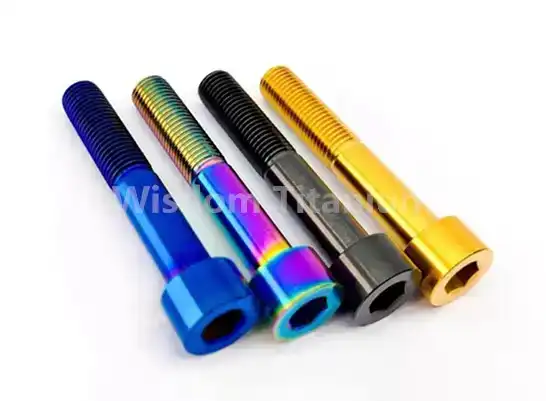
If you manage procurement for an industrial fastener distribution business, you already know that material choice directly affects your downstream customers' product performance, shipping costs, and long-term reliability. One question I hear consistently from engineers and supply chain managers is this: just how much lighter are titanium Allen head bolts compared to steel? The answer matters more than most people realize. This guide walks through the weight difference in concrete numbers, breaks down why it matters across aerospace, automotive, marine, and energy applications, and gives you the procurement context needed to make a well-informed sourcing decision.
Understanding Titanium Allen Head Bolts
Material Composition and Grades
Titanium allen head bolts are mostly made from two types of alloy: Grade 5 titanium (Ti-6Al-4V), which is a titanium alloy, and Grade 2 titanium. The tensile strength of Grade 5, which is made up of 90% titanium, 6% aluminum, and 4% vanadium, is above 950 MPa, which puts it fully in the high-performance fastener group. Grade 2 is good for applications that don't require a lot of mechanical strength and where resistance to corrosion is the most important thing.
Standard Sizes and Thread Specifications
The sizes of these fasteners range from M1.6 to M18, and they meet the thread standards for DIN 912, DIN 6921, DIN 6923, and ISO. This standardization is a real operational benefit for industrial distributors who manage stock in more than one market. Threads are usually rolled instead of cut, which makes them more resistant to fatigue. This is important in places with cyclic loads, like automotive or marine assemblies.
Surface Treatment Options
Titanium screws can have different finishes on their surfaces based on the job. Physical Vapor Deposition (PVD) coating makes the surface harder and lowers the risk of galling. Anodizing gives things colors that make them easy to find and adds a thin oxide layer that makes them even more resistant to corrosion. Both treatments can be used on Grade 5 and Grade 2 products without changing their size limits.
How Much Lighter Are Titanium Allen Head Bolts Compared to Steel?
Titanium Allen head bolts weigh about 40–45% less than carbon steel bolts of the same size and shape, and about 40–45% less than 304 stainless steel bolts of the same size and shape. Titanium is lighter than steel because it has a density of 4.51 g/cm³ compared to 7.85 g/cm³ for steel. When purchasing managers look at big orders, this means measurable logistics savings, less structural load on finished product assemblies, and a way to stand out in markets where weight is important.
The Numbers Behind the Weight Gap
To give you an idea of how much they weigh, an M8 × 25mm Grade 5 titanium socket cap bolt weighs about 3.5 grams, and a carbon steel one weighs about 6 grams. Out of a lot of 10,000 pieces, that difference adds up to almost 25 kg less weight per package. This is a very important thing to think about in aerospace, where the weight of parts directly affects how much fuel they use, and in professional cycling, where grams decide who finishes on the podium.
Real-World Industry Impact
Aerospace OEMs have shown that programs that lighten aircraft, such as replacing fasteners, save fuel. Teams in auto racing that replace steel fasteners on brake caliper assemblies and suspension parts with titanium hex socket bolts report measurable drops in unsprung mass. Manufacturers of bicycles that use titanium bolts on the stem and drivetrain parts advertize that the lighter parts are better quality, which is why they charge more.
Weight-to-Strength Efficiency
Another great thing about titanium is that it doesn't lose strength when it loses weight. The tensile strength of Grade 5 titanium above 950 MPa is about the same as that of Grade 10.9 alloy steel. This means that engineers don't have to use bigger or more numerous fasteners to make up for the lower strength. Ti-6Al-4V has one of the best ratios of strength to weight of any construction metal on the market right now.
Titanium Allen Head Bolts vs. Steel and Other Alloys: Decision-Making Factors
Mechanical Property Comparison
Titanium allen head bolts socket head cap screws are different from carbon steel and 316 stainless steel in more ways than just weight. Up to about 400°C, grade 5 titanium keeps its mechanical properties. This makes it better than standard 316 stainless steel in environments where temperatures stay high for a long time. Without surface protection, carbon steel rusts quickly, so it can't be used in marine or chemical processing settings where titanium's naturally occurring oxide layer works better.
Here is a short list of the most important mechanical properties of different materials:
- Grade 5 Titanium: Density 4.51 g/cm³ | Tensile strength >950 MPa | Excellent corrosion resistance | Non-magnetic
- Carbon Steel (Grade 10.9): Density 7.85 g/cm³ | Tensile strength ~1040 MPa | Poor corrosion resistance without coating
- 316 Stainless Steel: Density 8.0 g/cm³ | Tensile strength ~515 MPa | Good corrosion resistance | Heavier than titanium
These numbers make it clear why engineers in places that care about weight or that are prone to corrosion are choosing titanium over stainless steel more and more for important fastener positions.
Application-Specific Guidance
It is very important for procurement managers who work with a wide range of industry clients to match the right fastener material to the right application setting. Titanium allen head bolts are most effective in naval gear, chemical processing equipment, UAV kits, medical device frames, and high-performance car parts. Standard carbon steel hex bolts can still be used for general structural tasks where weight and corrosion are not very important. Knowing this difference helps wholesalers give correct advice to customers further down the line and build their reputation as a professional resource.
Cost vs. Value Analysis
Titanium bolts cost more per unit than steel bolts, usually 5–10 times more, depending on the size and grade. Total cost of ownership, on the other hand, often favors titanium in situations where it is hard to do upkeep, expensive to replace, or where extra weight costs a lot of money. Distributors can have more meaningful talks with engineering teams when they see titanium screws as a category that adds value instead of a commodity that needs to be bought.
Procurement Considerations for Titanium Allen Head Bolts
Certification and Documentation Requirements
When distributors work with controlled markets or industrial OEMs, they need to make sure that sellers have ISO 9001 certification, Material Test Reports (MTR) that show the chemicals' make-up through XRF analysis, and REACH/RoHS declarations. Customers in the aerospace, energy, or medical sectors must have these documents; if a supplier doesn't have them, they will be taken off of approved vendor lists, no matter how much they charge.
Batch Consistency and Traceability
Variations in quality from batch to batch are normal when buying titanium allen head bolts. These variations usually happen in the thread tolerance and head shape. By asking for GO/NO-GO gage verification for thread class 6g and batch number paperwork that allows full tracking, wholesalers can avoid quality claims further down the line. When you order 1,000 pieces or more, you should be required by contract to do random destructive tensile tests on sample batches.
Lead Time and Minimum Order Planning
For large orders, the standard lead time for M6–M12 titanium socket head bolts is 15–30 days. For first trial orders, which are usually between 500 and 1,000 pieces, a trusted seller should be able to handle a smaller MOQ so that supplier qualification steps can be done without having to commit a lot of money. In this type of product, it is common to pay with a 30% T/T deposit and the remaining 70% before shipment.
Trustworthy Supplier Recommendations
What to Look for in a Titanium Fastener Supplier
A trustworthy titanium allen head bolts maker should have up-to-date ISO 9001 certification, be able to test materials in-house, and have written systems for tracking production. Suppliers located in areas that are already known for making titanium, especially those with access to integrated supply chains for raw materials, tend to offer more stable prices and respond more quickly to changes in specifications.
Wisdom Titanium: A Qualified Manufacturing Partner
The Baoji Wisdom Titanium Industry and Trading Co., Ltd was established in 2016 and is certified by ISO 9001. Its headquarters are in the Baoji Titanium Valley in Shaanxi Province, which is known as China's biggest titanium industry center and one of the world's most important titanium production bases. This location gives Wisdom Titanium direct access to the whole supply chain for raw materials, from titanium sponge to finished fasteners. This helps keep prices stable and lead times reliable. The company sells titanium allen head bolts in two grades: Grade 2 and Grade 5. The bolts come with full MTR and certification paperwork, and they can be coated with PVD or anodized. The sizes range from M1.6 to M18.
Evaluating Long-Term Supplier Relationships
Beyond initial qualification, a supplier's long-term dependability depends on how quickly they respond to communications, whether they are willing to offer dedicated account management for large orders, and their ability to increase production during times of high demand. Distributors should check to see if a seller can guarantee wait times of 15 to 30 days for all sales, not just samples.
Conclusion
Titanium allen head bolts are lighter than steel ones, and this isn't just a small technical detail. They're 40–45% lighter, which has real effects on how well cars work, how much fuel they use, and how well they fight corrosion in the sea environment. This benefit is provided by Grade 5 titanium without lowering its tensile strength, which makes it a useful alternative to steel in harsh conditions. Titanium hex socket fasteners are a good investment for industrial distributors who want to add a high-margin, technically unique product line. The important thing is to buy from a company that has verified certifications, clear batch tracking, and enough production capacity to keep delivery dates.
FAQ
1. Are titanium allen head bolts more expensive than steel?
Yes, titanium screws usually cost 5–10 times more per unit than carbon steel nuts that do the same job. But when corrosion resistance or weight savings lead to long-term operational savings, like lower fuel costs in aerospace or less maintenance in marine environments, the total cost over the product's service life often comes out ahead.
2. Can titanium bolts handle high-temperature applications?
Grade 5 titanium (Ti-6Al-4V) keeps its mechanical qualities up to about 400°C (752°F), which means it can be used for parts in the engine bay and sections that are close to the exhaust. In this way, it works much better than aluminum fasteners.
3. Do titanium bolts require anti-seize compound?
Yes, titanium Allen head bolts can gall, which is a form of cold welding that can happen when they are put into titanium or aluminum parts. Using an anti-seize lubricant made of nickel or copper during fitting makes sure that the right amount of power is applied and that the part can be removed cleanly.
4. What thread standard should I specify?
It is standard for ISO metric threads that meet DIN 912 to be used in most industrial and OEM applications in the US and Europe. Most Grade 5 titanium socket head cap screws have a thread class of 6g.
5. What is the minimum order quantity for sample testing?
Reputable titanium fastener makers should be able to handle trial orders of 500 to 1,000 pieces to get to know the provider. The minimum order quantity (MOQ) for full production can be negotiated based on the size and finish needs of the order.
Get Titanium Allen Head Bolts from Wisdom Titanium
Wisdom Titanium sells titanium allen head bolts that are ISO 9001-certified. They come in two grades, Grade 2 and Grade 5, and range in size from M1.6 to M18. They come with full MTR documentation, batch tracking, and export-standard packaging. We make titanium Allen head bolts and are based in Baoji Titanium Valley. We can handle large orders and offer accurate 15–30 day wait times and low-volume prices. To get a price, email our team at sales@wisdomtitanium.com.
References
1. Donachie, M. J. Titanium: A Technical Guide. ASM International, 2000.
2. Bickford, J. H. An Introduction to the Design and Behavior of Bolted Joints. CRC Press, 2007.
3. Lütjering, G., & Williams, J. C. Titanium. Springer, 2007.
4. ASM Aerospace Specification Metals. Ti-6Al-4V Titanium Alloy Material Data Sheet. ASM International, 2015.
5. Budynas, R. G., & Nisbett, J. K. Shigley's Mechanical Engineering Design. McGraw-Hill Education, 2020.
6. International Fastener Institute (IFI). Fastener Standards Reference Guide. IFI, 2019.




