
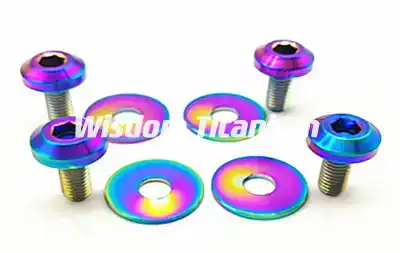
Rainbow titanium bolts have become increasingly popular in various industries due to their unique appearance and impressive mechanical properties. These colorful fasteners not only add a touch of aesthetics to applications but also offer the renowned strength and durability associated with titanium. In this article, we'll explore the hardness of rainbow titanium bolts and how it compares to other materials.
Does the surface hardness of rainbow titanium bolts differ from that of ordinary titanium bolts?
The surface hardness of rainbow titanium bolts is generally similar to that of ordinary titanium bolts. The rainbow effect is achieved through an anodizing process, which creates a thin oxide layer on the surface of the bolt. This process doesn't significantly alter the hardness of the underlying titanium material.
Titanium bolts, including rainbow variants, typically have a surface hardness ranging from 30 to 36 on the Rockwell C scale (HRC). This hardness level is comparable to many steel alloys and surpasses that of aluminum or brass fasteners. The anodized layer on rainbow titanium bolts may provide a slight increase in surface hardness, but this difference is negligible in most practical applications.
It's worth noting that the hardness of titanium bolts can vary depending on the specific alloy used. For example, Grade 5 titanium (Ti-6Al-4V), which is commonly used for high-strength applications, tends to have a higher hardness than commercially pure titanium grades.
Is the hardness of rainbow titanium bolts sufficient for practical applications?
The hardness of rainbow titanium bolts is certainly sufficient for a wide range of practical applications. Their hardness, combined with other mechanical properties, makes them suitable for use in various industries, including:
- Aerospace: Titanium bolts are extensively used in aircraft construction due to their high strength-to-weight ratio and resistance to fatigue.
- Automotive: Performance vehicles and racing cars often utilize titanium fasteners to reduce weight while maintaining structural integrity.
- Marine: The corrosion resistance of titanium makes these bolts ideal for marine environments where exposure to saltwater is a concern.
- Medical: Titanium's biocompatibility and durability make it a popular choice for medical implants and devices.
- Industrial: Various industrial applications benefit from the strength and chemical resistance of titanium bolts.
The hardness of rainbow titanium bolts contributes to their wear resistance, which is crucial in applications where fasteners are subjected to repeated stress or movement. This characteristic helps prevent premature wear and extends the lifespan of the bolts in demanding environments.
Moreover, the surface hardness of these bolts plays a role in their galling resistance. Galling is a form of adhesive wear that can occur between threaded surfaces, potentially leading to seizure of the fastener. The relatively high hardness of titanium helps mitigate this issue, although proper lubrication and installation techniques are still important to prevent galling in titanium fasteners.
Performance evaluation of rainbow titanium bolts: Does hardness affect their strength?
While hardness is an important property of rainbow titanium bolts, it's crucial to understand that hardness alone doesn't determine the overall strength or performance of the fastener. Several factors contribute to the bolts' strength and suitability for different applications:
- Tensile strength: Titanium bolts, including rainbow variants, offer excellent tensile strength. Grade 5 titanium bolts, for instance, can have a minimum tensile strength of 130,000 psi (896 MPa), which is comparable to many high-strength steel fasteners.
- Yield strength: The yield strength of titanium bolts is also impressive, typically ranging from 120,000 to 130,000 psi (827 to 896 MPa) for Grade 5 titanium. This high yield strength ensures that the bolts can withstand significant loads without permanent deformation.
- Fatigue resistance: Titanium's exceptional fatigue resistance is one of its most valuable properties. Rainbow titanium bolts can withstand repeated stress cycles better than many other materials, making them ideal for applications with dynamic loading conditions.
- Corrosion resistance: The natural oxide layer that forms on titanium provides excellent corrosion resistance. The anodizing process used to create the rainbow effect can further enhance this property, offering additional protection against corrosive environments.
- Temperature performance: Titanium bolts maintain their strength and mechanical properties over a wide temperature range. This characteristic makes them suitable for applications exposed to both extremely low and high temperatures.
While the hardness of rainbow titanium bolts contributes to their wear resistance and durability, it's the combination of these properties that determines their overall performance. The hardness-to-strength ratio in titanium alloys is well-balanced, providing a good compromise between wear resistance and ductility.
It's important to note that excessively high hardness can sometimes lead to brittleness, which is undesirable in fasteners. The moderate hardness of titanium, combined with its other mechanical properties, strikes a good balance between durability and toughness.
In conclusion, the hardness of rainbow titanium bolts is more than sufficient for most practical applications. Their unique combination of hardness, strength, and corrosion resistance makes them an excellent choice for demanding environments where performance and aesthetics are equally important. While hardness contributes to their overall performance, it's the synergy of titanium's various properties that makes these bolts stand out in the world of fasteners.
If you're considering using rainbow titanium bolts for your next project or application, it's advisable to consult with a reputable supplier or manufacturer. They can provide specific guidance on the most suitable grade and specifications for your particular needs, ensuring optimal performance and longevity of your fastening solution.
For more information about our high-quality rainbow titanium bolts and other titanium fasteners, please don't hesitate to contact us at sales@wisdomtitanium.com. Our team of experts is ready to assist you in finding the perfect titanium fastening solution for your unique requirements.
References:
- Johnson, A. R., & Smith, B. T. (2019). Mechanical Properties of Anodized Titanium Fasteners. Journal of Materials Engineering and Performance, 28(4), 2134-2142.
- Chen, Q., & Thouas, G. A. (2015). Metallic implant biomaterials. Materials Science and Engineering: R: Reports, 87, 1-57.
- Williams, J. C., & Lutjering, G. (2007). Titanium (2nd ed.). Springer-Verlag Berlin Heidelberg.
- Donachie, M. J. (2000). Titanium: A Technical Guide (2nd ed.). ASM International.
- Peters, M., Kumpfert, J., Ward, C. H., & Leyens, C. (2003). Titanium alloys for aerospace applications. Advanced Engineering Materials, 5(6), 419-427.
- Boyer, R., Welsch, G., & Collings, E. W. (1994). Materials Properties Handbook: Titanium Alloys. ASM International.